Local residents are raising questions about a proposed 110-unit development in an isolated region adjacent to the national park.


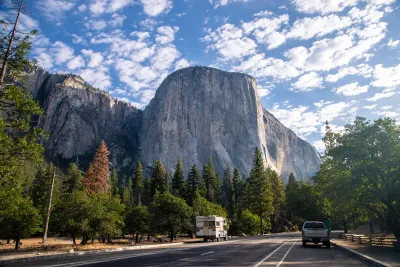
A developer is planning to build 110 units of housing on the edge of Yosemite National Park, sparking concerns among conservationists who say preserving the borders of the park as wildland is key to the health of the park’s ecosystem.
As Kurtis Alexander explains in the San Francisco Chronicle, “The proposal calls for construction of 110 “factory built modular” homes, 20% of which would be reserved for low-income residents, on two wooded parcels totaling 31 acres.” The property is mostly zoned for forest and is adjacent to the 189-home Yosemite West community, built on the remnants of an old logging operation.
While they are located outside the national park itself, access to both areas require traveling through Yosemite. “The company’s 20-page application leaves a lot of unknowns. It does not address the project’s impacts on the national park nor many fundamental issues, including how future residents would access the site through a gated and unpaved road owned by the park service; where water supplies would come from; and how houses would be built on the property’s steep slopes.” Additional traffic would also strain the park’s already clogged roads, Alexander adds.
The project is being proposed under the so-called Builder’s Remedy, a California law that allows developers to bypass local zoning rules if the jurisdiction does not have a state-approved housing element.
The isolated location of the proposed development has also raised questions about its purpose and whether it is intended primarily as a short-term rental community for park visitors, and who the 20 percent of units reserved as below-market rate would actually serve.
FULL STORY: A developer wants to build 110 homes just outside Yosemite. Locals are shocked

Balancing Aesthetics and Affordability
Policies too narrowly focused on design can drive up the cost of construction and prevent the development of affordable housing.
The Case Against Rent Control
Rent control is gaining popularity in cities and states around the country. Some economists urge caution when considering this form of tenant protection.
To upzone or not to upzone? Two views on the housing crisis
Allowing more density can increase the housing supply, but does the attendant rise in land prices cancel out the benefits?

The state-sanctioned urbicide of Austin
People don’t kill cities. Freeways do.

US to reduce Colorado River water deliveries to Mexico
A new Colorado Treaty amendment reduces Mexico’s Colorado River water allocation by 250,000 acre feet.

New Jersey’s second-largest city bans standalone data centers
Jersey City will continue to allow co-location facilities, such as those meant for research institutions that store their own data.

Amtrak not solely to blame for New Jersey commuter rail's unreliability, report finds
A new study from the Garden State Initiative found that NJ Transit’s budget grew 20% across a 4 year period, but reliability declined significantly over the same period.

EPA erases limits on planet-warming pollution from power plants
Under Monday’s plan, power plants would still have some limits on how much mercury, arsenic and other contaminants they can emit.

Phoenix announces new on-demand transit service, more frequent RAPID buses
Both new services will launch in October, and are part of Phoenix's Project Effective Access Solutions for Easing Congestion.

FREE Course: Walkable City 1: Why Walkability?
After describing his path towards focusing on walkability as the essence of good planning, Jeff Speck marches through his five principal reasons for making more walkable places.
Reinventing Malls: Planning Alchemy—Turning Gray Fields Into Gold
The course focuses on the opportunities and imperatives that shape reinvention of mall sites.

Eagle County Government
Harvard University Graduate School of Design
Nashville Planning Department
The Architects Foundation
University of Cincinnati Online
The Pocatello Development Authority
The Urban Renewal Agency of the City of Pocatello
Journal of the American Planning Association