This year’s athlete housing is designed specifically to be repurposed as student housing after the games.


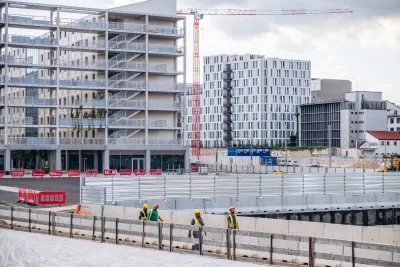
Unlike some prior Olympic housing villages, Milan’s new athletes’ village is, as Feargus O'Sullivan puts it in Bloomberg CityLab, “a tidy case study in how host cities are setting priorities—and learning from past mistakes—when it comes to Olympic construction.”
The complex is specifically designed to meet the city’s student housing needs after the games end. The units are conveniently already dorm-like, studio apartments with private bathrooms and kitchenettes. “To reduce emissions, each floor also has a large communal kitchen, roofs are outfitted with photovoltaic panels, and the complex’s six buildings were prefabricated offsite.”
Although some dorms will be available to low-income students at reduced rates, the majority will be the costliest of Milan’s officially affiliated student lodgings. “This has rankled some locals who see the private-public partnership between the city and developer COIMA SGR (which was involved in a corruption investigation last year) as a poor deal for Milan.”
For many locals, this points to a common problem with Olympic developments: “Even as the processes become more environmentally friendly, the resulting structures may be discouragingly expensive for all but a few.”
FULL STORY: Milan Olympics Housing Is Built for Easy Reuse

Vancouver's Sustainable Olympic Village
With goals of LEED-certification and plans for reuse after the games, Vancouver's Olympic Village is being called a model for event-based sustainability.
New Jersey affordable housing requirements spur infill development across the state
A 50-year-old law continues to reshape development around housing goals.

Office conversion is picking up steam in San Francisco
The city spent five years streamlining approval processes and reducing fees to encourage more adaptive reuse of vacant office buildings.

Planetizen Federal Action Tracker
A weekly monitor of how Trump’s orders and actions are impacting planners and planning in America.

The state-sanctioned urbicide of Austin
People don’t kill cities. Freeways do.

US to reduce Colorado River water deliveries to Mexico
A new Colorado Treaty amendment reduces Mexico’s Colorado River water allocation by 250,000 acre feet.

Guerilla urbanists are building DIY bus stop benches in Chicago
A before-and-after of one of the bus stops with a new bench. The new benches are not officially sanctioned or permitted, but the residents who placed them hope they will be the start of a network of DIY benches across the city.

Mamdani overhauls NYC's Vision Zero plan with 100 new policy goals
The overhaul aims to reduce traffic deaths and make streets safer for pedestrians, cyclists and drivers through lower speed limits, new safety infrastructure and more.

Amtrak not solely to blame for New Jersey commuter rail's unreliability, report finds
A new study from the Garden State Initiative found that NJ Transit’s budget grew 20% across a 4 year period, but reliability declined significantly over the same period.

FREE Course: Walkable City 1: Why Walkability?
After describing his path towards focusing on walkability as the essence of good planning, Jeff Speck marches through his five principal reasons for making more walkable places.
Reinventing Malls: Planning Alchemy—Turning Gray Fields Into Gold
The course focuses on the opportunities and imperatives that shape reinvention of mall sites.

Eagle County Government
Harvard University Graduate School of Design
Nashville Planning Department
The Architects Foundation
University of Cincinnati Online
The Pocatello Development Authority
The Urban Renewal Agency of the City of Pocatello
Journal of the American Planning Association