Key components are stuck in customs as the Chinese-based producer works to certify that the parts were not produced with forced labor.


The Chinese-owned railcar maker China Railway Rolling Stock Corporation announced it will have to furlough 161 workers in its Springfield, Massachusetts plant, which produces rail cars for the Massachusetts Bay Transportation Authority (MBTA) and Los Angeles Metro, among others.
As Beth Treffeisen explains in an article on Boston.com, “the company said the ongoing delays stem from a U.S. Customs detention notice tied to the Uyghur Forced Labor Prevention Act.” The law requires companies to provide “clear and convincing evidence” that goods produced in China’s Xinjiang region have no links to forced labor.
CRRC MA has established a task force to trace the stuck products through eight supplier levels to comply with customs rules. “Work teams conducted over 100 on-site supplier visits and held more than 1,000 planning sessions to document the sources of raw materials used in each component.”
According to Treffeisen, “The company filed a 60-day notice with the state, stating that it does not know when the car shells and components will be released and that it anticipates two-month furloughs beginning March 16.”
Read the full story: Over 160 workers to be furloughed at Springfield rail plant after MBTA car parts get stuck in customs
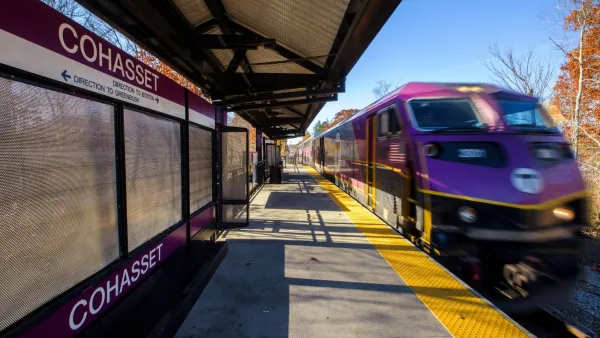
MBTA extends commuter rail discounts and lowers express bus fare to keep passengers riding into the fall
Boston-area commuters can access half-price monthly passes through November.
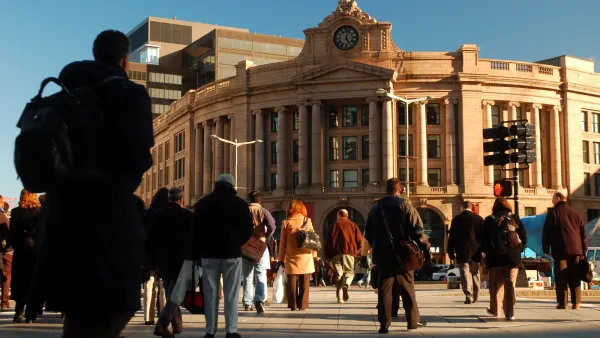
MBTA threatens to use eminent domain to pedestrianize Boston streets during World Cup
Boston city hall has been unusually reluctant to align with MassDOT and MBTA's proposed crowd management plans.
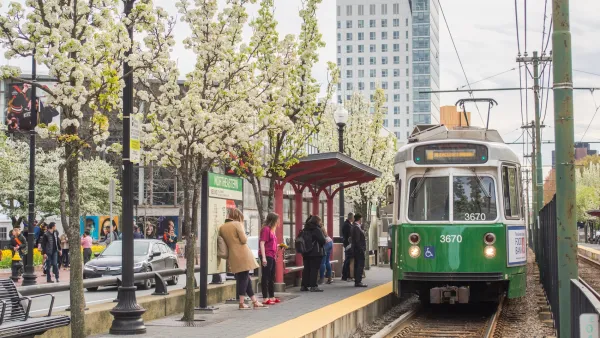
MBTA 'Resilience Roadmap' plans for climate change's impacts on transit infrastructure
The Massachusetts transit agency says its tunnels and power systems are at greatest risk from increasingly unpredictable extreme weather.

Planetizen Federal Action Tracker
A weekly monitor of how Trump’s orders and actions are impacting planners and planning in America.

California plans to bury El Niño’s downpour
If the state plays its cards right, it may be able to store a billion acre-feet of El Niño’s water in aquifers.

Desperate measures: Advocates weigh draining Lake Powell to fill Colorado River
Draining the reservoir could reduce evaporation losses by a couple hundred thousand acre-feet.

Mamdani’s pied-à-terre tax survives legal challenge
A panel of judges found that the plaintiffs failed to demonstrate injury as a result of New York City's implementation of the tax.

Eastern Nebraska is running out of electricity
Data centers and electrification are straining eastern Nebraska’s grid, throttling economic development.

Seattle passes record-breaking transit services expansion
Proposition 1 will double the city’s transit tax to add 95,000 more bus trips and preserve 180,000 bus trips annually.

FREE Course: Walkable City 1: Why Walkability?
After describing his path towards focusing on walkability as the essence of good planning, Jeff Speck marches through his five principal reasons for making more walkable places.
Reinventing Malls: Planning Alchemy—Turning Gray Fields Into Gold
The course focuses on the opportunities and imperatives that shape reinvention of mall sites.

City of Rosemead
Rutgers University, Edward J. Bloustein School of Planning and Public Policy
One Hundred Miles
University of Michigan School for Environment and Sustainability (SEAS)
Hunter College, City University of New York (CUNY)
The Architects Foundation
City of Cambridge
Montrose County
The Pocatello Development Authority