A two-year rideshare pilot program offered connectivity to a community disrupted by highways.


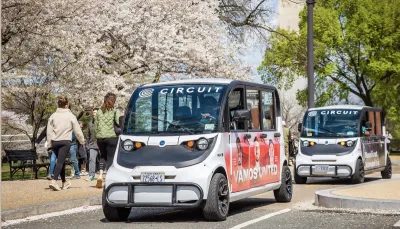
A rideshare program in Southwest Washington, D.C. helped local residents access grocery stores, with data from its two-year pilot showing that 32 percent of trips made using Circuit Rideshare were made to and from grocery stores.
In a piece in Greater Greater Washington, Zachary Baldwin outlines the history of the project, which was developed by the Southwest Business Improvement District as part of its DC Mobility Innovation District (DC MID). The pilot was funded for 25 months, but needs external funding to continue.
As Baldwin explains, “Circuit offered a dedicated fixed route in Buzzard Point, in partnership with DC Central Kitchen, in addition to an on-demand service accessed via mobile app or phone number. The program initially provided free service to gain traction, and a $2-per-ride fare was introduced after three months.” The system served over 125,000 passengers with average wait times of under 10 minutes, and 15 percent of trips were taken by people enrolled in the RideWell program who receive government assistance.
According to Baldwin, “The Circuit Rideshare program served a wide range of the Southwest community, including low-income residents, employees, and tourists, offering essential and low-cost transportation with opportunities to improve transit connectivity.”
FULL STORY: In a DC neighborhood divided by highways, a pilot program provided connection


Is Microtransit a Threat to ‘Real Transit’?
A new report warns that microtransit is nothing more than a taxpayer funded Uber with potentially dangerous consequences for existing traditional transit services.
West Memphis to launch new transit system
The city across the Mississippi River from Memphis, Tennessee will soon begin service on its own, on-demand transit system.

El Paso launches improved bus network, new microtransit service
Sun Metro is eliminating some bus lines in favor of more frequent service, estimating that only 1% of riders will have to walk farther to reach a station.

Planetizen Federal Action Tracker
A weekly monitor of how Trump’s orders and actions are impacting planners and planning in America.

The state-sanctioned urbicide of Austin
People don’t kill cities. Freeways do.

US to reduce Colorado River water deliveries to Mexico
A new Colorado Treaty amendment reduces Mexico’s Colorado River water allocation by 250,000 acre feet.

Amtrak not solely to blame for New Jersey commuter rail's unreliability, report finds
A new study from the Garden State initiative found that NJ Transit’s budget grew 20% across a 4 year period, but reliability declined significantly over the same period.

EPA erases limits on planet-warming pollution from power plants
Under Monday’s plan, power plants would still have some limits on how much mercury, arsenic and other contaminants they can emit.

Phoenix announces new on-demand transit service, more frequent RAPID buses
Both new services will launch in October, and are part of Phoenix's Project Effective Access Solutions for Easing Congestion.

FREE Course: Walkable City 1: Why Walkability?
After describing his path towards focusing on walkability as the essence of good planning, Jeff Speck marches through his five principal reasons for making more walkable places.
Reinventing Malls: Planning Alchemy—Turning Gray Fields Into Gold
The course focuses on the opportunities and imperatives that shape reinvention of mall sites.

Eagle County Government
Harvard University Graduate School of Design
Nashville Planning Department
The Architects Foundation
University of Cincinnati Online
The Pocatello Development Authority
The Urban Renewal Agency of the City of Pocatello
Journal of the American Planning Association