How a proposed law banning parking in the 20’ of curb next to an intersection throughout NYC would improve road safety and free up space for rain gardens and other green infrastructure.


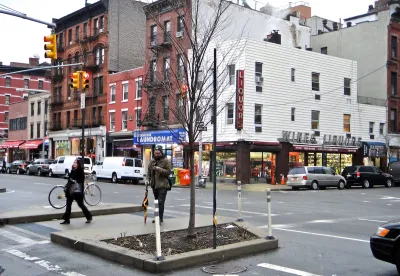
A traffic safety intervention could double as a flood control mechanism in New York City, write Sara Lind and Alex Morano in City Limits.
The practice known as daylighting, which prohibits parking within 20 feet of intersections to increase visibility, also creates hundreds of feet of empty curb space at each intersection. This space can be used to create ‘rain gardens,’ which absorb rainwater during storms. “In New York City, sidewalk rain gardens hold up to 2,500 gallons of water each, and there is ample space in the 32,000 acres of roadbed to build rain gardens at scale.”
Although New York State has a law calling for universal daylighting, the law allows New York City to exempt itself. For the authors, “Intro. 1138, a City Council bill that removes New York City’s exemption from state daylighting laws, is the common-sense solution. A simple change closing the daylighting loophole unlocks curb space for rain gardens at every intersection.”
The authors assert that, with its limited space, New York City needs universal daylighting to build green infrastructure at scale.
FULL STORY: Opinion: How Daylighting Can Allow NYC’s Streets to Fight Flooding


How Well Will San Francisco’s Daylighting Program Work?
Unlike other efforts to prevent cars from parking near intersections to improve visibility and road safety, San Francisco has no plans to install physical infrastructure to keep vehicles out of danger zones.
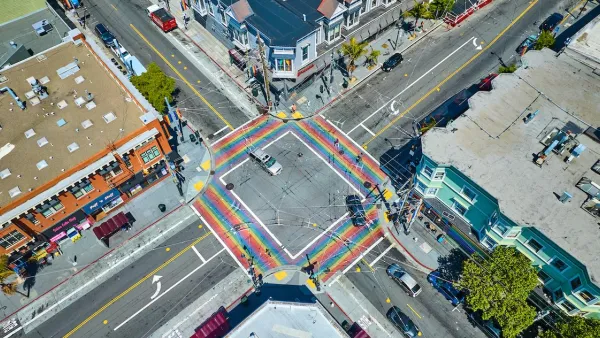
San Francisco Implements ‘Daylighting’ at Intersections
Vehicles are prohibited from parking within 20 feet of a crosswalk as part of the city’s Vision Zero efforts to eliminate traffic deaths and make roads safer.
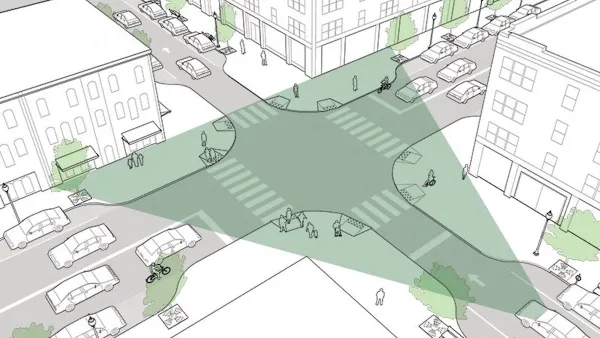
How ‘Daylighting’ Intersections Can Save Lives
Eliminating visual obstructions can make intersections safer for all users.

Planetizen Federal Action Tracker
A weekly monitor of how Trump’s orders and actions are impacting planners and planning in America.

The state-sanctioned urbicide of Austin
People don’t kill cities. Freeways do.

US to reduce Colorado River water deliveries to Mexico
A new Colorado Treaty amendment reduces Mexico’s Colorado River water allocation by 250,000 acre feet.

5 New England states march closer to 800 megawatt wind energy project
Securing federal approval for the project may be complicated under the Trump administration, which has historically been hostile towards domestic wind power.

Baltimore to break ground on $50 million Transit Priority Project
The project will bring faster bus trips, safer streets and better bike connections to Baltimore.

Airbnb launches $250 million 'last-dollar financing' housing accelerator, makes first investment in Austin
The company will put $6.4 million towards affordable housing development in Texas’ capital.

FREE Course: Walkable City 1: Why Walkability?
After describing his path towards focusing on walkability as the essence of good planning, Jeff Speck marches through his five principal reasons for making more walkable places.
Reinventing Malls: Planning Alchemy—Turning Gray Fields Into Gold
The course focuses on the opportunities and imperatives that shape reinvention of mall sites.

Eagle County Government
Harvard University Graduate School of Design
Nashville Planning Department
The Architects Foundation
University of Cincinnati Online
The Pocatello Development Authority
The Urban Renewal Agency of the City of Pocatello
Journal of the American Planning Association