Federal support for offshore wind projects is helping the industry grow, with nine projects approved so far this year.


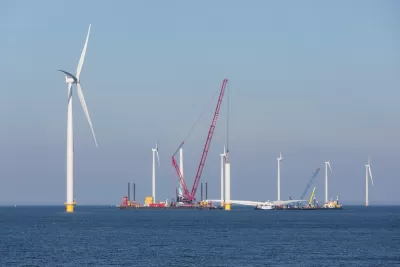
In a piece for Sierra magazine, Sarah Giltz and Nancy Pyne highlight the growth of the offshore wind industry in the United States. “Today there are enough offshore wind projects moving forward to power nearly 5 million homes,” Giltz and Pyne write.
According to the authors, a new plan from the Department of the Interior “increases transparency and predictability and creates greater regulatory certainty for offshore wind,” while other federal agencies are also working to develop policy recommendations and modernize renewable energy infrastructure. “By 2030, offshore wind is expected to create 77,000 family-sustaining jobs, support thousands of small businesses, and inject hundreds of millions of dollars in local communities.”
The authors emphasize the need for project labor agreements to ensure that the industry provides stable, high-quality jobs. “It’s clear that partnerships are key as developers, unions, conservation organizations and communities work to build this new industry together. Collaboration will be essential to build on the current momentum and ensure the offshore wind industry creates good jobs and provides real benefits to local communities.”
Read the full story: Offshore Wind Development in the US is Reaching Gale Force

California presses forward on offshore wind
The state is taking steps to prepare its grid and port infrastructure for offshore wind projects despite the federal government's pushback on the technology.
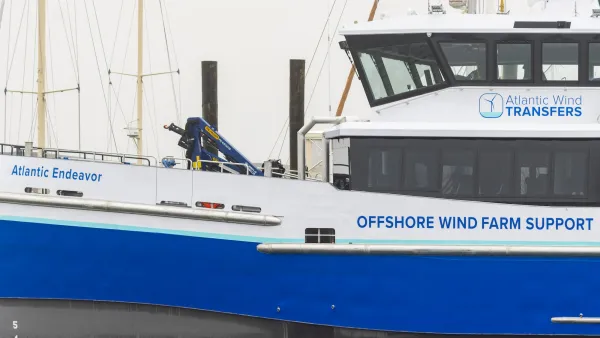
Nation’s Largest Offshore Wind Project, Suspended by Trump, Restarts Construction
A judge issued a temporary restraining order against the Trump administration’s suspension of five East Coast offshore wind projects.
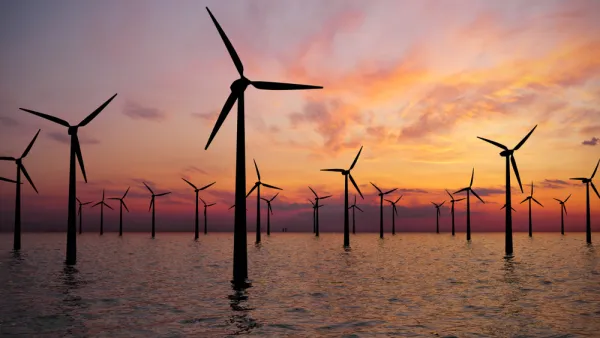
Bringing Community Voices Into Renewable Energy Planning
The MIT Renewable Energy Clinic helps coastal communities navigate the complexities of offshore wind development through neutral, inclusive engagement that surfaces local concerns and supports fair decision-making.

Planetizen Federal Action Tracker
A weekly monitor of how Trump’s orders and actions are impacting planners and planning in America.

California plans to bury El Niño’s downpour
If the state plays its cards right, it may be able to store a billion acre-feet of El Niño’s water in aquifers.

Desperate measures: Advocates weigh draining Lake Powell to fill Colorado River
Draining the reservoir could reduce evaporation losses by a couple hundred thousand acre-feet.

Mamdani’s pied-à-terre tax survives legal challenge
A panel of judges found that the plaintiffs failed to demonstrate injury as a result of New York City's implementation of the tax.

Eastern Nebraska is running out of electricity
Data centers and electrification are straining eastern Nebraska’s grid, throttling economic development.

Seattle passes record-breaking transit services expansion
Proposition 1 will double the city’s transit tax to add 95,000 more bus trips and preserve 180,000 bus trips annually.

FREE Course: Walkable City 1: Why Walkability?
After describing his path towards focusing on walkability as the essence of good planning, Jeff Speck marches through his five principal reasons for making more walkable places.
Reinventing Malls: Planning Alchemy—Turning Gray Fields Into Gold
The course focuses on the opportunities and imperatives that shape reinvention of mall sites.

City of Rosemead
Rutgers University, Edward J. Bloustein School of Planning and Public Policy
One Hundred Miles
University of Michigan School for Environment and Sustainability (SEAS)
Hunter College, City University of New York (CUNY)
The Architects Foundation
City of Cambridge
Montrose County
The Pocatello Development Authority