With the housing shortage only getting worse, updates to a key federal program could help.


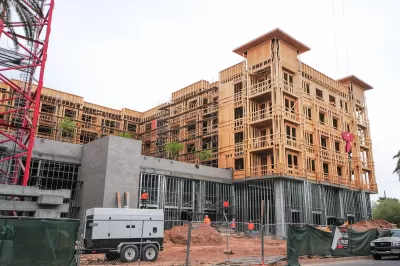
In a piece published by the Federation of American Scientists, Stanley Chang outlines some policy recommendations that would improve the efficacy of the Low-Income Housing Tax Credit (LIHTC) program, a federal program that “has been the backbone of new affordable housing construction nationwide for the last 37 years.”
According to Chang, “Existing LIHTC incentives for nonprofits do not ensure that profits are recycled to build more housing, because many nonprofits have other, nonhousing missions.” Thus, “Incentivizing organizations to use their profits to build more housing will enable LIHTC to create much more housing in the long term.”
Chang recommends amending the federal code governing the program to require entities participating in the program to use profits on housing and offer preference to state and local governments. “If LIHTC funds created projects that recycled their profits into building more housing, LIHTC would create a virtuous cycle to build more and more housing, moving the needle without additional expenditure of taxpayer funds.”
FULL STORY: Low-Income Housing Tax Credit Policy Recommendations


Oakland opens first affordable housing for teachers
The school district says 70% of its teachers can't afford to live in Oakland.

Santa Monica Modular Project Offers Hope for Affordable Housing in Pricy California Cities
The Berkeley Station development used modular construction to build the project on a nine-month timeline.

Report: Dallas Has Just 6 Affordable Homes for Every 10 Middle-income Households
The city’s affordable housing stock is rapidly disappearing.

Planetizen Federal Action Tracker
A weekly monitor of how Trump’s orders and actions are impacting planners and planning in America.

The state-sanctioned urbicide of Austin
People don’t kill cities. Freeways do.

US to reduce Colorado River water deliveries to Mexico
A new Colorado Treaty amendment reduces Mexico’s Colorado River water allocation by 250,000 acre feet.

5 New England states march closer to 800 megawatt wind energy project
Securing federal approval for the project may be complicated under the Trump administration, which has historically been hostile towards domestic wind power.

Baltimore to break ground on $50 million Transit Priority Project
The project will bring faster bus trips, safer streets and better bike connections to Baltimore.

Airbnb launches $250 million 'last-dollar financing' housing accelerator, makes first investment in Austin
The company will put $6.4 million towards affordable housing development in Texas’ capital.

FREE Course: Walkable City 1: Why Walkability?
After describing his path towards focusing on walkability as the essence of good planning, Jeff Speck marches through his five principal reasons for making more walkable places.
Reinventing Malls: Planning Alchemy—Turning Gray Fields Into Gold
The course focuses on the opportunities and imperatives that shape reinvention of mall sites.

Eagle County Government
Harvard University Graduate School of Design
Nashville Planning Department
The Architects Foundation
University of Cincinnati Online
The Pocatello Development Authority
The Urban Renewal Agency of the City of Pocatello
Journal of the American Planning Association