Too often, national parks and other recreational spaces in the United States are difficult or impossible to access without a car. Some parks are working to change that.


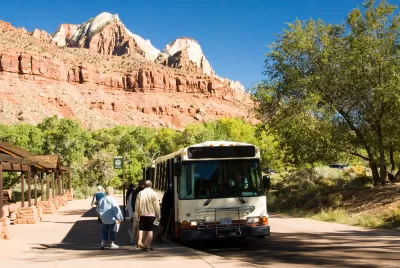
In a piece in Millennial American Dream republished in Streetsblog USA, Michael Moore describes how Rocky Mountain National Park and Glacier National Park provide exemplary models for providing parks access to people who don’t own cars via bus shuttles.
By providing convenient transportation options, these parks reduce traffic congestion, minimize pollution, and make it easier for visitors to access hiking trails and attractions. Implementing similar shuttle services in popular US parks could significantly enhance accessibility and alleviate parking woes.
Moore also suggests making more in-park lodging, such as European-style hiking hostels, available to tourists to reduce the need to drive in and out. Additionally, parks can reduce economic barriers by providing affordable gear rentals and boosting connectivity to public transit. “Establishing reliable bus and train connections from major US cities and airports to lesser-known parks is crucial for achieving better access and dispersing visitor flow,” Moore writes.
Parks access shouldn’t be limited to people who own cars. “Implementing transit connections, alternative transportation options, in-park accommodations, small cabin hostels, refreshment options, gear rentals, and long-distance transit links can transform the way we experience nature in the US.”
FULL STORY: Making Hiking Accessible Without Cars

Bike use in London grew by 43% since 2019, but car use remains roughly the same
The city's efforts to reduce car use have stalled despite ambitious programs like congestion pricing and low-traffic neighborhoods.
Yosemite crowds wait hours to enter park after NPS ends reservation system
Bumper-to-bumper traffic and a lack of parking foreshadowed a potentially chaotic summer.
Glacier National Park drops reservation requirement, plans to double down on shuttle network
Since 2021, visitors with cars have had to make a reservation to access the park.

Planetizen Federal Action Tracker
A weekly monitor of how Trump’s orders and actions are impacting planners and planning in America.

The state-sanctioned urbicide of Austin
People don’t kill cities. Freeways do.

US to reduce Colorado River water deliveries to Mexico
A new Colorado Treaty amendment reduces Mexico’s Colorado River water allocation by 250,000 acre feet.

5 New England states march closer to 800 megawatt wind energy project
Securing federal approval for the project may be complicated under the Trump administration, which has historically been hostile towards domestic wind power.

Baltimore to break ground on $50 million Transit Priority Project
The project will bring faster bus trips, safer streets and better bike connections to Baltimore.

Airbnb launches $250 million 'last-dollar financing' housing accelerator, makes first investment in Austin
The company will put $6.4 million towards affordable housing development in Texas’ capital.

FREE Course: Walkable City 1: Why Walkability?
After describing his path towards focusing on walkability as the essence of good planning, Jeff Speck marches through his five principal reasons for making more walkable places.
Reinventing Malls: Planning Alchemy—Turning Gray Fields Into Gold
The course focuses on the opportunities and imperatives that shape reinvention of mall sites.

Eagle County Government
Harvard University Graduate School of Design
Nashville Planning Department
The Architects Foundation
University of Cincinnati Online
The Pocatello Development Authority
The Urban Renewal Agency of the City of Pocatello
Journal of the American Planning Association