Philadelphia has long been acknowledged as the capital of rowhouses in the United States. It’s becoming more common for those rowhouses to be referred to as rowhomes.


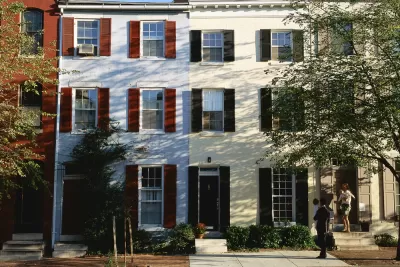
If you’re like me you’ve accidentally used the word “rowhouse” incorrectly in conversation with a resident of Philadelphia. Residents of Philadelphia takes great pride in their rowhouse, and for good reason. The city even launched a “Healthy Rowhouse Project” [pdf] in 2014 and published a rowhouse design manual in 2008 [pdf]. In Philadelphia, the distinctions regarding rowhouses matter, and the term is constantly at risk of conflation with a host of other terms, such as rowhome, townhome, townhouse, and brownstone.
It should come as some relief, then, that Jordan Levy has written an article for BillyPenn that clarifies the key distinctions. It seems that need has never been more pressing:
A review of local media and city government usage shows both overwhelmingly choose “rowhouse” these days, and plenty of Philadelphians join them. But conversational use of “rowhome” abounds — and some feel very strongly about their chosen term.
To help clarify matters, Levy provides a glossary of terms like bandbox, the London house, the city house, and the townhouse, before turning attention to the critical distinction: rowhome vs. rowhouse.
“So, rowhouses are rowhomes, which can be townhouses in some cases and brownstones in others.” There you go.
Read the full story: What’s the difference between ‘rowhouse’ and ‘rowhome’?

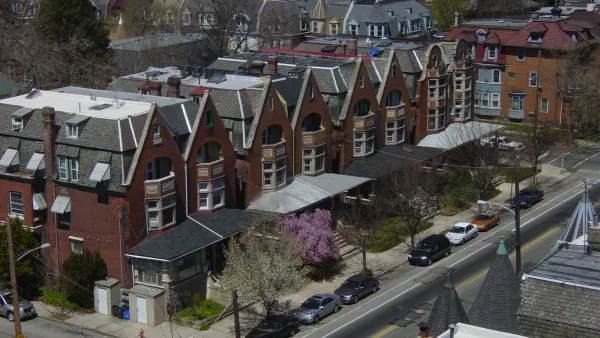
Philly City Council to Consider Bill Protecting Neighbors from Construction Damage
The proposal would hold builders accountable for damage incurred to adjacent homes as historic rowhouse properties see increased redevelopment.
Designing Homes for the In-between Spaces
"Leftover lots" are the object of one Philadelphia-based architecture firm's fascination.
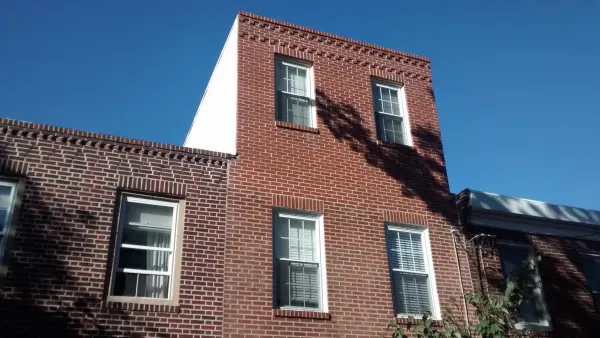
Philadelphia Rowhouse Owners Embrace the 'Overbuild'
Quarters can be cramped for growing families in Philadelphia's many two-story rowhouses. Rather than decamp to the suburbs, more and more homeowners are simply adding a third story, known as an "overbuild."

Planetizen Federal Action Tracker
A weekly monitor of how Trump’s orders and actions are impacting planners and planning in America.

California plans to bury El Niño’s downpour
If the state plays its cards right, it may be able to store a billion acre-feet of El Niño’s water in aquifers.

Desperate measures: Advocates weigh draining Lake Powell to fill Colorado River
Draining the reservoir could reduce evaporation losses by a couple hundred thousand acre-feet.

MTA gives itself 30 days to transform pit into basketball court
The site has been under construction since 2022; the city originally estimated it would finish the court in 2024.

Non-stop party: Chicago voters weigh permanent festival grounds
A stable place for bleachers, stages and drainage may streamline the setup and teardown of large events.

Metra may invest $9.1 billion in regional rail
The agency released a draft of a study examining potential ways to offer more frequent train service.

FREE Course: Walkable City 1: Why Walkability?
After describing his path towards focusing on walkability as the essence of good planning, Jeff Speck marches through his five principal reasons for making more walkable places.
Reinventing Malls: Planning Alchemy—Turning Gray Fields Into Gold
The course focuses on the opportunities and imperatives that shape reinvention of mall sites.

City of Rosemead
Rutgers University, Edward J. Bloustein School of Planning and Public Policy
One Hundred Miles
Hunter College, City University of New York (CUNY)
The Architects Foundation
University of Cincinnati Online
City of Cambridge
Montrose County
The Pocatello Development Authority