A local controversy in New Jersey has residents debating whether a city should interfere with artistic expression on private property.


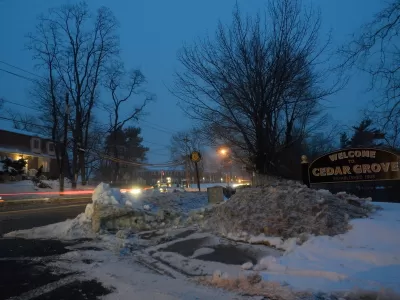
A controversy over a coffee shop mural in Cedar Grove, New Jersey has sparked a debate over what constitutes a sign and how far a city should go to regulate 'artistic expression,' reports Kaitlyn Kanzler.
Although Cedar Bean's Coffee Joint owner Dave Fletcher got permission from his landlord and neighbors before commissioning the mural on the back of his building in June, the city cited the mural as an illegal sign under a newly amended sign ordinance that now includes murals and paintings. Council members say the amendment is not meant to stifle artistic expression or stop business owners from putting up murals, but they want "to put a procedure in place to apply for permission to put up a mural." According to Councilwoman Kerry Peterson, "it's about everyone following the same process and nothing gets out of control."
Local art advocates expressed disappointment with the council's decision to approve the amendment. Nat Harris, who heads the Cedar Grove Artists Alliance, said while "[t]here was ample opportunity for them to table the vote and maybe talk to the community more," it seemed that the decision had been made. Harris will be meeting with council members next week "to discuss how the Cedar Grove Art Alliance and the town can work together."
Read the full story: Mural controversy in Cedar Grove raises questions on local artistic expression
Los Angeles' Legacy of Murals is Disappearing
The legacy of Los Angeles murals has all but left the city, buried under sign ordinances, billboard policy and tagging. Tanner Blackman in the Dept. of City Planning Code Studies Section is working to free up the knot of regulation.
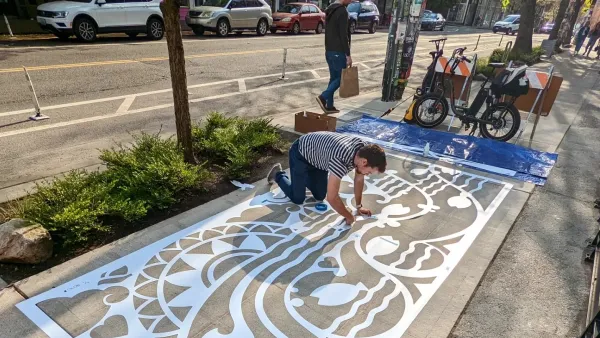
This Seattle sidewalk art only appears when it rains
Prompted to find a silver lining to the gloom of rainy Pacific Northwest days, an artist hit upon a novel solution: water-activated sidewalk paint.
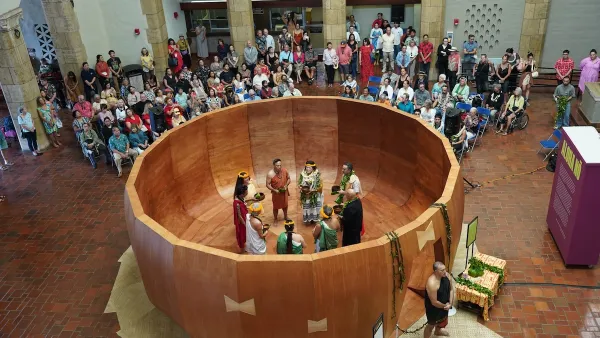
A Monument to Resilience: Native Hawaiian Art Installation Honors History and Healing
The towering ʻUmeke Lāʻau installation by Native Hawaiian artist Meleanna Aluli Meyer, unveiled at Honolulu's city hall, is a powerful symbol of cultural resilience and healing.

Planetizen Federal Action Tracker
A weekly monitor of how Trump’s orders and actions are impacting planners and planning in America.

California plans to bury El Niño’s downpour
If the state plays its cards right, it may be able to store a billion acre-feet of El Niño’s water in aquifers.

Desperate measures: Advocates weigh draining Lake Powell to fill Colorado River
Draining the reservoir could reduce evaporation losses by a couple hundred thousand acre-feet.

Mamdani’s pied-à-terre tax survives legal challenge
A panel of judges found that the plaintiffs failed to demonstrate injury as a result of New York City's implementation of the tax.

Eastern Nebraska is running out of electricity
Data centers and electrification are straining eastern Nebraska’s grid, throttling economic development.

Seattle passes record-breaking transit services expansion
Proposition 1 will double the city’s transit tax to add 95,000 more bus trips and preserve 180,000 bus trips annually.

FREE Course: Walkable City 1: Why Walkability?
After describing his path towards focusing on walkability as the essence of good planning, Jeff Speck marches through his five principal reasons for making more walkable places.
Reinventing Malls: Planning Alchemy—Turning Gray Fields Into Gold
The course focuses on the opportunities and imperatives that shape reinvention of mall sites.


City of Rosemead
Rutgers University, Edward J. Bloustein School of Planning and Public Policy
One Hundred Miles
University of Michigan School for Environment and Sustainability (SEAS)
Hunter College, City University of New York (CUNY)
The Architects Foundation
City of Cambridge
Montrose County
The Pocatello Development Authority