Eight single-family houses on a half-acre of land.


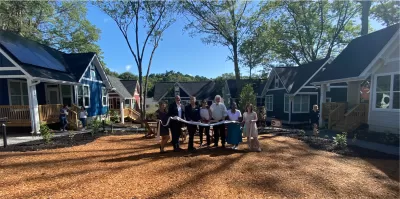
"Two years after it broke ground, a Clarkston project described as Georgia’s first standalone village of tiny houses is officially a wrap—and totally sold," reports Josh Green.
Among the features and amenities new residents will gain when moving in to the Cottages on Vaughan development are homes ranging in size from 250-square-foot "micro-cottages" to the largest homes on site, which total 500 square feet. "To encourage interaction between residents, a common greenspace with seating and a picnic table is at the center of the community. It also features climate-conscious aspects such as optional solar panels and edible, regenerative landscaping," adds Green.
Homes have sold for prices between $109,000 and $200,000—affordability is one of the primary selling points of the tiny homes movement.
While the project is considered a model for future projects, the process getting to completion wasn't easy. "The project required 14 months of work with Clarkston city official to write and pass the DeKalb County city’s first tiny-home ordinance," according to Green.
Read the full story: Photos: Georgia's first tiny home village is complete—and sold out

First Tiny Home Neighborhood Planned in Georgia
Eight homes, varying in size from 250 square feet to 500 square feet have been approved in an Atlanta suburb.

'Tiny Home Village' Fires Raise Doubts About Their Sustainability
'Tiny home villages' were touted as a quick, if temporary, solution to California's housing crisis, but a series of fires is raising concern about their safety.
Tiny Homes Village Planned in St. Louis
St. Louis Mayor Lyda Krewson hopes to use CARES Act funding to 50 new homes for homeless living in the city.

Planetizen Federal Action Tracker
A weekly monitor of how Trump’s orders and actions are impacting planners and planning in America.

California plans to bury El Niño’s downpour
If the state plays its cards right, it may be able to store a billion acre-feet of El Niño’s water in aquifers.

Desperate measures: Advocates weigh draining Lake Powell to fill Colorado River
Draining the reservoir could reduce evaporation losses by a couple hundred thousand acre-feet.

Chicago voters approve permanent festival grounds, penalty for vacant property owners
Currently, major summer and fall festivals take over public parks for weeks at a time, drawing criticism from nearby residents

NYC votes to cut outdoor dining red tape, speed up permitting
New York City also voted to allow the Department of Transportation to begin work on urgent projects before notifying elected officials.

California appears to reject Prop. 45
The proposition would have expanded the projects that qualify for a streamlined environmental review, effectively paring down the California Environmental Quality Act.

FREE Course: Walkable City 1: Why Walkability?
After describing his path towards focusing on walkability as the essence of good planning, Jeff Speck marches through his five principal reasons for making more walkable places.
Reinventing Malls: Planning Alchemy—Turning Gray Fields Into Gold
The course focuses on the opportunities and imperatives that shape reinvention of mall sites.

City of Rosemead
Rutgers University, Edward J. Bloustein School of Planning and Public Policy
One Hundred Miles
Hunter College, City University of New York (CUNY)
The Architects Foundation
University of Cincinnati Online
City of Cambridge
Montrose County
The Pocatello Development Authority