New transportation research measures the impact of commercial vehicles as drivers search for parking on city streets.


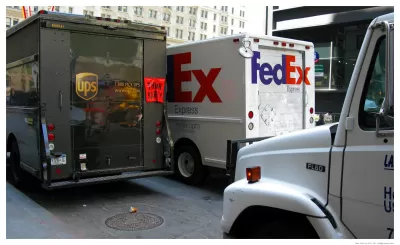
"In a clever study of commercial vehicles in downtown Seattle, scholars Giacomo Dalla Chiara and Anne Goodchild of the University of Washington found that cruising for parking accounted for a whopping 28% of total trip time. The researchers call their work – published online last month in the journal Transport Policy – 'the first significant empirical evidence of cruising for commercial vehicles,'" writes Eric Jaffe.
Dynamic pricing for curbside parking can help manage car traffic and cut down on circling. "But it’s not clear that dynamic prices would have the same impact on commercial circling: unlike car drivers, delivery drivers can’t choose or change their destination, they can’t use an alternative travel mode, and they’re not paying the high parking rates from their own pocket," says Jaffe.
Instead, says Jaffe, flexible curbs and off-hours delivery programs could provide the space commercial vehicle need without devoting it solely to parking. Real-time curb availability data would also help with better management of curbside spaces and decrease cruising. Alternative vehicles, such as smaller vans and cargo bikes, and local logistics hubs are other strategies that can improve delivery efficiency and decrease the demand for curbside parking and the cruising that comes along with it.
FULL STORY: Delivery vehicles waste a lot of time searching for parking. Cities can fix that

Curb Space Management Finally Getting a Good Look
Cities are beginning to recognize that effective curb management is an important part of reducing congestion and ensuring equitable use of public space.
Curbside Management to Tame Roadway Chaos
A pilot program in Columbus, Ohio, will help bring order to the city’s curbside space, a response to a mobility network that has become more complicated and crowded.
Do Rideshare and Goods Delivery Need Their Own Curb Space?
On some busy blocks, Uber and Lyft drivers have nowhere safe to park. Neither do parcel delivery personnel. Shared use mobility zones could address the problem.

Planetizen Federal Action Tracker
A weekly monitor of how Trump’s orders and actions are impacting planners and planning in America.

The state-sanctioned urbicide of Austin
People don’t kill cities. Freeways do.

US to reduce Colorado River water deliveries to Mexico
A new Colorado Treaty amendment reduces Mexico’s Colorado River water allocation by 250,000 acre feet.

5 New England states march closer to 800 megawatt wind energy project
Securing federal approval for the project may be complicated under the Trump administration, which has historically been hostile towards domestic wind power.

Baltimore to break ground on $50 million Transit Priority Project
The project will bring faster bus trips, safer streets and better bike connections to Baltimore.

Airbnb launches $250 million 'last-dollar financing' housing accelerator, makes first investment in Austin
The company will put $6.4 million towards affordable housing development in Texas’ capital.

FREE Course: Walkable City 1: Why Walkability?
After describing his path towards focusing on walkability as the essence of good planning, Jeff Speck marches through his five principal reasons for making more walkable places.
Reinventing Malls: Planning Alchemy—Turning Gray Fields Into Gold
The course focuses on the opportunities and imperatives that shape reinvention of mall sites.

Eagle County Government
Harvard University Graduate School of Design
Nashville Planning Department
The Architects Foundation
University of Cincinnati Online
The Pocatello Development Authority
The Urban Renewal Agency of the City of Pocatello
Journal of the American Planning Association