In struggling communities full of single-family homes, the cost is too high for developers to acquire and renovate blighted properties. The Neighborhood Homes Investment Act would offer an incentive for investment in existing building stock.


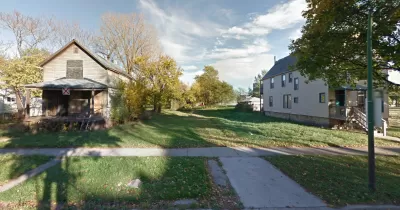
"Lawmakers have proposed a federal tax credit that would fuel the rehabilitation of deteriorated single-family homes in distressed neighborhoods," reports Donna Kimura.
"Introduced by Reps. Brian Higgins (D-N.Y.) and Mike Kelly (R-Pa.), the Neighborhood Homes Investment Act (NHIA) seeks to build on the success of the low-income housing tax credit (LIHTC) for multifamily housing properties," adds Kimura. The bill is known as H.R.3316 in the House.
The article includes more details about the proposed legislation, including the expected return on investment: "Supporters estimate the credit could produce 500,000 homes over 10 years and generate about $100 billion in development and 785,714 jobs in construction and related industries."
The Center for Community Progress recently released a press release announcing support for the companion act in the Senate, S.4073.
Read the full story: Bill Seeks to Create ‘Neighborhood Homes’ Tax Credit
Neighborhood Homes Investment Act Picks Up Momentum
A proposed tax credit designed to stabilize single-family neighborhoods facing growing numbers of vacancies is making its way through Congress.

Long Beach Urban Farming Initiative Targets Vacant Lots
A California policy lets cities offer tax incentives to landowners who put vacant lots to use as urban farms or gardens. Long Beach is the latest comer, but the uptake has been sluggish elsewhere.
Blight Is a Bad Word
What makes one building worth saving and another worth destroying? Strong Towns' Rachel Quednau explores the line between destruction and preservation.

Planetizen Federal Action Tracker
A weekly monitor of how Trump’s orders and actions are impacting planners and planning in America.

California plans to bury El Niño’s downpour
If the state plays its cards right, it may be able to store a billion acre-feet of El Niño’s water in aquifers.

Desperate measures: Advocates weigh draining Lake Powell to fill Colorado River
Draining the reservoir could reduce evaporation losses by a couple hundred thousand acre-feet.

Chicago voters approve permanent festival grounds, penalty for vacant property owners
Currently, major summer and fall festivals take over public parks for weeks at a time, drawing criticism from nearby residents

NYC votes to cut outdoor dining red tape, speed up permitting
New York City also voted to allow the Department of Transportation to begin work on urgent projects before notifying elected officials.

California appears to reject Prop. 45
The proposition would have expanded the projects that qualify for a streamlined environmental review, effectively paring down the California Environmental Quality Act.

FREE Course: Walkable City 1: Why Walkability?
After describing his path towards focusing on walkability as the essence of good planning, Jeff Speck marches through his five principal reasons for making more walkable places.
Reinventing Malls: Planning Alchemy—Turning Gray Fields Into Gold
The course focuses on the opportunities and imperatives that shape reinvention of mall sites.

City of Rosemead
Rutgers University, Edward J. Bloustein School of Planning and Public Policy
One Hundred Miles
Hunter College, City University of New York (CUNY)
The Architects Foundation
University of Cincinnati Online
City of Cambridge
Montrose County
The Pocatello Development Authority