According to this article in the New York Times, the days of development interests dominating the planning process in New York City are over.



Stefanos Chen reports on renewed efforts in New York City to oppose development plans that don't provide enough affordable housing, according to neighborhood interests:
Bushwick. Inwood. Two Bridges.
They are invoked by protesters across New York City, regarded as the front lines in a battle against what some communities see as misguided plans to create more housing.
In recent months, the three neighborhoods have thwarted or stalled both private and public efforts to develop thousands of new apartments, the majority of which would be too expensive for local residents, and have energized like-minded campaigns all over the city.
According to Chen, contemporary grassroots development opposition campaigns are finding success, when just a few years ago developers tended to build what they wanted, where they wanted. Local organizers aren't just campaigning against specific developments, according to Chen, they're taking on "zoning loopholes" and "neighborhood rezoning" efforts. "And these aren’t merely symbolic victories, the groups say, but decisions that could change what gets built in the city, and how, for years to come."
FULL STORY: The People vs. Big Development

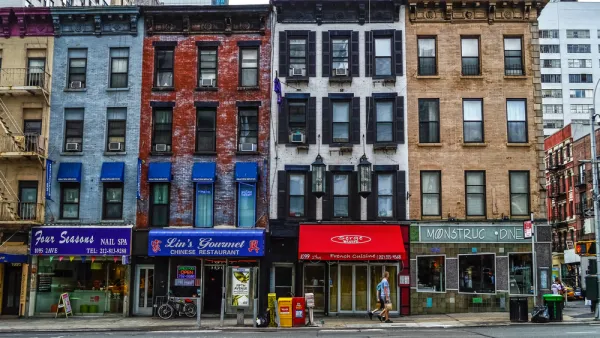
New York City Council Wants Community Engagement to Lead Affordable Housing Development
New York Mayor Eric Adams and City Council Speaker Adrienne Adams have proposed very different responses to the city’s lack of affordable housing.
Study: Affordable Housing Development Raises Nearby Property Values
More evidence that a common talking point of affordable housing opposition is more fear than fact.
Planning via Zoom: Legal Scrutiny for Pandemic Realities in New York City
The question of whether a public review process conducted by Zoom is sufficient to approve a sweeping rezoning plan is a matter of no small legal concern in New York City.

Planetizen Federal Action Tracker
A weekly monitor of how Trump’s orders and actions are impacting planners and planning in America.

The state-sanctioned urbicide of Austin
People don’t kill cities. Freeways do.

US to reduce Colorado River water deliveries to Mexico
A new Colorado Treaty amendment reduces Mexico’s Colorado River water allocation by 250,000 acre feet.

5 New England states march closer to 800 megawatt wind energy project
Securing federal approval for the project may be complicated under the Trump administration, which has historically been hostile towards domestic wind power.

Baltimore to break ground on $50 million Transit Priority Project
The project will bring faster bus trips, safer streets and better bike connections to Baltimore.

Airbnb launches $250 million 'last-dollar financing' housing accelerator, makes first investment in Austin
The company will put $6.4 million towards affordable housing development in Texas’ capital.

FREE Course: Walkable City 1: Why Walkability?
After describing his path towards focusing on walkability as the essence of good planning, Jeff Speck marches through his five principal reasons for making more walkable places.
Reinventing Malls: Planning Alchemy—Turning Gray Fields Into Gold
The course focuses on the opportunities and imperatives that shape reinvention of mall sites.

Eagle County Government
Harvard University Graduate School of Design
Nashville Planning Department
The Architects Foundation
University of Cincinnati Online
The Pocatello Development Authority
The Urban Renewal Agency of the City of Pocatello
Journal of the American Planning Association