The National Transportation Safety Board recommends that all 50 states require people on bikes of all ages to wear helmets.


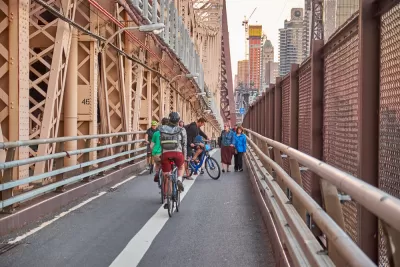
"A federal safety board issued a surprise recommendation for mandatory bike helmet laws in all 50 states — unanimously approving a last-minute resolution that had not been recommended by the board’s own staff," reports Gersh Kuntzman.
"The National Transportation Safety Board voted 3-0 to recommend helmet laws even as staff members reminded panelists that such laws may reduce overall cycling, and lead to the 'unintended consequence' of more road fatalities because fewer cyclists will mean less pressure on local officials to build the kind of protected infrastructure that is proven to improve cyclist safety."
The surprise element came from the fact that the recommendation was not included in the recommendations drafted by staff prior to the meeting. The recommendation came from a list minute addendum created by board member Jennifer Homendy.
There was some debate on the subject prior to the vote. On the side of board members seeking helmet laws is data that credits helmets with reducing the likelihood if injuries for people on bikes by 48 percent. Helmets are also credited with "[reducing] serious injuries by 60 percent and [reducing] traumatic injuries by 53 percent," according to Kuntzman.
On the other side is evidence from The Netherlands, where high levels of bike safety are found in a country with very low rates of helmet use. Staff analyst Dr. Ivan Cheung testified that "helmet use often discourages cycling, prompting him to refer to the 'unintended consequences' of mandating their use."
FULL STORY: SURPRISE! Federal Panel Seeks Mandatory Helmet Laws

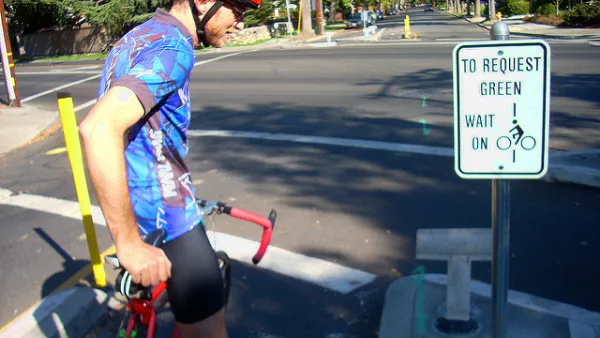
‘Idaho Stop’ Now Legal in Colorado
Colorado is the latest state to make it legal for people on bikes to treat stop signs like yield signs when no cars are in the intersection.
Colorado Legislature Approves 'Idaho Stop' Bill
Pending Gov. Polis's signature on a bill approved recently by the Colorado State Legislature, Colorado will become the latest state to allow people on bikes to yield at stop signs.
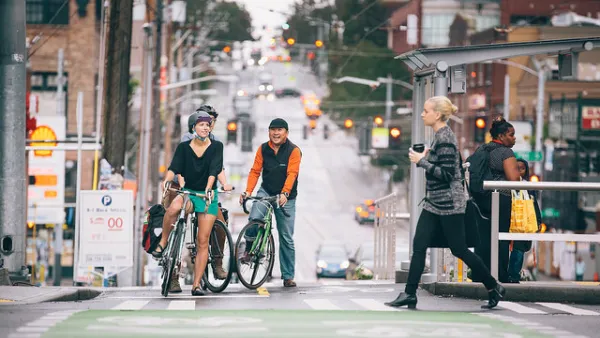
Bike Helmets No Longer Required in Seattle After Research Reveals Enforcement Disparities
The data on bike helmets have changed. Laws are starting to change too.

Planetizen Federal Action Tracker
A weekly monitor of how Trump’s orders and actions are impacting planners and planning in America.

The state-sanctioned urbicide of Austin
People don’t kill cities. Freeways do.

US to reduce Colorado River water deliveries to Mexico
A new Colorado Treaty amendment reduces Mexico’s Colorado River water allocation by 250,000 acre feet.

5 New England states march closer to 800 megawatt wind energy project
Securing federal approval for the project may be complicated under the Trump administration, which has historically been hostile towards domestic wind power.

Baltimore to break ground on $50 million Transit Priority Project
The project will bring faster bus trips, safer streets and better bike connections to Baltimore.

Airbnb launches $250 million 'last-dollar financing' housing accelerator, makes first investment in Austin
The company will put $6.4 million towards affordable housing development in Texas’ capital.

FREE Course: Walkable City 1: Why Walkability?
After describing his path towards focusing on walkability as the essence of good planning, Jeff Speck marches through his five principal reasons for making more walkable places.
Reinventing Malls: Planning Alchemy—Turning Gray Fields Into Gold
The course focuses on the opportunities and imperatives that shape reinvention of mall sites.

Eagle County Government
Harvard University Graduate School of Design
Nashville Planning Department
The Architects Foundation
University of Cincinnati Online
The Pocatello Development Authority
The Urban Renewal Agency of the City of Pocatello
Journal of the American Planning Association