More than 40 percent of Dallas residents live within a half-mile of a park, but the school district and the city are working together with nonprofits to improve that figure.


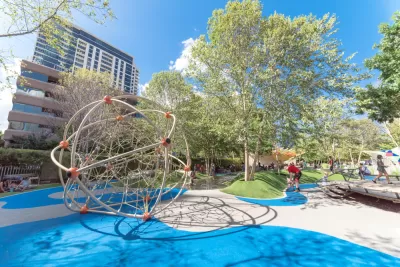
The Dallas Morning News editorial board expresses support for a new program in Dallas that is opening school playgrounds to use after school hours and during the summer to provide more open space and play options for families.
The Dallas Independent School District (ISD) and the city of Dallas are teaming up on an effort the editorial board calls good government after a year of quiet work to open and improve five schools in park poor areas in Dallas. The results are also due to the hard work of the Texas Trees Foundation and the Trust for Public Land, according to the editorial.
"An average of 80 trees were added to each campus, from oaks to ornamentals. Updated park equipment was installed, and things like loop trails and embankment slides were constructed," explain the editorial.
The editorial board also congratulates the effort for keeping prices down. "All of the work done to get these five campuses into better shape cost about $1 million, a bargain for such public improvements. And $750,000 of that money came not from taxpayers but from a generous, albeit anonymous, donor."
Read the full story: Dallas is transforming school playgrounds into city parks — and it couldn’t come at a more crucial time

Historic Queens park is getting a $120M upgrade
The borough's largest park will undergo significant upgrades for accessibility, flood mitigation and historic preservation.
Private Donations Propel Early Restoration of Palisades Playground
Los Angeles has secured over $1.3 million in private funding to restore the Pacific Palisades playground months ahead of schedule, creating a modern, accessible space that supports community healing after recent wildfires.
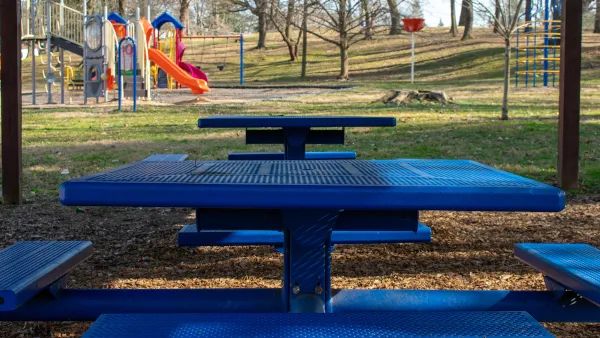
A Data-Driven Approach to ‘Playspace Inequity’
Mapping playgrounds and their conditions can reveal how childhood play opportunities are inequitably distributed within cities.

Planetizen Federal Action Tracker
A weekly monitor of how Trump’s orders and actions are impacting planners and planning in America.

Eastern Nebraska is running out of electricity
Data centers and electrification are straining eastern Nebraska’s grid, throttling economic development.

Washington state to charge fee to drivers with fuel-efficient cars
Revenue from the fee will go towards supporting the state’s highways.

States split over EPA’s proposal to drop greenhouse gas rules for power plants
The proposed rule drew over 165K comments, including from officials, health and environmental groups, and private citizens.

Final vote on BAAJA may happen this week — what happens if it passes?
The bill makes it very difficult to revoke permits, amplifying the power of whoever is issuing them.

How a Massachusetts city used laser beams to find the root of its tree loss
Cambridge discovered that the most tree loss was occurring on residential lots rather than city-owned property.

FREE Course: Walkable City 1: Why Walkability?
After describing his path towards focusing on walkability as the essence of good planning, Jeff Speck marches through his five principal reasons for making more walkable places.
Reinventing Malls: Planning Alchemy—Turning Gray Fields Into Gold
The course focuses on the opportunities and imperatives that shape reinvention of mall sites.

City of Charlotte
City of Rosemead
Rutgers University, Edward J. Bloustein School of Planning and Public Policy
University of Michigan School for Environment and Sustainability (SEAS)
Hunter College, City University of New York (CUNY)
The Architects Foundation
University District Partnership
City of Cambridge
The Pocatello Development Authority