The Oregon Department of Transportation anticipates spending about a million dollars to bring boulders to road embankments so that they are less hospitable to the homeless.


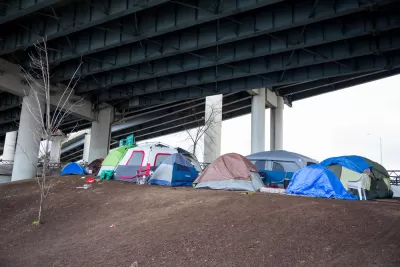
To disrupt illegal camp sites set up by homeless in Portland, the Oregon Department of Transportation (ODOT) is moving boulders onto the roadsides. The project will eventually cost about a million dollars, but ODOT argues this cost is less than the cost of dealing with existing campsites.
Many have pointed out that this policy does nothing to address the underlying problem or help the people in the camp, but only forces them to move somewhere else.
Still, some neighbors support the move, including Tiffany Hammer, who spoke with reporter Lindsay Nadrich. "Personal safety is something Hammer and other neighbors said they have not had in years," Nadrich writes for NBC affiliate KGW. There had previously been reports of fires breaking out in the camp and of people defacing rose bushes. The bushes at least will no longer be an issue.
Read the full story: Neighbors pleased as ODOT replaces roses with boulders to deter homeless

SROs Are Getting People Off the Streets in Portland
Single-room-occupancy hotels are providing much-needed affordable housing for the city’s most vulnerable residents.
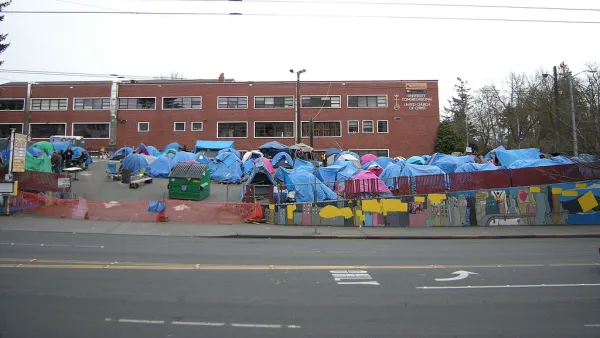
Analysis: Homeless Villages Don't Spur Crime
Homeless villages aren't hotbeds of crime, according to recent analysis. Rather, they can be part of a "crime prevention ecosystem."
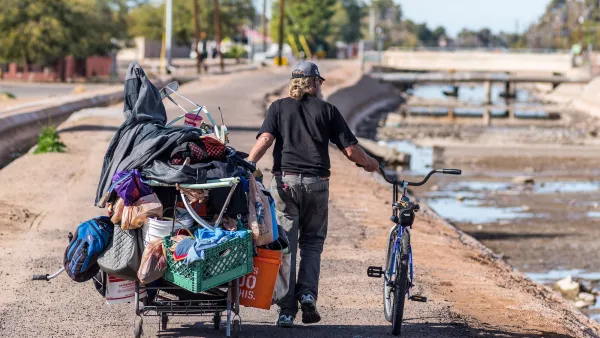
New Phoenix and Oakland Homelessness Plans Prioritize Prevention, Permanent Housing
Phoenix’s unsheltered homeless population grew by 28 percent last year.

Washington state to charge fee to drivers with fuel-efficient cars
Revenue from the fee will go towards supporting the state’s highways.

Illinois considers spending $1 billion in taxpayer money on data center
A quantum computing campus and data center are currently under construction in Chicago.

Trump to blast ‘hydrocarbon highway’ through ‘world’s longest art gallery’
Environmental and historic preservation groups are suing to stop the project.

NYC, state sue feds over mixed-immigration-status housing assistance rule
The state’s lawsuit argues that the rule change violates the Administrative Procedure Act.

Michigan to turn neighborhood into virtual power plant
Residents will soon be able to divert their excess energy to the grid in exchange for compensation.

Data center, mining project swarm to long-awaited Alaska railroad line
The state-owned railroad approved final plans for the spur line this week; the project is expected to cost $311 million, mostly funded by the federal government

FREE Course: Walkable City 1: Why Walkability?
After describing his path towards focusing on walkability as the essence of good planning, Jeff Speck marches through his five principal reasons for making more walkable places.
Reinventing Malls: Planning Alchemy—Turning Gray Fields Into Gold
The course focuses on the opportunities and imperatives that shape reinvention of mall sites.

City of Charlotte
City of Rosemead
Rutgers University, Edward J. Bloustein School of Planning and Public Policy
University of Michigan School for Environment and Sustainability (SEAS)
Hunter College, City University of New York (CUNY)
The Architects Foundation
University District Partnership