The new linear park will use land under the city’s elevated rail tracks. Worries, however, are emerging about the effects the project will have on surrounding communities, particularly related to affordable housing.


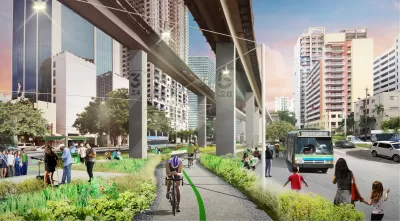
Adina Solomon reports on the Underline, a new 10-mile linear park project under the Miami Metrorail tracks, which broke ground in November last year and will provide bike and walking trails, open spaces, and other public and art spaces. The first phase of construction, a half-mile stretch in downtown Miami, is underway.
The Underline is facing concerns about gentrification and housing affordability — issues that have challenged similar projects such as the High Line in New York and the Atlanta BeltLine. "Friends of the Underline is about to embark on a study looking at neighborhood connectivity, accessibility and equitable growth, which will also explore a component for workforce and affordable housing," says Solomon.
The Underline’s leadership also plans to hold community meetings as the project continues. In addition, the organization is working with the High Line Network, a group of infrastructure reuse projects using an equitable impact framework.
FULL STORY: Who Will Benefit from Miami’s New Rails-to-Trails Park?


Climate Gentrification in Miami
With the threat of sea level rise, homes on higher ground in Miami are becoming increasingly desirable. But they are located in low-income communities of color, and residents are facing rising housing costs and displacement.
'Climate Gentrification' Is Exacerbating Economic Inequality in Miami
A new study shows that over the last several decades the price of real estate has been heavily influenced by the actual and anticipated effects of climate change.
Sustainable for Whom? Large-Scale Urban Development Projects and 'Environmental Gentrification'
Large, adaptive-reuse projects are all the rage in urban planning today, but absent a fundamentally new approach—with affordability at the center of the process—they are likely to become engines of what's been termed "environmental gentrification."

Planetizen Federal Action Tracker
A weekly monitor of how Trump’s orders and actions are impacting planners and planning in America.

The state-sanctioned urbicide of Austin
People don’t kill cities. Freeways do.

US to reduce Colorado River water deliveries to Mexico
A new Colorado Treaty amendment reduces Mexico’s Colorado River water allocation by 250,000 acre feet.

Mamdani overhauls NYC's Vision Zero plan with 100 new policy goals
The overhaul aims to reduce traffic deaths and make streets safer for pedestrians, cyclists and drivers through lower speed limits, new safety infrastructure and more.

Amtrak not solely to blame for New Jersey commuter rail's unreliability, report finds
A new study from the Garden State Initiative found that NJ Transit’s budget grew 20% across a 4 year period, but reliability declined significantly over the same period.

EPA erases limits on planet-warming pollution from power plants
Under Monday’s plan, power plants would still have some limits on how much mercury, arsenic and other contaminants they can emit.

FREE Course: Walkable City 1: Why Walkability?
After describing his path towards focusing on walkability as the essence of good planning, Jeff Speck marches through his five principal reasons for making more walkable places.
Reinventing Malls: Planning Alchemy—Turning Gray Fields Into Gold
The course focuses on the opportunities and imperatives that shape reinvention of mall sites.

Eagle County Government
Harvard University Graduate School of Design
Nashville Planning Department
The Architects Foundation
University of Cincinnati Online
The Pocatello Development Authority
The Urban Renewal Agency of the City of Pocatello
Journal of the American Planning Association