A particularly frustrating 1.2-mile stretch became a whole lot smoother when simple orange cones turned a parking lane and a bike lane into a lane for buses.


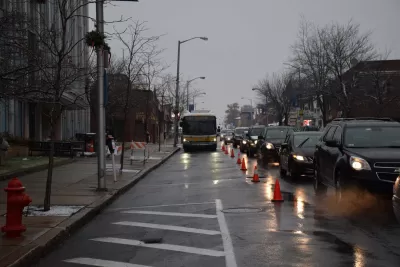
In Boston, the tricks of "tactical urbanism" are coming in handy for legitimate transit operators. Regarding one snarled stretch, Angie Schmitt writes, "The intense traffic congestion can drag out the approximately 1.2 mile-long trip between Roslindale Square and the Forest Hills Orange Line station as long as 45 minutes."
But in a recent trial run, "Bus riders got a dramatically faster ride thanks to a one-day pilot in which Boston DOT and the MBTA converted a parking lane and a bike lane into a bus lane using just orange cones."
The improvised bus lane was a hit, shaving around 30 minutes from many riders' commutes. "This is an incredibly cost-effective way to move more people more efficiently along our streets without the time and resources required for capital projects," remarked Andrew McFarland of Boston's LivableStreets Alliance. Similar and longer experiments of the same kind are planned for the new year.
FULL STORY: Boston Tests Faster Bus Service Simply By Laying Out Orange Cones

Boston Bus Signal Priority Project Yields Faster Travel Times
The city now plans to expand a year-long pilot project that reduced the time buses waited at traffic signals.
Opinion: Los Angeles Must Prioritize Bikes and Buses
L.A. has a plan for improving mobility. Why are city leaders ignoring it?
Boston’s Free Buses are Also its Slowest
Two fare-free bus lines have seen a sharp increase in travel times.

The state-sanctioned urbicide of Austin
People don’t kill cities. Freeways do.

US to reduce Colorado River water deliveries to Mexico
A new Colorado Treaty amendment reduces Mexico’s Colorado River water allocation by 250,000 acre feet.

New Jersey’s second-largest city bans standalone data centers
Jersey City will continue to allow co-location facilities, such as those meant for research institutions that store their own data.

Amtrak not solely to blame for New Jersey commuter rail's unreliability, report finds
A new study from the Garden State Initiative found that NJ Transit’s budget grew 20% across a 4 year period, but reliability declined significantly over the same period.

EPA erases limits on planet-warming pollution from power plants
Under Monday’s plan, power plants would still have some limits on how much mercury, arsenic and other contaminants they can emit.

Phoenix announces new on-demand transit service, more frequent RAPID buses
Both new services will launch in October, and are part of Phoenix's Project Effective Access Solutions for Easing Congestion.

FREE Course: Walkable City 1: Why Walkability?
After describing his path towards focusing on walkability as the essence of good planning, Jeff Speck marches through his five principal reasons for making more walkable places.
Reinventing Malls: Planning Alchemy—Turning Gray Fields Into Gold
The course focuses on the opportunities and imperatives that shape reinvention of mall sites.

Eagle County Government
Harvard University Graduate School of Design
Nashville Planning Department
The Architects Foundation
University of Cincinnati Online
The Pocatello Development Authority
The Urban Renewal Agency of the City of Pocatello
Journal of the American Planning Association