The Northern Michigan Sports Commission hasn't even been created yet, but it already has funding clout in the state government.


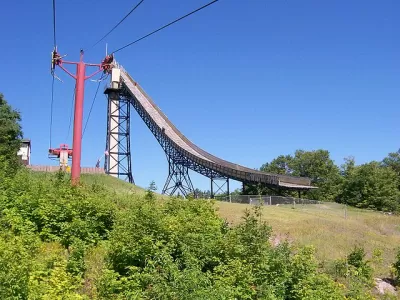
A committee in the Michigan House of Representatives approved a bill that would move financing around—benefitting the change would be a ski jump at Copper Peak in the city of Ironwood.
"The $1.9 million annual shift of funds would go into a Northern Michigan Sports Commission that hasn't been created yet, but would award grants to recreation projects across northern Michigan," report Kathleen Gray. "The bulk of the first year's tax shift would go to Copper Peak."
Gray adds that the $1.9 million was previously earmarked for improvements at the Cobo Center, a convention center located in Downtown Detroit, so the move has attracted controversy. "Democrats, Cobo Center officials, and the county executives of Wayne, Oakland and Macomb counties oppose the bill, saying that any diversion of money from Cobo's coffers could slow the convention center's recovery, just as the facility is beginning to operate in the black."
Supporting the shift in funding priorities, however, are "Upper Peninsula entrepreneurs and lawmakers who are hoping the money can be used to make improvements to the Copper Peak ski jump so it can become an attraction for world-class athletes and Olympians." The ski jump facility at Copper Peak last operated in 1994.
Read the full story: House panel votes to give $1.9 million in Cobo cash to Upper Peninsula ski jump hill

Learning loss and urban schools, part 2
Did test scores in progressive cities drop more post-COVID than test scores in moderate ones?

Detroit to transform waterfront with $2.2 billion investment
Developers will convert about 18 acres of unused parking lot space into civic spaces.
Detroit greenway brings revival — and fears of displacement
The planned Joe Louis Greenway is already bringing change to the neighborhoods near it.

Planetizen Federal Action Tracker
A weekly monitor of how Trump’s orders and actions are impacting planners and planning in America.

California plans to bury El Niño’s downpour
If the state plays its cards right, it may be able to store a billion acre-feet of El Niño’s water in aquifers.

Desperate measures: Advocates weigh draining Lake Powell to fill Colorado River
Draining the reservoir could reduce evaporation losses by a couple hundred thousand acre-feet.

Mamdani’s pied-à-terre tax survives legal challenge
A panel of judges found that the plaintiffs failed to demonstrate injury as a result of New York City's implementation of the tax.

Eastern Nebraska is running out of electricity
Data centers and electrification are straining eastern Nebraska’s grid, throttling economic development.

Seattle passes record-breaking transit services expansion
Proposition 1 will double the city’s transit tax to add 95,000 more bus trips and preserve 180,000 bus trips annually.

FREE Course: Walkable City 1: Why Walkability?
After describing his path towards focusing on walkability as the essence of good planning, Jeff Speck marches through his five principal reasons for making more walkable places.
Reinventing Malls: Planning Alchemy—Turning Gray Fields Into Gold
The course focuses on the opportunities and imperatives that shape reinvention of mall sites.


City of Rosemead
Rutgers University, Edward J. Bloustein School of Planning and Public Policy
One Hundred Miles
University of Michigan School for Environment and Sustainability (SEAS)
Hunter College, City University of New York (CUNY)
The Architects Foundation
City of Cambridge
Montrose County
The Pocatello Development Authority