The new micromobility report is out, and despite rising costs and tight regulations, it is bigger than ever, and still growing. After nearly a decade of adjustment, cities’ mobility systems may be changed for good.


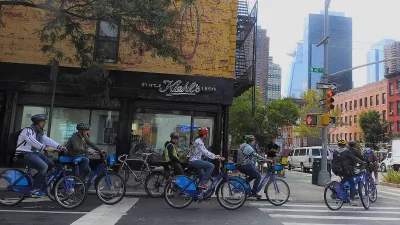
Remember the scooter wars? In 2017, when shared scooters appeared out of nowhere on city streets across the U.S., many viewed them as a scourge. It was a rerun of a similar controversy around big city docked bikeshare systems like New York’s Citibike a few years earlier.
Since then, these brightly colored two wheelers have mostly faded into the background of urban life. But they’re not sitting idle.
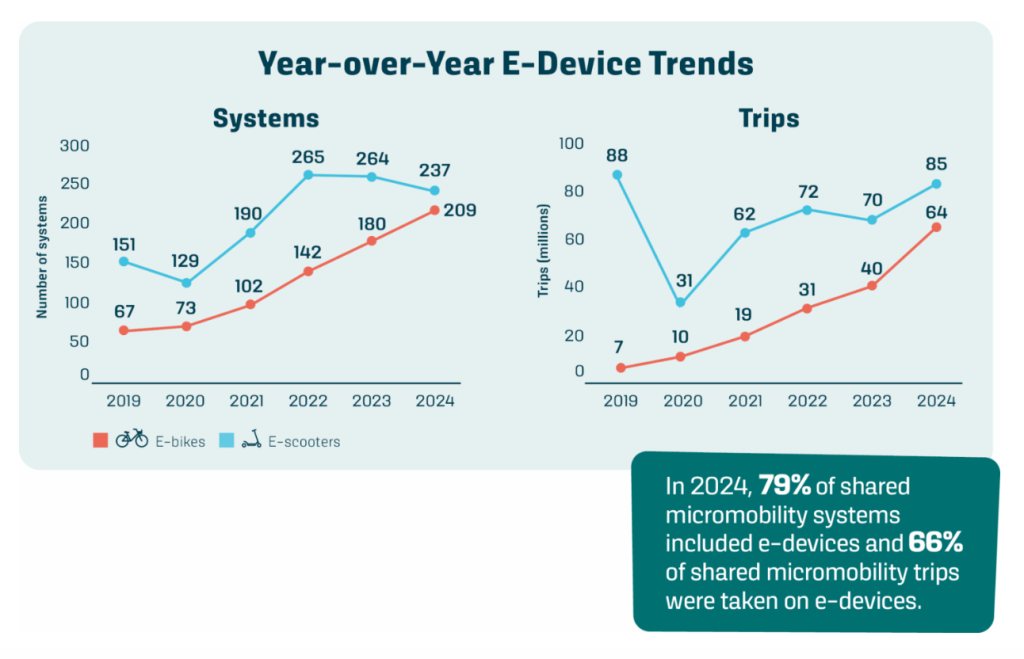
In fact, across North America, people are taking to bikeshare and scootershare systems in record numbers. In the U.S., Canada, and Mexico, riders took 225 million trips on bike and scooter share systems in 2024, an increase of 53 million, or 31 percent, from the year prior, according to a new report by the North American Bikeshare and Scootershare Association. The growing popularity of e-bikes on docked bikeshare systems like Citibike was a major driver of the increase. But scooters and dockless bikes saw growing ridership as well.

For all the schadenfreude of bikeshare graveyards and scooters being lit on fire, the industry has proven resilient. Shared micromobility is no passing fad — it’s a serious mode of transportation that’s getting more popular by the year.
Since the chaotic summer of ’17, cities have done a great deal to rein in some of the worst side-effects of shared micromobility, with geo-fencing and parking regulations. If cities redouble their efforts to install safe infrastructure and make these services more affordable, bike and scooter share systems could have a lot more room to grow.
The report only provides data by country, so there are no city-specific insights to be had here. Rather, the report sheds light on the shared micromobility industry as a whole.
Of the 225 million shared micromobility rides in 2024, 171 million took place in the U.S., while Canada and Mexico saw 27 million rides apiece. Canada’s shared micromobility ecosystem is much like America’s, with a mix of docked and dockless bikeshare systems (many of which now include electric bikes) and scootershare systems. Mexico has only pedal-powered docked bikeshare systems.
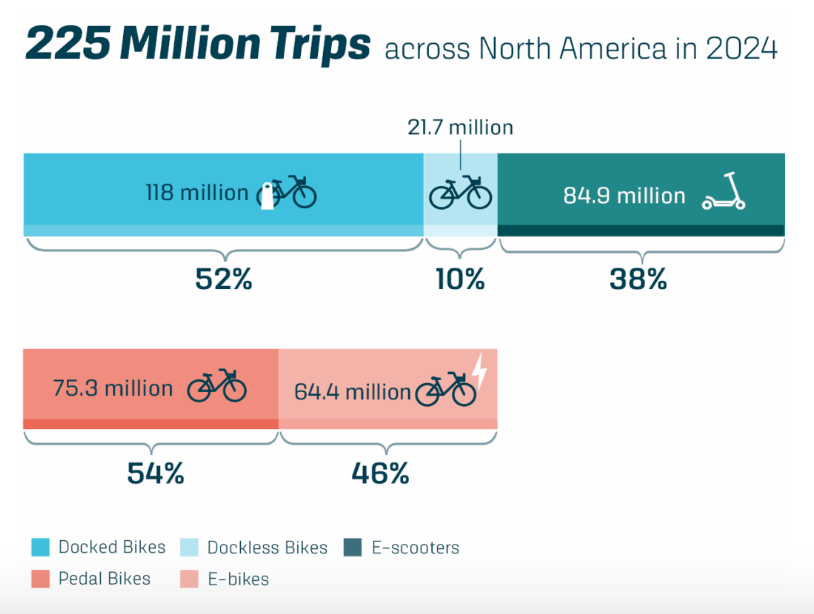
Docked systems make up the majority of rides and growth, thanks to the growing popularity of e-bikes. Among U.S. bikeshare systems, e-bikes now make up 65 percent of rides, providing 58.5 million trips in 2024. That’s up from 35 million e-bike trips in the U.S. in 2023. A lot of that growth is coming from big cities where the Lyft operated bikeshare systems continue to add e-bikes to their fleets, including systems in New York, Chicago, Boston, Washington, and the Bay Area.
Local news reports and public data sets from each of those cities show significant ridership increases in recent years, with no signs of a slowdown. New York’s Citibike alone saw 45 million trips in 2024, 66 percent of which were on e-bikes. Systems in Chicago and Washington saw 6 million rides, each.
Unlike docked bikeshare systems, shared scooter networks have still not recovered their pre-pandemic ridership numbers. Many companies have folded or consolidated their operations. (2024 saw a slight decrease in the total number of bikeshare and scootershare systems in North America, according to the report.) Nonetheless, scooter ridership increased significantly between 2023 and 2024, going from about 70 million to 85 million trips.

Shared scooter systems are much more tightly regulated now than in years past, the report shows. About one-in-five cities have “lock-to” rules that require scooters to be locked to bike racks. Just over 60 percent of cities have created designated scooter parking areas, and 70 percent use virtual geo-fencing systems to enforce parking rules.
Many other systems use geo-fencing to enforce slow-zones or no-go-zones. These rules have probably made scooters more politically palatable. But at times, they may be suppressing ridership. In Dallas, for instance, scootershare services must stop providing rides after 9pm. That was a major inconvenience for me on my last visit there, and prevented rides I otherwise would have taken.
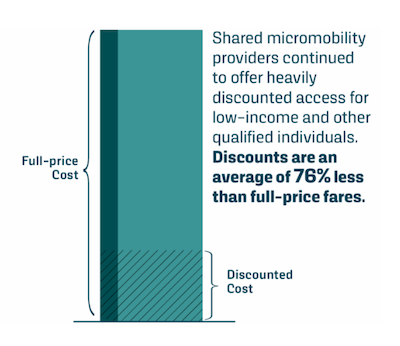
The report also offers demographic data on who uses shared micromobility. Those with incomes above 100,000 are slightly over-represented among riders, but the lowest income people are even more overrepresented. More than 90 percent of shared micromobility programs require providers to offer discounts according to the report.
White people are the racial group most over-represented among shared micromobility riders, though the gap has narrowed since the previous survey. Men continue to be significantly over-represented compared to women.
The report comes as Lyft-owned bikeshare systems in New York, the Bay Area and Chicago come in for criticism of their high prices. (Prices are lower in Boston and Washington, DC, because of public subsidies.) Scooters have long been pricier than many riders would like, after circa 2010s “Millennial lifestyle subsidies,” i.e., generous venture capital funding that kept prices artificially low, dried up.
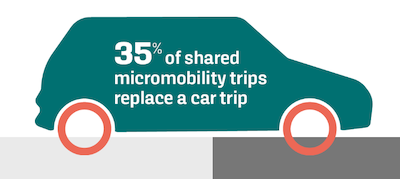
The fact that shared scooter and bike ridership continues to grow despite the growing costs indicates that there’s more ridership to be had if more cities stepped in with subsidies to lower fares.
Likewise, the shared micromobility era has been marked by a steady increase in protected bike infrastructure in major cities. But broadly speaking, North America’s streets remain hostile places for people on bikes and scooters. Should this change with better-designed streets, more people still would be inclined to ride.

NYC E-Scooter Program Threatened Despite High Ridership
Rental scooters in Queens and the Bronx provided close to two million trips in 2024, with many trips starting or ending near transit. Some city officials want to remove them.
Bikeshare Ridership Up From Pre-Pandemic Levels
Shared micromobility, particularly docked bikeshare systems, are seeing record growth, but ‘scooter inflation’ may cool riders’ enthusiasm.
Denver Transit Agency Will Subsidize First Mile of Shared Scooter Trips
A pilot program seeks to address the problem of transit access by paying for the first mile of trips to and from two light rail stations.

The state-sanctioned urbicide of Austin
People don’t kill cities. Freeways do.

US to reduce Colorado River water deliveries to Mexico
A new Colorado Treaty amendment reduces Mexico’s Colorado River water allocation by 250,000 acre feet.

New Jersey’s second-largest city bans standalone data centers
Jersey City will continue to allow co-location facilities, such as those meant for research institutions that store their own data.

Amtrak not solely to blame for New Jersey commuter rail's unreliability, report finds
A new study from the Garden State Initiative found that NJ Transit’s budget grew 20% across a 4 year period, but reliability declined significantly over the same period.

EPA erases limits on planet-warming pollution from power plants
Under Monday’s plan, power plants would still have some limits on how much mercury, arsenic and other contaminants they can emit.

Phoenix announces new on-demand transit service, more frequent RAPID buses
Both new services will launch in October, and are part of Phoenix's Project Effective Access Solutions for Easing Congestion.

FREE Course: Walkable City 1: Why Walkability?
After describing his path towards focusing on walkability as the essence of good planning, Jeff Speck marches through his five principal reasons for making more walkable places.
Reinventing Malls: Planning Alchemy—Turning Gray Fields Into Gold
The course focuses on the opportunities and imperatives that shape reinvention of mall sites.

Eagle County Government
Harvard University Graduate School of Design
Nashville Planning Department
The Architects Foundation
University of Cincinnati Online
The Pocatello Development Authority
The Urban Renewal Agency of the City of Pocatello
Journal of the American Planning Association


