The Trump Administration has put forth its plan for the reconstruction of the Gaza Strip. It is a totalitarian nightmare.


Wherever one stands on Hamas, Israel and the Gaza War, there are a few basic realities on the ground. The greater part of the Gaza Strip’s buildings, infrastructure and modest economic capacity has been turned into rubble, and the vast majority of its two million residents are living in tents and temporary shelters, or camping out in what’s left of the buildings, under miserable, often life-threatening conditions. Although the war itself is hardly over, despite the self-serving pronouncements by Trump and his acolytes, there’s at least a glimmer of a possibility that it will end before too long. Which raises the question: what then?
It may seem a little quixotic to start planning to rebuild Gaza. After all, millions of people are suffering, heavily-armed Hamas fighters still roam the tunnels, and Israel is dug in across half the territory. But a basic principle of planning — often, I admit, ignored in practice — is that when you can anticipate that something may happen, that’s when you should start planning, because if you wait until you know that it will happen, you may be too late. So even though rebuilding Gaza may be a unfortunately long way off, it is not premature to start thinking about how to rebuild Gaza.
These thoughts were prompted by watching the presentation by Trump’s son-in-law Jared Kushner at Davos, where he described how the Board of Peace (more about this later) will be rebuilding Gaza. Predictably, the plan is short on details. But it’s far, far worse than that. First, a little background.
As far as one can tell, at some point soon after the Gaza peace plan was signed, Kushner, son of a prominent New Jersey-based developer clan with a checkered and somewhat lurid history, and Steve Witkoff, a New York real estate developer whom Trump has appointed to be his special envoy to the Middle East, decided that a plan for Gaza’s future was needed. Over the next 45 days they came up with a plan. As far as anything I’ve been able to find would indicate, the only named person aside from them involved (other than, I assume, a roomful of young people skilled at creating AI renderings and crunching numbers) was a billionaire global investor/developer of Israeli origin named Yakir Gabay,[1] although one article adds that “input has been received from Israeli officials, the private sector, and contractors.” Neither planners nor Palestinians appear to have made the cut.
The plan they created, called Project Sunrise, was presented privately at a White House meeting in mid-December to a gaggle of business people and politicians, many from Arab countries. Predictably, it was soon leaked, and appeared in the Wall Street Journal and the Washington Post. You can see the 38-page Project Sunrise PowerPoint here.
Jared Kushner’s presentation at Davos can be thought of as a stripped-down version of the more detailed Project Sunrise presentation, with the addition of a slide dubbed Master Plan, which I’ll discuss below.
The plan as a whole is a toxic mixture of absurdity, delusion and sheer hubris. Under the plan, the US government would create a US-controlled entity[2] called the GREAT (Gaza Reconstitution, Economic Acceleration and Transformation) Trust, which would take control of all public land and run Gaza for the indefinite future, turning it back to the Palestinians only when it decides that “a reformed and deradicalized Palestinian Polity is ready to step in its shoes.” In the meantime, the Trust will presumably have turned Gaza into a thriving, Dubai-esque paradise, including new cities, a port, data centers, the Elon Musk Smart Manufacturing Zone and the Gaza Trump Riviera & Islands, “world-class resorts along the coastline and on small artificial islands (similar to the Palm Islands in Dubai),” (slide 6).
One can assume that the franchising and naming details have already been worked out. Or at least a concept of a framework of them.
All of this would be (slightly) funny if not for the fact that they are playing with the lives of millions of people. But when I put on my city planner hat and zoom in on that part of the document that deals with the physical aspects of rebuilding Gaza, it becomes seriously scary. I’m going to look at Kushner and Witkoff’s plans, but also look at some of the ideas that other — more serious but less powerful — people have proposed for rebuilding Gaza.
Let’s start by looking at what Kushner and Witkoff call their Master Plan. Now, in the first version of their plan that was aired in December, there wasn’t a master plan as such; instead, the plan was the sum of 10 “Mega Projects,” a list of projects accompanied by a kind of crude blob map of the Gaza Strip. This was not a plan, but a developer’s wish list.

Apparently somebody told Kushner and Witkoff that they needed something a little more serious-looking, so at Davos Kushner unveiled the next image, complete with the weird Board of Peace logo. This one almost looks like a plan. The outline of the Gaza Strip, instead of being a rough sketch, is now shown more or less at scale. Instead of blobs, we now have colored, hard-edged areas denoting each activity or land use. Cities are yellow, coastal resorts (the Gaza Trump Riviera) are purple, “parks, agriculture and sports facilities” are green, industrial areas are black, etc. In fact, it doesn’t look all that different at first glance from some actual plans.
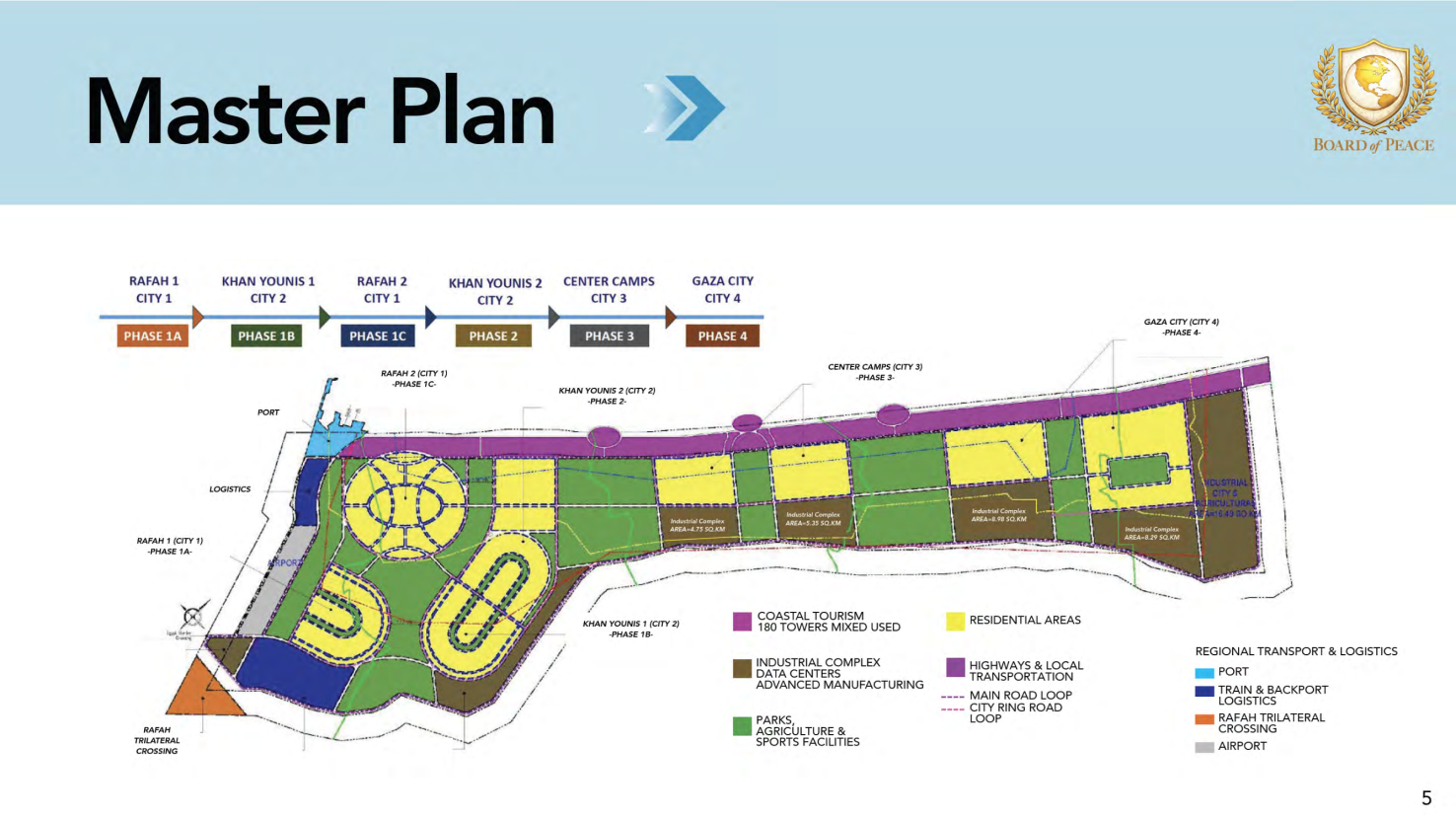
Looking at the future cities, it’s hard to escape the feeling that the shapes are more or less arbitrary or random. There are four rectangles, another rectangle with a hole in it, a basketball, a magnet and a football stadium or racetrack. And these shapes cover large areas. The rectangle with the hole in it, for example, covers close to 6 square miles. The racetrack is 4 miles long. More importantly, these shapes and their locations bear no resemblance whatsoever to the existing configuration of cities and farmland in the Gaza Strip. For example, the entire historic Old City of Gaza is located in an area designated for “industrial complex, data centers [and] advanced manufacturing.”[3]
This is where the entire premise of the so-called master plan breaks down. The single driving premise of the Kushner-Witkoff plan is that the entire Gaza Strip is a tabula rasa waiting for developers to arrive and rebuild it however they deem most profitable. The people who lived in Gaza before October 7, 2023 and who live there now in the hope of a better future mean no more to Kushner and Witkoff than pawns on a chessboard. They will be re-housed — except, of course, for those who can be induced to leave — to ensure that they will be available as “skilled (low cost)” workers in whatever industries the United States can convince to locate in Gaza, under the rule of the US-controlled GREAT Trust. The “skilled (low cost)” language is a direct quote from the plan.
This is a frighteningly solipsistic, dystopian vision for the future of Gaza, which for all its many problems long before October 7, was and is a real place. It is not clear that Kushner or Witkoff, let alone Trump, realize that (or, if they do, care).
Another slide, though, from the December presentation provides even better insight into their thinking. Slide 7 offers the following bizarre goal for the plan:
Like Haussmann’s strategy in 19th century Paris, this plan aims to address one of Gaza’s ongoing insurgency’s root causes: its urban design.
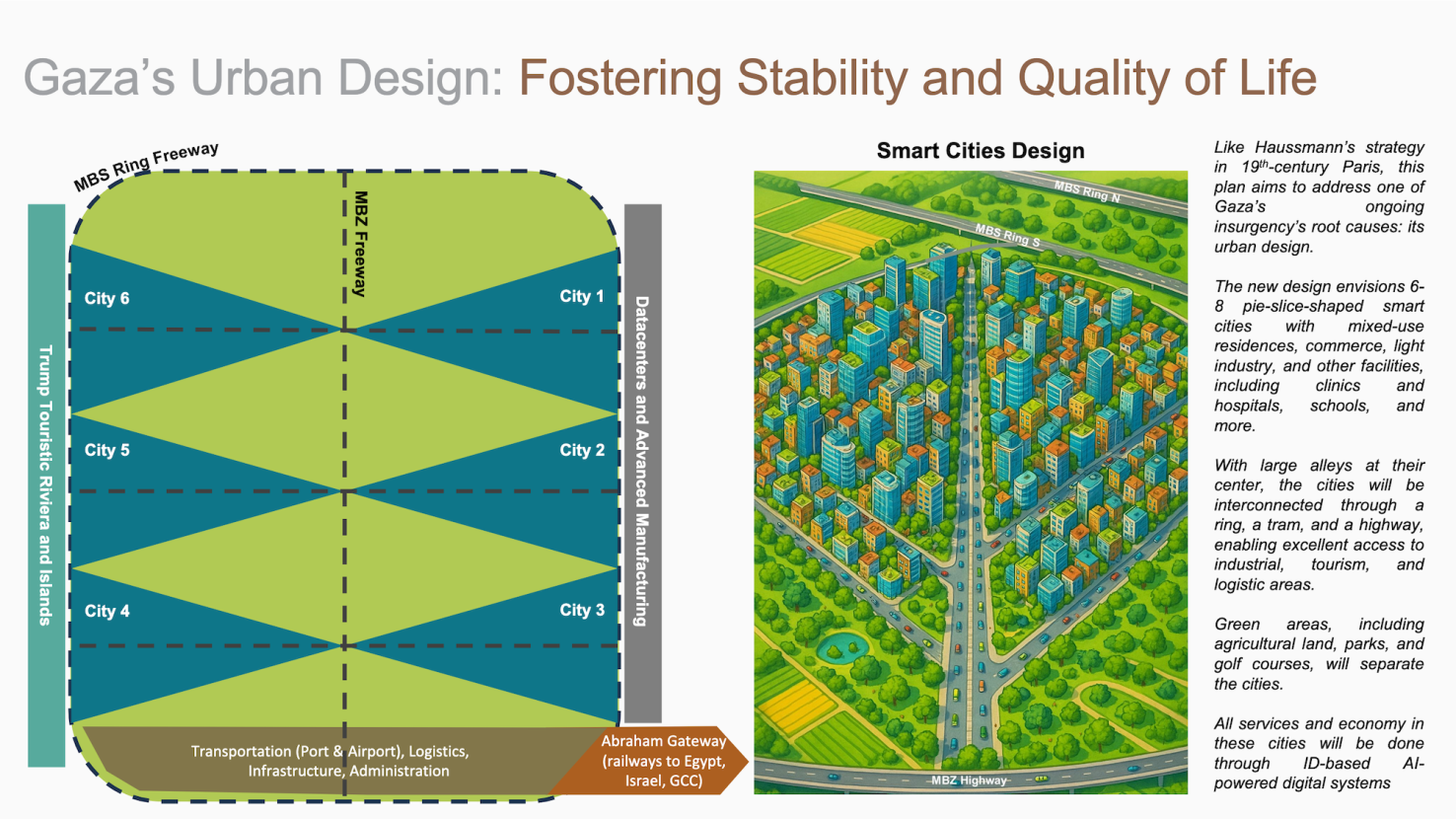
What exactly are Kushner and Witkoff talking about? It may take a bit of effort to pick it apart. To begin, the idea that urban design, of all things, is a root cause of insurgency is, frankly, bizarre. In fact, the entire sentence is absurd. Whatever constitutes an “ongoing insurgency,” Gaza’s “urban design,” — by which I assume they believe that its narrow, winding alleys, dead end streets and congestion may be facilitating Hamas’ ability to survive by enabling their militants to hide among the population and blocking Israeli armored vehicles — at most may be facilitating the “insurgency.” This is vaguely plausible, although not remotely a “root cause” of anything. It is unclear to me that it necessarily has that much to do with Hamas’ ability to build and maintain its network of tunnels.
In any event, it seems that one of them appears to have read something about Baron Haussmann’s rebuilding of Paris in the 1850s and 1860s, and picked up the common assertion that he rebuilt the city with long, straight boulevards for the purpose of enabling the army to move in quickly and have a wide field of fire in case it had to restore order in the event of an insurgency. While that story is widely believed, the consensus of serious historians is that military concerns were at most a minor or secondary concern in Haussmann’s thinking. The reference to Haussmann by Kushner and Witkoff in the context of their assertions about Gaza’s urban design offers instead a window into their thinking, making it clear that they obviously believe the assertion to be true.
It is not too much of a reach to suggest that, under the guise of “fostering stability and quality of life,” the slide actually depicts a city designed to be totally vulnerable to an army marching in to suppress an uprising (red arrow). The city in the AI rendering in Slide 7 is designed for totalitarian rule; indeed, among the few real world counterparts that come to mind are the less successful housing projects of the former Soviet Union (Figure 4).
I do not believe that my characterization of the Gaza plan as totalitarian is far-fetched, in light of another of Kushner and Witkoff’s planning goals, which is that:
All services and economy in these cities will be done through ID-based AI-powered digital systems.
In other words, their future Gaza is to be a surveillance state, designed to outshine even China in its ability to control the movements of its people and, presumably, prevent anything from emerging that might get in the way of their carrying out their role as a skilled but low-cost workforce. It is unsurprising that, in view of their agenda, Kushner and Witkoff saw no need to involve any real Palestinians in the preparation of this plan.
In his full Master of the Universe[4] mode in Davos, Kushner summed up the plan by saying:
Let’s just plan for catastrophic success… People ask us what our Plan B is. We do not have a Plan B.
That appears to be true although, given the reaction to their plan, it would probably not be a bad idea for them to have a Plan B. At least two other groups of people, though, have actually put forward very different ways of looking at the daunting task of rebuilding Gaza.
Under the rubric of Gaza Phoenix, a multidisciplinary team of Palestinian professionals and academics from Gaza, the West Bank, and the Palestinian diaspora have volunteered their time to develop a way of rebuilding Gaza which embodies serious, thoughtful planning, as they describe it:
The Phoenix Gaza Framework is built on a collaborative, interdisciplinary process that integrates local knowledge, academic research, and spatial planning expertise. Shaped through internal deliberations, field data, and input from municipal actors, the methodology unfolds in three main phases — emergency, stabilization, and long-term reconstruction — each aligned with specific criteria, spatial components, sectoral actions, and community-defined priorities. This flexible, non-linear approach ensures that Gaza’s rebuilding is grounded in its diverse realities and led by its people.
The Phoenix team approach is the opposite of the Kushner and Witkoff clean slate, developer-driven, approach. Above all, it is follows two critically important principles:
- There are no clean slates. No piece of planet earth, developed or not, is a clean slate, let alone a densely populated area like Gaza. Start by understanding what has been there, and is there, and build from that point.
- Listen to and engage the people who live there. Whatever the history may be, and however one may feel about what has gone before, the people of Gaza are people, and have voices. They are not merely fodder for a regimented, low-cost workforce.
The Gaza Phoenix website offers a detailed roadmap — heavy on specific strategies and approaches, and (deliberately, I believe) light on glitzy renderings. Whether one agrees with everything in it or not, it should be studied by anyone serious about rebuilding the Gaza Strip. Kushner and Witkoff could learn a lot from it.
While not a comprehensive plan, a study done by a team at the RAND Corporation lays out a strategy for what they call incremental urbanism, a process for meeting the urgent need for temporary housing while laying the groundwork for permanent communities.
The RAND study reflects the reality, ignored by Kushner and Witkoff, that where temporary communities are established — whether the post-1948 refugee camps in the West Bank and Gaza, post-1947 refugee camps in Karachi, the favelas of Brazil, or their counterparts in Asia and Africa — they tend to transform over time into permanent communities, as illustrated in the picture below of the Balata camp near Nablus in the West Bank. Tents or shelters are replaced with concrete block houses, and houses are gradually replaced with multistory apartment buildings. For all the power and creativity of the informal processes that fuel these transformations, the results are crowded, polluted and unhealthy.

Given the way refugee camps or squatter settlements are typically formed with no thought for their long-term future, this outcome is all but inevitable. The value of the RAND study is that it outlines in some detail a process by which the temporary housing urgently needed now can be built in a way that, as it is informally transformed into permanent housing, the process leads to a healthy and sustainable urban community. Again, the RAND study is not a comprehensive plan for rebuilding Gaza. But it is a thoughtful, valuable approach to one of the stickiest aspects of the rebuilding process, if and when it ever begins.
Jared Kushner is wrong. There is a Plan B (and a Plan C). There are probably other plans and ideas that I’m not aware of, but are well worth considering. Moreover, given the many features of the Kushner and Witkoff plan which are unlikely to be acceptable to the Arab nations that the US expects to put up a lot of the money needed, their plan, one hopes, is unlikely to go beyond its PowerPoint presentation. Then again, they may not care.
The time for a plan may still be far off. The Gaza war is not really over. The hostages are home, but a steady cycle of Hamas provocations and bloody Israeli reprisals continues, with no clear path to true peace visible. But one needs to hope that at some point it will be possible to start truly planning for a better future for Gaza, and that at that point, something better than the Trump administration’s Big Brother totalitarian vision will prevail.
NOTES
[1] I hesitate to call him Israeli, because he is apparently now a Cypriot citizen and spends most of his time in Cyprus and London. That said, he has strong ties to Israel, visits there regularly, and is clearly plugged into influential Israeli political and business circles. In recent years he has invested heavily in US real estate, particularly in New York City, through a company he controls called Yellowstone Real Estate Investments.
[2] The plan does say that “Ideally, Arab and other countries invest in the Trust, making it a multilateral institution.”
[3] For a more detailed look at how the plan ignores the historic configuration of Gaza, see Mohammed Haddad and Mohammad Mansour (2026), “Map shows what would happen to Gaza under the US ‘master plan’”, Al Jazeera, Jan. 27 https://www.aljazeera.com/news/2026/1/27/map-shows-what-would-happen-to-gaza-under-the-us-master-plan
[4] Kushner is a real-life incarnation of Sherman McCoy in Thomas Wolfe’s famous novel, "The Bonfire of the Vanities."


Planetizen Federal Action Tracker
A weekly monitor of how Trump’s orders and actions are impacting planners and planning in America.

Amtrak, CN end decades-long dispute with eight-year agreement
The new operating agreement establishes an updated framework for the companies to work together, including processes to resolve disputes.

Judges permit Denver to divert 77,000 acre feet from the Colorado River for reservoir expansion
Overuse and climate change have caused the Colorado River’s water levels to plummet.

Alabama scores up to $2.5 billion federal loan for largest infrastructure project in state’s history
The Mobile River Bridge and Bayway Project aims to ease congestion at Alabama’s worst bottleneck.

Trump is considering data centers on 6 states' public land — some state officials say they had no idea
If the administration approves the proposed projects, data center and data center-related developments will cover 17,600 acres of public land.

Despite court ruling, Trump is keeping nearly all wind projects in the US on hold
At least 110 wind energy projects have not heard from the government since a federal judge ruled that the Trump administration's freeze on wind turbine clearances was likely illegal.

FREE Course: Walkable City 1: Why Walkability?
After describing his path towards focusing on walkability as the essence of good planning, Jeff Speck marches through his five principal reasons for making more walkable places.
Reinventing Malls: Planning Alchemy—Turning Gray Fields Into Gold
The course focuses on the opportunities and imperatives that shape reinvention of mall sites.

KFH Group Inc.
Greater Baltimore Committee
Eagle County Government
The Architects Foundation
University of Cincinnati Online
The Pocatello Development Authority
The Urban Renewal Agency of the City of Pocatello

