After the local community board removed a protected bike lane from its plans for the redesign of Queens Boulevard, Mayor Bill de Blasio restored it, under the premise of saving lives.


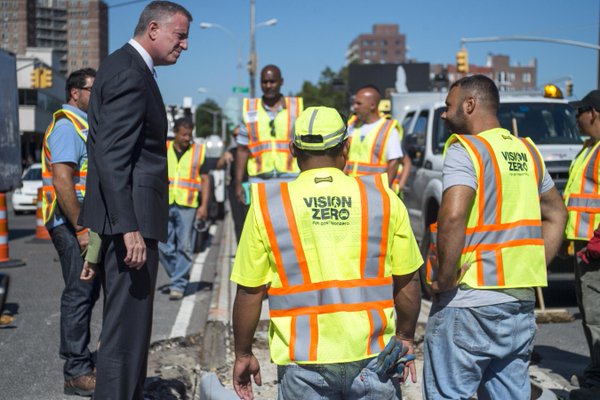
credit: NYC Office of the Mayor
Opposition to bike lanes is nothing new in New York City. Perhaps the most vocal opposition was against the Prospect Park West bike lane in Brooklyn in 2010. While opposition to such lanes continues (even against Prospect Park West), as evidenced in Queens by Dan Rivoli, mobility reporter for the New York Daily News, the need for bike safety trumps it when backed by a strong leader and committed staff.
"The city Department of Transportation will put in a new bike lane along part of Queens Blvd. even though the local community board doesn’t want it, Mayor de Blasio said Wednesday [May 11]," writes Rivoli. "The decision was announced after the chair of Queens Community Board 4 in Corona and Elmhurst removed the bike lane from a package of street safety designs to improve the notorious Boulevard of Death before voting to approve the changes Tuesday night.
Despite the community board's vote on the safety package without the bike lane, de Blasio said it was going in anyway as part of his Vision Zero* pedestrian and bicycle safety agenda.
“I respect those who disagree with us, but in the end, the safety of our neighbors and our children is the most fundamental responsibility we have in this work,” de Blasio said in a statement.
I have instructed the Department of Transportation to move forward on the next phase of safety enhancements to Queens Boulevard, including a protected bike lane for cyclists,” he said.
The article contains a map showing the three sections, known as operational projects, of Queens Blvd. that have been or will be redesigned. Operational Project 1, a 1.3 mile stretch, is finished and is a success by any standard. It won Streetsblog's 2015 Streetsie award for "Best Urban Street Transformation" and third place in People for Bike's third (2015) annual list of "10 Best New Bike Lanes." Take a Streetfilm tour here with Ryan Russo from the NYC DOT.
The restored protected bike lane will run on Operational Project 2, "from 74th St. to Eliot Ave. near the Long Island Expressway," writes Rivoli. "The rest of Queens Blvd. [Operational Project 3] up to Union Turnpike will get a bike lane in 2017."
Rivoli's requests for comments from the community board were not returned. "Community boards have advisory roles in city planning, but opposition from these local bodies have led the city to scale back safety projects in the past," he notes.
Why the deadly moniker?
"Since 1990, 185 New Yorkers have lost their lives on Queens Blvd., mainly pedestrians," states Mayor de Blasio at the ceremony (YouTube, at 9:34 in the 41:42 minute video) in Woodside marking the opening of the first completed stretch of the redesigned road. Transportation commissioner Polly Trottenberg, as well as community advocates, are credited for the completion of the project in addition to the mayor. More information on the boulevard here.
Vision Zero: According to the city webpage, "approximately 4,000 New Yorkers are seriously injured and more than 250 are killed each year in traffic crashes. Being struck by a vehicle is the leading cause of injury-related death for children under 14, and the second leading cause for seniors. On average, vehicles seriously injure or kill a New Yorker every two hours."
Hat tip to Mark Boshnack, Oneonta Daily Star
FULL STORY: De Blasio strong-arms development of Queens Blvd. bike lane in Vision Zero push, despite community objection

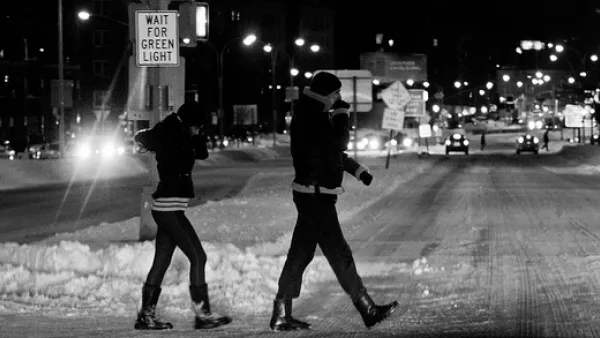
A Vision Zero Success Story in New York
The 300-foot wide Queens Boulevard has been known as the Boulevard of Death. Since 1990, it has claimed 186 lives, 74 percent being pedestrians, including 18 in 1997 alone. A series of safety improvements have brought fatalities to zero since 2014.
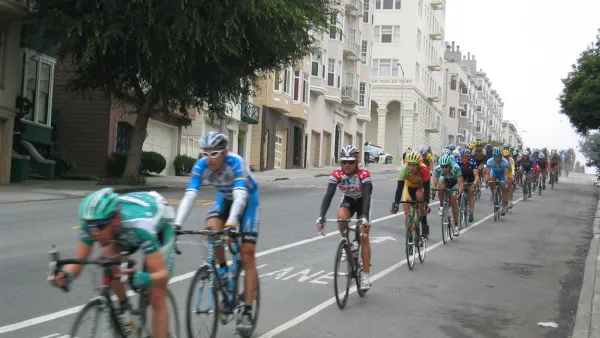
Quick Build Initiative Transforming the Streets of San Francisco
Street improvements to benefit cyclists and pedestrians have been moving rapidly in San Francisco since the June approval of the Vision Zero quick-build initiative, a two-year plan to expedite safety project on high-injury corridors.
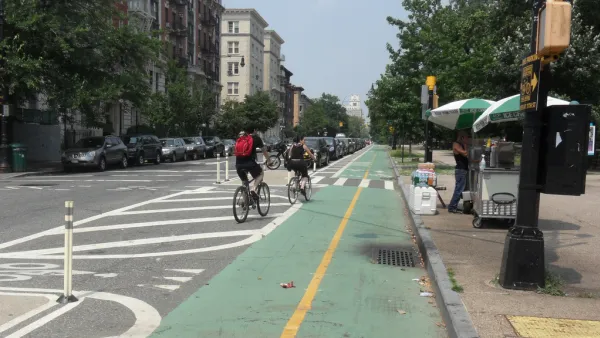
Got Protected Bike Lanes?
While Angie Schmitt doesn't ask this question in her article on the movement behind these lanes, she writes that cities without them "are being left behind". They're popular because they effectively address the #1 reason for not riding: safety

Planetizen Federal Action Tracker
A weekly monitor of how Trump’s orders and actions are impacting planners and planning in America.

The state-sanctioned urbicide of Austin
People don’t kill cities. Freeways do.

US to reduce Colorado River water deliveries to Mexico
A new Colorado Treaty amendment reduces Mexico’s Colorado River water allocation by 250,000 acre feet.

Baltimore to break ground on $50 million Transit Priority Project
The project will bring faster bus trips, safer streets and better bike connections to Baltimore.

Airbnb launches $250 million 'last-dollar financing' housing accelerator, makes first investment in Austin
The company will put $6.4 million towards affordable housing development in Texas’ capital.

Guerilla urbanists are building DIY bus stop benches in Chicago
A before-and-after of one of the bus stops with a new bench. The new benches are not officially sanctioned or permitted, but the residents who placed them hope they will be the start of a network of DIY benches across the city.

FREE Course: Walkable City 1: Why Walkability?
After describing his path towards focusing on walkability as the essence of good planning, Jeff Speck marches through his five principal reasons for making more walkable places.
Reinventing Malls: Planning Alchemy—Turning Gray Fields Into Gold
The course focuses on the opportunities and imperatives that shape reinvention of mall sites.

Eagle County Government
Harvard University Graduate School of Design
Nashville Planning Department
The Architects Foundation
University of Cincinnati Online
The Pocatello Development Authority
The Urban Renewal Agency of the City of Pocatello
Journal of the American Planning Association