Yes, L.A.'s first foray into congestion pricing has improved travel times for those utilizing the high occupancy/toll lanes, but congestion has gotten worse in all other lanes, to the surprise of planners.


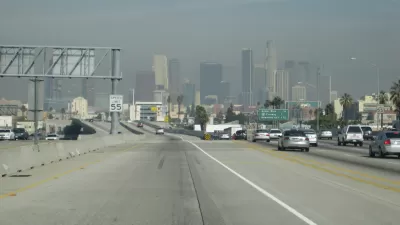
When Los Angeles opened its first high occupancy/toll lanes along the 110 freeway five months ago, the experiment in congestion pricing was intended to improve travel times for all drivers. But that's not what has happened, reports Laura J. Nelson. Preliminary data indicates that, "Average travel speeds have increased in the lanes formerly reserved for carpoolers, but traffic has slowed on the rest of the freeway."
"But the 110 remains something of a laboratory," adds Nelson, "and officials are hoping the toll lanes ultimately will relieve congestion on the entire freeway. The results from the experiment are expected to strongly influence decisions on possible expansion of toll lanes countywide."
"'Growing pains. It's not surprising,' said [Clifford Winston, a government performance analyst at the Brookings Institute], noting that similar projects in Washington, D.C., and elsewhere saw the same pattern during the early months."
Read the full story: Traffic zips in toll lanes, but slows in free lanes

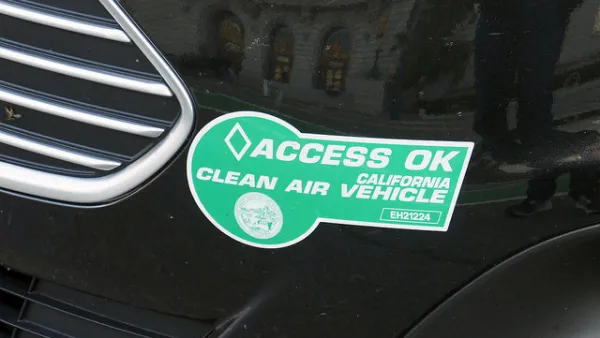
Electric Vehicles to Lose Important Perk in Southern California
One of the major reasons for purchasing an electric vehicle in California is the ability to use a carpool lane as a solo driver and use an express lane toll-free. The latter perk will soon disappear for solo-occupant EVs on two freeways.
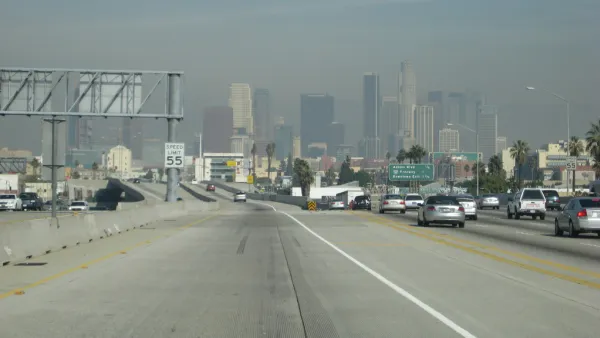
Slow Express Lanes Causes L.A. County Metro to Tinker With Toll Pricing
As more solo-commuters have moved into the express pay lanes designed to quickly move traffic on Los Angeles's congested freeway system, speeds have dropped and L.A. Metro officials are looking to pricing disincentives to speed things up again.
LA's Pilot Express Lanes Coming Soon
California Report previews 25 miles of new express or high occupancy toll lanes coming to LA as a pilot project paid from the competitive value pricing grant program under President Bush. The lanes currently are reserved for high occupancy vehicles

Planetizen Federal Action Tracker
A weekly monitor of how Trump’s orders and actions are impacting planners and planning in America.

Data reveals that NYC’s bet on congestion pricing has paid off
After almost two years of the program, reports show positive impacts on traffic and air quality and no disruptions to parking.

Denver is solving homelessness. Why aren't the rest of us?
Since 2023, Denver's street homeless population has decreased by 64%, proving that effective tools exist to support those in need of housing.

In California, electric school buses are powering 1,000 homes — and turning a profit
Tellus Power, the charging equipment manufacturer behind the project, is also helping school buses connect to the power grid in Vermont, Illinois and San Francisco.

‘No state has sacrificed more:’ Arizona joins Nevada, sues feds over Colorado River plan
The Arizona Department of Water Resources' motion claims that the state's cities, tribes and farmers can't survive without sufficient water from the Colorado River.

Permits for single-family homes have nosedived, along with investor confidence
Permits to build new single-family homes also hit a 3.5 year low in September.

FREE Course: Walkable City 1: Why Walkability?
After describing his path towards focusing on walkability as the essence of good planning, Jeff Speck marches through his five principal reasons for making more walkable places.
Reinventing Malls: Planning Alchemy—Turning Gray Fields Into Gold
The course focuses on the opportunities and imperatives that shape reinvention of mall sites.

City of Rosemead
Rutgers University, Edward J. Bloustein School of Planning and Public Policy
One Hundred Miles
The Architects Foundation
University of Cincinnati Online
Montrose County
Northern Illinois Transit Authority (NITA)
The Pocatello Development Authority