An article in The Architect's Newspaper describes post-Katrina redevelopment plans and calls the city a lab for architecture and planning.


From The Architect's Newspaper:
"Construction that began a few years ago is now starting to finish up, while the city's new Mayor Mitch Landrieu has launched a program to instigate 100 city-initiated projects that will begin or even be completed in the next three years. In total, according to William Gilchrist, the city's Director of Place-Based Planning, over $13 billion in federal, state and local investments will go into effect. In many ways, said Gilchrist, the city has become a laboratory for new ideas in architecture and urban planning."
The ambitious plans have attracted a star-studded team of architects, development experts, and even Hollywood actors. Brad Pitt's Make It Right foundation is "building contemporary-style, highly sustainable (from solar powered to rainwater harvesting) homes in the Lower Ninth Ward- the hardest hit of all of New Orleans' neighborhoods," according to Sam Lubell (author of the article). The hope, according to Lubell, is that a large portion of the projects are completed by the city's tri-centennial in 2018.
Read the full story: New Orleans Rising

Planetizen Federal Action Tracker
A weekly monitor of how Trump’s orders and actions are impacting planners and planning in America.

Eastern Nebraska is running out of electricity
Data centers and electrification are straining eastern Nebraska’s grid, throttling economic development.
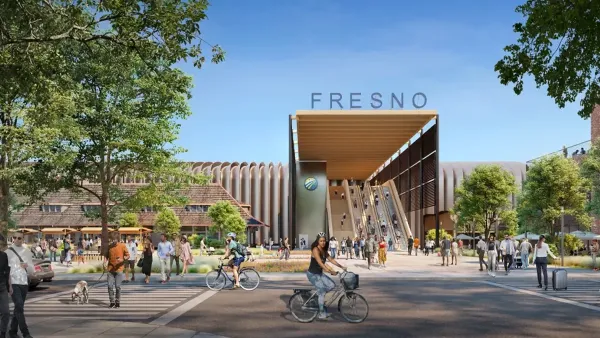
California High-Speed Rail Authority picks trainset manufacturer
The California High-Speed Rail Authority aims to start servicing passengers by 2033.

Massachusetts bogs generate both power, and cranberries
Putting solar panels above farmland is one way Massachusetts is advancing toward its goal of net-zero carbon emissions by 2050.

What could the future of LA transit look like under Raman?
The mayor-elect views broken sidewalks and potholes as crises that can be fixed with better governance.

States are counting on battery farms. Some towns don’t want them.
While fire safety has improved, some communities are still wary.

FREE Course: Walkable City 1: Why Walkability?
After describing his path towards focusing on walkability as the essence of good planning, Jeff Speck marches through his five principal reasons for making more walkable places.
Reinventing Malls: Planning Alchemy—Turning Gray Fields Into Gold
The course focuses on the opportunities and imperatives that shape reinvention of mall sites.

City of Rosemead
Rutgers University, Edward J. Bloustein School of Planning and Public Policy
One Hundred Miles
University of Michigan School for Environment and Sustainability (SEAS)
Hunter College, City University of New York (CUNY)
The Architects Foundation
City of Cambridge
The Pocatello Development Authority
The Urban Renewal Agency of the City of Pocatello