Under pressure from DOT Secretary Ray LaHood, N.J. Gov. Chris Christie has authorized the Hudson River rail tunnel project known as ARC: Access to the Region's Core, to resume work. Key to the decision would have been the loss of $3 billion to N.J.


Sen. Lautenberg released this press report as soon as it was know of Christie's reversal after his meeting with LaHood.
"The Secretary was clear with Governor Christie: if this tunnel doesn't get built, the three billion dollars will go to other states. We can't allow that to happen," Lautenberg said.
Lautenberg was amongst the most vocal to react to the initial news of the Governor's halting the project in a press release Thursday (Oct. 7):
"Killing the ARC Tunnel will go down as one of the biggest public policy blunders in New Jersey's history. Without increased transportation options into Manhattan, New Jersey's economy will eventually be crippled," Senator Lautenberg said.
That decision was strongly criticized by NYT columnist Paul Krugman on Friday: "The End of the Tunnel": "So this was a terrible, shortsighted move from New Jersey's point of view. But that's not the whole cost. Canceling the tunnel was also a blow to national hopes of recovery, part of a pattern of penny-pinching that has played a large role in our continuing economic stagnation."
Thanks to Shannon Tracey
Read the full story: Lautenberg: It's Time To Put The Tunnel Back On Track
Bridge-gate Widens to Include ARC Tunnel Cancellation
Remember the $8.7 billion Hudson River rail tunnel project that Chris Christie canceled in 2010 shortly after becoming governor? N.J. legislators investigating the September lane shut-down on the George Washington Bridge are now connecting the dots.
Amtrak's $151 Billion High Speed Rail Plan
With the CA state Senate's appropriation of $8 billion toward their $68 billion high speed rail plan, the spotlight turns to the other coast - the Northeast Corridor, with Amtrak's unveiling its updated, $151 billion plan. Both run 220 mph trains.
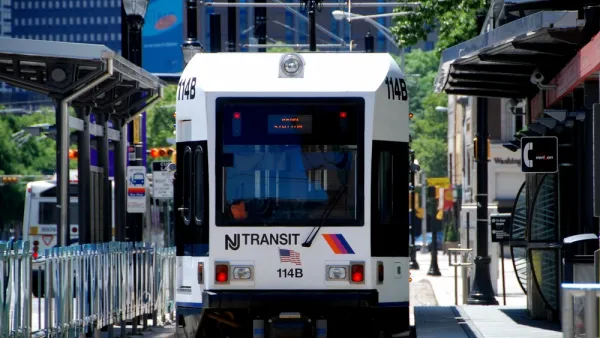
The Recent Decline of New Jersey Transit's Commuter Rail Operations
The New York Times looks into the decline of New Jersey Transit commuter railroad, rated as outstanding only nine years ago. Much of the decline can be traced to decisions by the Christie administration beginning in 2010.

Planetizen Federal Action Tracker
A weekly monitor of how Trump’s orders and actions are impacting planners and planning in America.

Eastern Nebraska is running out of electricity
Data centers and electrification are straining eastern Nebraska’s grid, throttling economic development.

Study reveals best places in the U.S. for cycling, walking
New research from Streetlight Data examines bicycle and pedestrian miles per capita in the 100 largest U.S. cities by population.

DSA members accuse Mamdani of 'abandoning values' over housing redevelopment
New York City's mayor plans to replace about 2,000 units of public housing with private, mixed-income housing.

All sides of BRT debate unhappy with CDOT’s most recent move
The Colorado Department of Transportation is no longer considering center-running bus lanes for Colorado Boulevard.

Massachusetts bogs generate both power, and cranberries
Putting solar panels above farmland is one way Massachusetts is advancing toward its goal of net-zero carbon emissions by 2050.

FREE Course: Walkable City 1: Why Walkability?
After describing his path towards focusing on walkability as the essence of good planning, Jeff Speck marches through his five principal reasons for making more walkable places.
Reinventing Malls: Planning Alchemy—Turning Gray Fields Into Gold
The course focuses on the opportunities and imperatives that shape reinvention of mall sites.

City of Rosemead
Rutgers University, Edward J. Bloustein School of Planning and Public Policy
One Hundred Miles
University of Michigan School for Environment and Sustainability (SEAS)
Hunter College, City University of New York (CUNY)
The Architects Foundation
City of Cambridge
The Pocatello Development Authority
The Urban Renewal Agency of the City of Pocatello