What does "equity" mean for transportation professionals? This is discussed in a 12-page comic published in the Canadian Institute of Transportation Engineers newsletter.


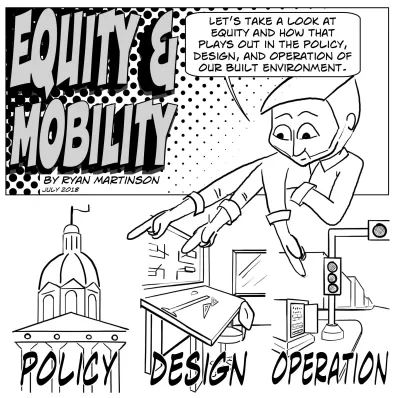
Engineer Ryan Martinson uses his cartooning skills to explore why and how to better incorporate social equity goals into transportation planning Equity & Mobility, a 12-page comic article published in the Summer issue of Transportation Talk," the Canadian Institute of Transportation Engineer's quarterly newsletter.

The article describes the differences between equality (everybody is treated equally, even if they they have different needs and abilities) and equity (people are treated fairly, taking into account their different needs and abilities), discusses how planning decisions allocate public resources and opportunities, explores how power imbalances can bias decision-making, how the definition of "design users" can affect who is served or excluded by a transport system, and examines how methods often used to evaluate transportation system performance tend to favor faster modes (particularly automobile travel) over more affordable and inclusive modes (such as walking, bicycling and public transit). Martinson also describes specific ways that individuals, professional organizations, agencies, and the public can better achieve transportation equity goals.

This is a timely and important issue for planning professionals. Planning decisions allocate valuable and scarce public resources, and affect people's economic and social opportunities. A growing body of research indicates that the mobility and accessibility options available in a community significantly affect resident's economic mobility, that is, the chance that children born in lower-income households become more economically successful as adults.
Read the full story: Equity & Mobility

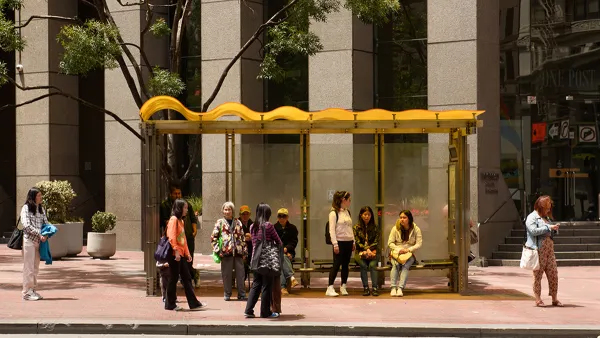
Evaluating Transportation Equity: ITE Quickbite
This short new publication by the Institute of Transportation Engineers provides an overview of key transportation equity concepts and describes practical ways to incorporate equity analysis into planning.
Equity Plus: Toward More Integrated Solutions
Many transportation equity strategies only address a small portion of the need. To be more effective, we need structural reforms that create more diverse and affordable transportation systems and more compact and multimodal communities.
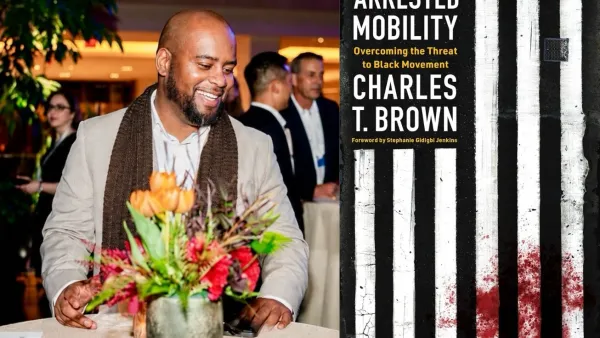
'Arrested mobility' and the fight for Black movement
Author Charles T. Brown explains how his experience growing up in rural Mississippi shaped his worldview and his current work for equitable transportation.

Planetizen Federal Action Tracker
A weekly monitor of how Trump’s orders and actions are impacting planners and planning in America.

California plans to bury El Niño’s downpour
If the state plays its cards right, it may be able to store a billion acre-feet of El Niño’s water in aquifers.

Chicago breaks ground on $3 billion megadevelopment
The new neighborhood, titled Foundry Park, will one day host 3,700 residences.

Satanic place names
From streams and lakes to valleys and canyons, I mapped more than 1,000 places named after the Devil.

California High-Speed Rail Authority CEO resigns after $600,000 scandal
Under Ian Choudri, the authority used taxpayer dollars to fund first class flights and trips to nightclubs.

Want to study the Missouri River? Soon, you may need unanimous approval from 10 states
Legislation would require 10 governors’ permission to study or build projects moving water outside the basin.

FREE Course: Walkable City 1: Why Walkability?
After describing his path towards focusing on walkability as the essence of good planning, Jeff Speck marches through his five principal reasons for making more walkable places.
Reinventing Malls: Planning Alchemy—Turning Gray Fields Into Gold
The course focuses on the opportunities and imperatives that shape reinvention of mall sites.

City of Rosemead
Rutgers University, Edward J. Bloustein School of Planning and Public Policy
One Hundred Miles
Hunter College, City University of New York (CUNY)
The Architects Foundation
University of Cincinnati Online
City of Cambridge
Montrose County
The Pocatello Development Authority