The former CEO of Uber, a highly controversial figure in urbanism circles, is still trying to influence the future of the built environment in a new post as CEO of a real estate investment startup.


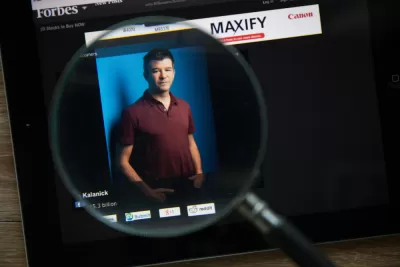
Travis Kalanick has landed on his feet after being ousted from Uber in June 2017—and his new gig is of obvious interest to planners and urbanists.
"The controversial Silicon Valley entrepreneur is joining a startup called City Storage Systems that focuses on repurposing distressed real estate assets like parking lots or abandoned strip malls and turning them into spaces suited for new industries, such as food delivery or online retail," report Johana Bhuiyan and Theodore Schleifer.
The company previously operated under the name CloudKitchens, but Kalanick's $150 million investment in the company will buy-out most of the company's previous outside investors, and place him in charge of the newly named startup as CEO.
The article includes more details about the ambitions of Kalanick in his new role.
Read the full story: Travis Kalanick is buying a new company that rehabs real estate and will run it as CEO
Travis Kalanick, Uber's Controversial Founder, Finally Leaves the Company
The announcement finally severs the ties between the ride-hailing company and its founder and former CEO.
The Uber Story
A new book traces the path of the influential mobility company from its earliest days and through its many organizational and leadership ups and downs.
Uber's Complicated Story
Since its founding a decade ago, Uber has reshaped the world through a trajectory of highs and lows.

Planetizen Federal Action Tracker
A weekly monitor of how Trump’s orders and actions are impacting planners and planning in America.

California plans to bury El Niño’s downpour
If the state plays its cards right, it may be able to store a billion acre-feet of El Niño’s water in aquifers.

Desperate measures: Advocates weigh draining Lake Powell to fill Colorado River
Draining the reservoir could reduce evaporation losses by a couple hundred thousand acre-feet.

US buildings threatened, destroyed by fires set to triple by 2060
Researchers found a high fire risk for socioeconomically vulnerable neighborhoods in the American West.

LA residents may be allowed to paint their own crosswalks
Councilwoman Katy Yaroslavsky put out a motion instructing the Los Angeles Department of Public Transportation to study the feasibility of allowing volunteers to paint crosswalks.

Dallas moves to overhaul its zoning code
The city's zoning reform will allow more multi-family and mixed-use developments.

FREE Course: Walkable City 1: Why Walkability?
After describing his path towards focusing on walkability as the essence of good planning, Jeff Speck marches through his five principal reasons for making more walkable places.
Reinventing Malls: Planning Alchemy—Turning Gray Fields Into Gold
The course focuses on the opportunities and imperatives that shape reinvention of mall sites.

City of Rosemead
Rutgers University, Edward J. Bloustein School of Planning and Public Policy
One Hundred Miles
Hunter College, City University of New York (CUNY)
The Architects Foundation
University of Cincinnati Online
City of Cambridge
Montrose County
The Pocatello Development Authority