Industry is "routinely violating" clean water laws, but both state and federal regulators seem to be looking the other way.


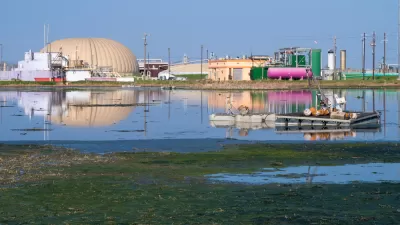
A new report has found that industrial facilities across the Texas are "routinely violating environmental laws by dumping excess chemicals and human waste into its rivers and bays, often without consequence," writes Naveema Sadasivem at the Texas Observer.
The study is an unsurprising condemnation of the Texas Commission for Environmental Quality—the state's primary regulatory agency—by the same organization that last year released a damning report on air pollution and enforcement. But it also exposes the potentially massive implications of a federal Environmental Protection Agency that has been significantly weakened since the start the Trump Administration.
"The report notes that there’s been a decrease in federal enforcement under the Trump administration, both in the number of cases the EPA is pursuing, as well as the fine amounts issued. In the first six months of the administration, the agency collected 60 percent less in fines compared with under Obama, Bush and Clinton."
Texas has never been known as the most environmentally responsible state, and TCEQ has never been known for enthusiastic enforcement of environmental regulation, but it has always had to answer to the EPA; the two agencies have fought each other in a number of battles.
Under the current president and his industry-oriented EPA administrator, there will be much less to fight about, or at least much less to fight with.
"The administration has proposed reducing the EPA’s budget for civil enforcement by $30.4 million for 2019. The federal budget that pays for grants assisting states in reducing water pollution has also been slashed by about 20 percent for 2018 and 2019. Those budgets cuts, combined with TCEQ’s history of turning a blind eye to repeat corporate polluters, will worsen water quality in the state."
In fact, as hundreds of employees flee the agency, the EPA has even hired a TCEQ official who once told the Texas Tribune, " "I haven't seen the data that says lowering ozone will produce a health benefit. In fact, I've seen data that shows it might have a negative health benefit."
(His nomination inspired a lengthy condemnation from the Union of Concerned Scientists.)
And the latest Texan to join the EPA is a former TCEQ official who is pretty much on the fence about climate change, and in response to questions about enforcement of environmental regulation told the Observer, “I want to find a way to [say] ‘yes’ in every possible situation where we’ve got the legal justification to do so."
Sadasivam spoke to Luke Metzger, executive director of Environment Texas, about this most recent report on water pollution. He told her, “Before, at least TCEQ had to report to EPA and there was that threat of removing delegation from the state hanging out there," and added, "[t]hat doesn’t seem to exist any more.”
FULL STORY: Dirtying the Waters: Texas Ranks First in Violating Water Pollution Rules

Comments Closed for Significant Changes to 'Waters of the United States' Rule
The Trump administration has spent the first two years of its time in office trying to overturn key provisions of the "Waters of the United States" rule.
EPA and Army Corps of Engineers Propose Revision of Wetlands Definition
Fulfilling a promise he made as a candidate, the Trump administration proposed a redefinition of what is classified as a wetland, with the result being the loss of federal protection of millions of acres of waterways and wetlands.
Allegheny River Town Debates Fracking Water Treatment Plant
Opponents cite environmental risks, supporters hope the facility will boost the economy of a struggling community.

The state-sanctioned urbicide of Austin
People don’t kill cities. Freeways do.

US to reduce Colorado River water deliveries to Mexico
A new Colorado Treaty amendment reduces Mexico’s Colorado River water allocation by 250,000 acre feet.

New Jersey’s second-largest city bans standalone data centers
Jersey City will continue to allow co-location facilities, such as those meant for research institutions that store their own data.

Amtrak not solely to blame for New Jersey commuter rail's unreliability, report finds
A new study from the Garden State Initiative found that NJ Transit’s budget grew 20% across a 4 year period, but reliability declined significantly over the same period.

EPA erases limits on planet-warming pollution from power plants
Under Monday’s plan, power plants would still have some limits on how much mercury, arsenic and other contaminants they can emit.

Phoenix announces new on-demand transit service, more frequent RAPID buses
Both new services will launch in October, and are part of Phoenix's Project Effective Access Solutions for Easing Congestion.

FREE Course: Walkable City 1: Why Walkability?
After describing his path towards focusing on walkability as the essence of good planning, Jeff Speck marches through his five principal reasons for making more walkable places.
Reinventing Malls: Planning Alchemy—Turning Gray Fields Into Gold
The course focuses on the opportunities and imperatives that shape reinvention of mall sites.

Eagle County Government
Harvard University Graduate School of Design
Nashville Planning Department
The Architects Foundation
University of Cincinnati Online
The Pocatello Development Authority
The Urban Renewal Agency of the City of Pocatello
Journal of the American Planning Association