The median home value in Marin County is well over a million dollars, thanks in part to the county and its residents keeping low income housing and development out.



Marin County residents have been successful in keeping a number of developments from getting built in their community. "'They say they want to maintain the roots and characteristics of our county,” said Omar Carrera, executive director of the nonprofit Canal Alliance. “But what they really are saying is that they want to maintain it as white and wealthy,'" Liam Dillon reports for the Los Angeles Times.
Recently, several projects were cancelled over complaints that the new housing would negatively impact residents’ quality of life, and destroy open spaces. "In recent years, Marin residents have blocked housing of all kinds. The 400-unit project that county supervisors rejected in December was the third in six years proposed by developers proposed for the site where a former Baptist seminary now sits abandoned," Dillon reports.
Read the full story: Marin County has long resisted growth in the name of environmentalism. But high housing costs and segregation persist
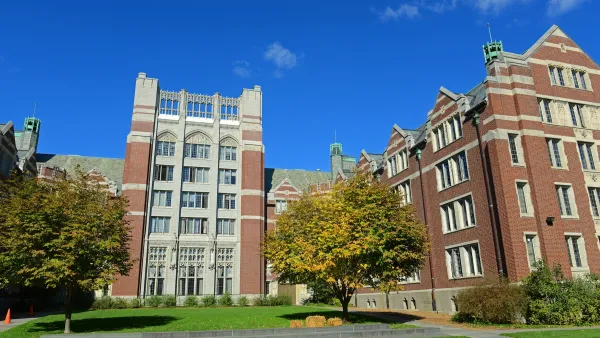
Wellesley sues state over proposed housing on state-owned parking lot
The college town opposes a 180-unit development that it says creates too much density for the area.

Louisville Launches ‘Anti-Displacement Tool’
After a years-long, tenant-led effort, Louisville will use a new tool to analyze whether a proposed housing development can meet a neighborhood’s housing needs and income levels. If it doesn’t, the city won’t subsidize it.

Strength in Diversity: Crafting an Affordable Housing Coalition in Cincinnati
The city’s longtime champions of housing for low-income residents joined forces with an array of allies to establish a sustainable source of funding for affordable housing.

Planetizen Federal Action Tracker
A weekly monitor of how Trump’s orders and actions are impacting planners and planning in America.

California plans to bury El Niño’s downpour
If the state plays its cards right, it may be able to store a billion acre-feet of El Niño’s water in aquifers.

Desperate measures: Advocates weigh draining Lake Powell to fill Colorado River
Draining the reservoir could reduce evaporation losses by a couple hundred thousand acre-feet.

US buildings threatened, destroyed by fires set to triple by 2060
Researchers found a high fire risk for socioeconomically vulnerable neighborhoods in the American West.

LA residents may be allowed to paint their own crosswalks
Councilwoman Katy Yaroslavsky put out a motion instructing the Los Angeles Department of Public Transportation to study the feasibility of allowing volunteers to paint crosswalks.

Dallas moves to overhaul its zoning code
The city's zoning reform will allow more multi-family and mixed-use developments.

FREE Course: Walkable City 1: Why Walkability?
After describing his path towards focusing on walkability as the essence of good planning, Jeff Speck marches through his five principal reasons for making more walkable places.
Reinventing Malls: Planning Alchemy—Turning Gray Fields Into Gold
The course focuses on the opportunities and imperatives that shape reinvention of mall sites.

City of Rosemead
Rutgers University, Edward J. Bloustein School of Planning and Public Policy
One Hundred Miles
Hunter College, City University of New York (CUNY)
The Architects Foundation
University of Cincinnati Online
City of Cambridge
Montrose County
The Pocatello Development Authority