Developer Freehold Communities is planning a suburban farming community in California's Sonora Desert.


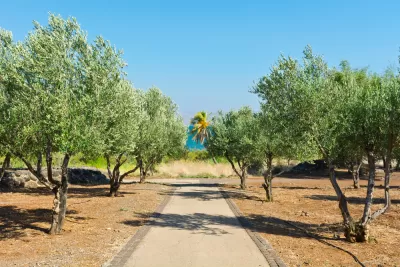
A Palm Springs golf course will soon give way to a sustainable community centered on 70 acres of olive groves and communal gardens. The 300-acre town of Miralon will be one of the largest of about 150 "farm-to-fork" neighborhoods throughout the U.S., reports Marilyn Kalfus in Mercury News. She speaks to Urban Land Institute senior fellow Ed McMahon and UCLA Anderson professor Paul Habibi for insight into the growing trend.
So-called "agrihoods" represent a "confluence of economic profits, environmental good and social benefit," Habibi says. Designed by international firm Robert Hidey Architects, the mostly single-family homes will follow the Palm Springs modernist tradition, with the addition of solar panels as standard features.
Like other agrihoods, Miralon will offer communal programming for adults and families; developers also hope the planned community's social and environmental mission will appeal to millennials.
Read the full story: Goodbye golf course, hello olive groves! New Palm Springs enclave to become an ‘agri-hood’

A Multimillion Dollar Virginia Company is Turning Empty Office Buildings Into Farms
Area 2 Farms envisions a world where 90% of the U.S. population lives within 10 miles of an indoor farm.
‘Agrihood:’ An Urban Farm With Affordable Housing
California’s largest urban farm also provides 165 units of affordable housing for seniors and veterans.
Agrihoods Still Proving Popular
Agrihoods emerged in the 1990s as a master-planned alternative to the golf-centered communities of the past. Many of these developments are going strong, and gaining in popularity.

Planetizen Federal Action Tracker
A weekly monitor of how Trump’s orders and actions are impacting planners and planning in America.

California plans to bury El Niño’s downpour
If the state plays its cards right, it may be able to store a billion acre-feet of El Niño’s water in aquifers.

Desperate measures: Advocates weigh draining Lake Powell to fill Colorado River
Draining the reservoir could reduce evaporation losses by a couple hundred thousand acre-feet.

Mamdani’s pied-à-terre tax survives legal challenge
A panel of judges found that the plaintiffs failed to demonstrate injury as a result of New York City's implementation of the tax.

Eastern Nebraska is running out of electricity
Data centers and electrification are straining eastern Nebraska’s grid, throttling economic development.

Seattle passes record-breaking transit services expansion
Proposition 1 will double the city’s transit tax to add 95,000 more bus trips and preserve 180,000 bus trips annually.

FREE Course: Walkable City 1: Why Walkability?
After describing his path towards focusing on walkability as the essence of good planning, Jeff Speck marches through his five principal reasons for making more walkable places.
Reinventing Malls: Planning Alchemy—Turning Gray Fields Into Gold
The course focuses on the opportunities and imperatives that shape reinvention of mall sites.

City of Rosemead
Rutgers University, Edward J. Bloustein School of Planning and Public Policy
One Hundred Miles
University of Michigan School for Environment and Sustainability (SEAS)
Hunter College, City University of New York (CUNY)
The Architects Foundation
City of Cambridge
Montrose County
The Pocatello Development Authority