The "Inside Out Project: We Are Edison" installation posted large portraits of residents in the Kalamazoo neighborhood of Edison on the side of a building. The exhibition invites the community to take a look at itself.


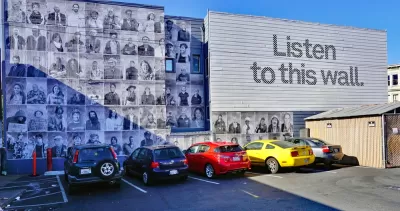
"If you ever wanted to know who lives in the Edison Neighborhood, you don't have to go any farther than the 1300 block of Portage Street," reports Al Jones.
"Portraits of more than 100 residents of Kalamazoo's largest neighborhood [were] displayed there over the next two weeks to showcase the diversity and interest of people in Edison," adds Jones.
The portraits were hung on the sides and windows of various buildings around the neighborhood, including 50 images on the former Kalamazoo Color Lab building. That building, vacant for more than two years, was recently donated to the Kalamazoo County Land Bank.
Although the exhibition wrapped up earlier in August, it's an idea that likely hasn't seen its last application. Inside Out is actively taking more portraits—updates on that work are available on Twitter.
Read the full story: Portraits of residents put a face on emerging Edison Neighborhood
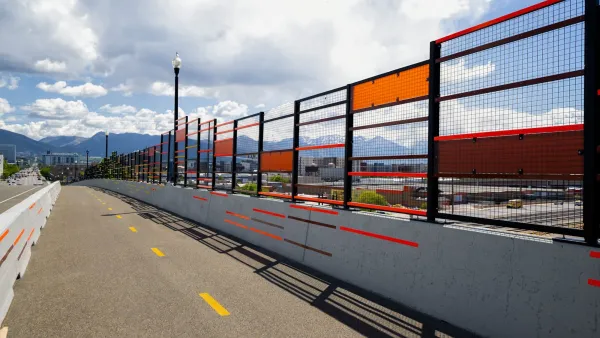
Salt Lake City opens protected bike path on viaduct trail
The 400 South Viaduct Trail features the state's longest continuous piece of public art.
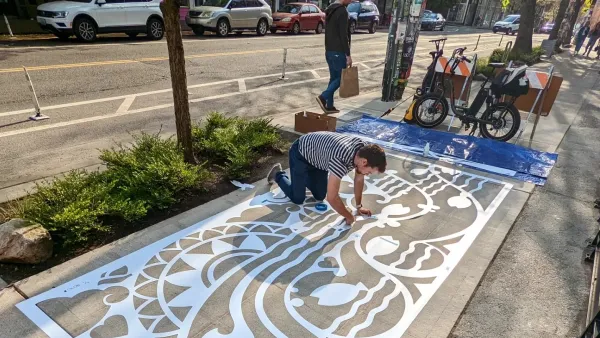
This Seattle sidewalk art only appears when it rains
Prompted to find a silver lining to the gloom of rainy Pacific Northwest days, an artist hit upon a novel solution: water-activated sidewalk paint.
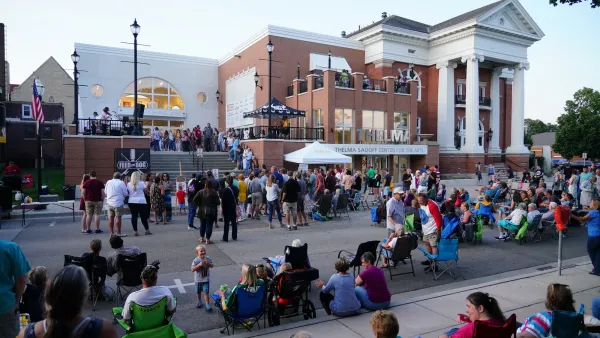
How Placemaking Lost its Way — And How it Can Get Back on Track
The term has often become diluted, getting attached to projects that don’t live up to its lofty aspirations.

Planetizen Federal Action Tracker
A weekly monitor of how Trump’s orders and actions are impacting planners and planning in America.

California plans to bury El Niño’s downpour
If the state plays its cards right, it may be able to store a billion acre-feet of El Niño’s water in aquifers.

Desperate measures: Advocates weigh draining Lake Powell to fill Colorado River
Draining the reservoir could reduce evaporation losses by a couple hundred thousand acre-feet.

Mamdani’s pied-à-terre tax survives legal challenge
A panel of judges found that the plaintiffs failed to demonstrate injury as a result of New York City's implementation of the tax.

Eastern Nebraska is running out of electricity
Data centers and electrification are straining eastern Nebraska’s grid, throttling economic development.

Seattle passes record-breaking transit services expansion
Proposition 1 will double the city’s transit tax to add 95,000 more bus trips and preserve 180,000 bus trips annually.

FREE Course: Walkable City 1: Why Walkability?
After describing his path towards focusing on walkability as the essence of good planning, Jeff Speck marches through his five principal reasons for making more walkable places.
Reinventing Malls: Planning Alchemy—Turning Gray Fields Into Gold
The course focuses on the opportunities and imperatives that shape reinvention of mall sites.

City of Rosemead
Rutgers University, Edward J. Bloustein School of Planning and Public Policy
One Hundred Miles
University of Michigan School for Environment and Sustainability (SEAS)
Hunter College, City University of New York (CUNY)
The Architects Foundation
City of Cambridge
Montrose County
The Pocatello Development Authority