Cities that are serious about transportation goals need to think seriously about supporting families who choose to live low car lifestyles.


Cities and counties across North America have adopted transportation goals to increase the number of people walking, biking and riding transit. Ultimately, these goals help improve public health, reduce air pollution from vehicle emissions and make streets safer for everybody. Places that support and encourage one car families will achieve long term success toward these metrics.
By definition, a one car family makes some of its trips on foot, bike or bus, thus helping achieve your transportation goals. One car families don’t magically appear; they require supportive physical environment and public policy.
For cities to thrive in the coming decades, they will need to accommodate families with young and adolescent children who take fewer trips in cars. Often, families fall into the two-car trap: the jobs, schools and services they depend on require two cars. In many places, it’s currently impractical for individuals to live a satisfying life completely car-free. For places with serious goals relating to walking and biking, a focus on supporting one car families will lead to long term progress.
Read the full article on American City & County.
FULL STORY: One car family: the next frontier in transportation

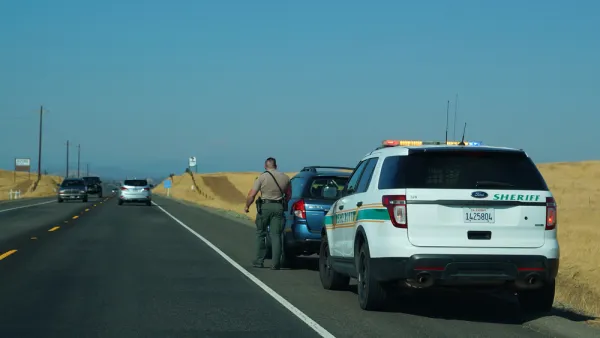
The Car-Centric World and the Ongoing Expansion of Police Powers
While cars are still equated with freedom of mobility and personal liberty, they've also offered courts the chance to expand police powers in the public realm, time and time again.

So Much for Peak VMT
Many observers and planners had hoped 2007 was the peak of vehicle miles travelled in the United States. After record-breaking increases in driving and auto sales, what are we to make of the present and future of driving in the United States?
Cities With Car-Free Potential
This post from Treehugger looks at 6 cities that could potentially go car-lite or car-free.

The state-sanctioned urbicide of Austin
People don’t kill cities. Freeways do.

US to reduce Colorado River water deliveries to Mexico
A new Colorado Treaty amendment reduces Mexico’s Colorado River water allocation by 250,000 acre feet.

New Jersey’s second-largest city bans standalone data centers
Jersey City will continue to allow co-location facilities, such as those meant for research institutions that store their own data.

Amtrak not solely to blame for New Jersey commuter rail's unreliability, report finds
A new study from the Garden State Initiative found that NJ Transit’s budget grew 20% across a 4 year period, but reliability declined significantly over the same period.

EPA erases limits on planet-warming pollution from power plants
Under Monday’s plan, power plants would still have some limits on how much mercury, arsenic and other contaminants they can emit.

Phoenix announces new on-demand transit service, more frequent RAPID buses
Both new services will launch in October, and are part of Phoenix's Project Effective Access Solutions for Easing Congestion.

FREE Course: Walkable City 1: Why Walkability?
After describing his path towards focusing on walkability as the essence of good planning, Jeff Speck marches through his five principal reasons for making more walkable places.
Reinventing Malls: Planning Alchemy—Turning Gray Fields Into Gold
The course focuses on the opportunities and imperatives that shape reinvention of mall sites.

Eagle County Government
Harvard University Graduate School of Design
Nashville Planning Department
The Architects Foundation
University of Cincinnati Online
The Pocatello Development Authority
The Urban Renewal Agency of the City of Pocatello
Journal of the American Planning Association