"A hungry world is not a just world," says one of the local residents quoted in this story about a community garden in Denver.



Graham Ambrose reports on the work of Clayton Early Learning, "an early childhood care and education center in northeast Denver’s Clayton neighborhood, [which] uses community gardens to get children excited about eating healthy food."
Clayton is a food desert, according to the U.S. Department of Agriculture, and low-income residents often struggle to find healthy food options. The entire of city of Denver struggles with childhood obesity, with nearly 1 in 3 children ages 2-14 overweight or obese [pdf], according to the Colorado Department of Public Health and Environment figures cited by Ambrose.
"Clayton Early Learning instructors use the community gardens to curb those realities by offering a sustainable source of healthy produce for children and their families," writes Ambrose. "Clayton administrators say that fewer than 13 percent of the program’s 2- to 5-year-olds are overweight."
FULL STORY: Community gardens build habits and feed families in Denver food desert

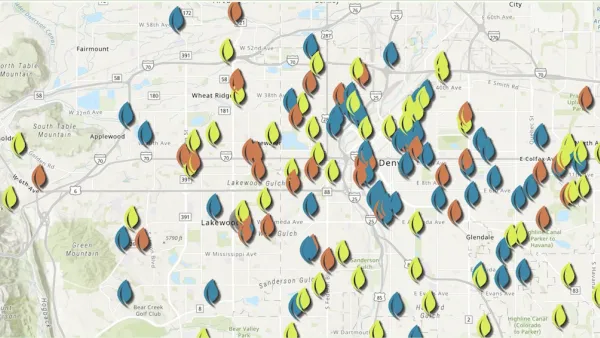
Denver, Colorado Bursts with Dozens of 'Food Forests'
Denver Urban Gardens is building green spaces that clean the air and offer free, fresh fruit to neighbors.

Do You Want Fries With That? Exploring the Intricacies of Food Systems Planning
Food systems expert Maggi Adamek talks with The Planning Commission Podcast about the complexities of food policy, from local zoning ordinances to international trade agreements.

A Microfarm Grows in an L.A. Front Yard
The founder of Asante Microfarm hopes his farm will serve as a model for bringing fresh produce to underserved communities.

Planetizen Federal Action Tracker
A weekly monitor of how Trump’s orders and actions are impacting planners and planning in America.

The state-sanctioned urbicide of Austin
People don’t kill cities. Freeways do.

US to reduce Colorado River water deliveries to Mexico
A new Colorado Treaty amendment reduces Mexico’s Colorado River water allocation by 250,000 acre feet.

5 New England states march closer to 800 megawatt wind energy project
Securing federal approval for the project may be complicated under the Trump administration, which has historically been hostile towards domestic wind power.

Baltimore to break ground on $50 million Transit Priority Project
The project will bring faster bus trips, safer streets and better bike connections to Baltimore.

Airbnb launches $250 million 'last-dollar financing' housing accelerator, makes first investment in Austin
The company will put $6.4 million towards affordable housing development in Texas’ capital.

FREE Course: Walkable City 1: Why Walkability?
After describing his path towards focusing on walkability as the essence of good planning, Jeff Speck marches through his five principal reasons for making more walkable places.
Reinventing Malls: Planning Alchemy—Turning Gray Fields Into Gold
The course focuses on the opportunities and imperatives that shape reinvention of mall sites.

Eagle County Government
Harvard University Graduate School of Design
Nashville Planning Department
The Architects Foundation
University of Cincinnati Online
The Pocatello Development Authority
The Urban Renewal Agency of the City of Pocatello
Journal of the American Planning Association