Kiribati’s former president Anote Tong faces climate change’s implications head on and see hope, even as islands become an early warning system for the international community.


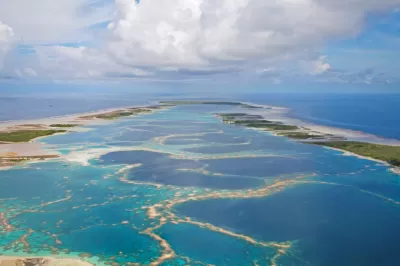
Susan Llewelyn Leach writes for Cities of the Future:
For the island nations of the South Pacific, climate change is a reality that is already causing people to migrate. The rise in sea level has made some low-lying islands uninhabitable, and in the case of Kiribati, over half the population is now crowded onto one main island, according to Anote Tong, the former president.
Indeed, an estimated 12 million people around the world have already been displaced by climate change. In the case of Kiribati’s population of approx. 116,000, the challenge is an existential one. Within a century the country will be underwater.
“Do we go or do we stay?” asks former president Tong, a tireless campaigner for the survival of his nation. But is staying even an option? He thinks so, but getting to that position has been a long road.
Read the full story: When the waters are rising…
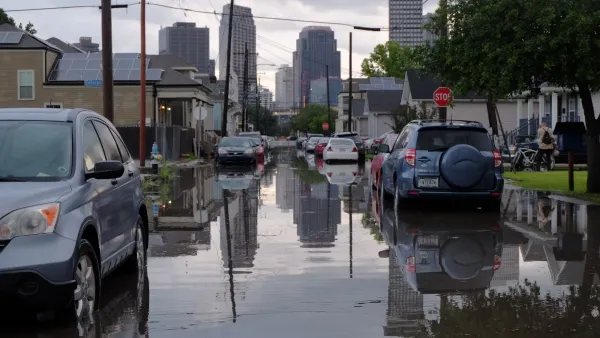
Study: New Orleans sea level rise is at 'point of no return'
Research shows that the city could be surrounded by water by the end of this century.
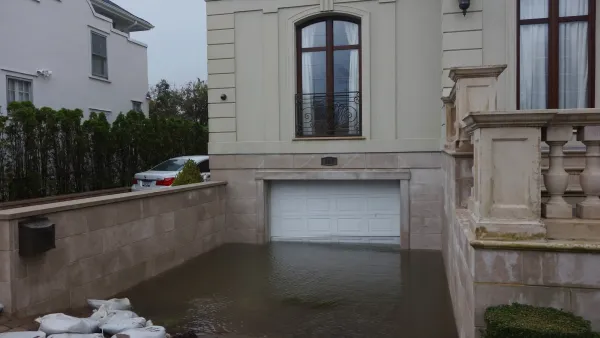
Over 500 NYC ‘Blue Zones’ at Risk of More Destructive Floods
High-risk flood zones cover roughly 20% of the city’s land.
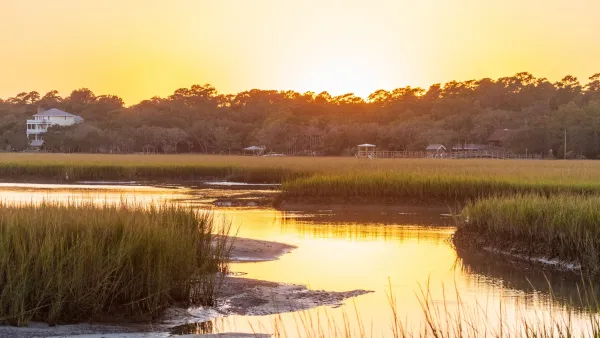
South Carolina Mapping Tool Tracks Marsh Migration From Sea Level Rise
The movement of South Carolina’s coastal salt marshes is an early harbinger of the path of future floods.

Planetizen Federal Action Tracker
A weekly monitor of how Trump’s orders and actions are impacting planners and planning in America.

California plans to bury El Niño’s downpour
If the state plays its cards right, it may be able to store a billion acre-feet of El Niño’s water in aquifers.

Desperate measures: Advocates weigh draining Lake Powell to fill Colorado River
Draining the reservoir could reduce evaporation losses by a couple hundred thousand acre-feet.

US buildings threatened, destroyed by fires set to triple by 2060
Researchers found a high fire risk for socioeconomically vulnerable neighborhoods in the American West.

LA residents may be allowed to paint their own crosswalks
Councilwoman Katy Yaroslavsky put out a motion instructing the Los Angeles Department of Public Transportation to study the feasibility of allowing volunteers to paint crosswalks.

Dallas moves to overhaul its zoning code
The city's zoning reform will allow more multi-family and mixed-use developments.

FREE Course: Walkable City 1: Why Walkability?
After describing his path towards focusing on walkability as the essence of good planning, Jeff Speck marches through his five principal reasons for making more walkable places.
Reinventing Malls: Planning Alchemy—Turning Gray Fields Into Gold
The course focuses on the opportunities and imperatives that shape reinvention of mall sites.

City of Rosemead
Rutgers University, Edward J. Bloustein School of Planning and Public Policy
One Hundred Miles
Hunter College, City University of New York (CUNY)
The Architects Foundation
University of Cincinnati Online
City of Cambridge
Montrose County
The Pocatello Development Authority