The Trinity River Project is coming into focus, after years of planning and decades of discussion. A $50 million donation in 2016 provided a big boost for Dallas' ambitious plans.


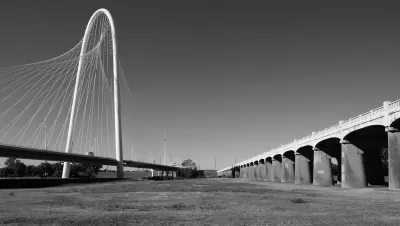
"Dallas, Texas, is getting a lot greener," according to an article by Leanna Garfield in explaining and describing plans for a 10,000-acre "nature district" along the Trinity River. That size would make the park 12 times as large as New York City's Central Park. "Featuring plenty of walkways, sports fields, trees, and other flora, the site will become one of the largest urban parks in America," writes Garfield.
The park's momentum gained a big boost last October, when Annette Simmons donated $50 million toward 285 acres of the ongoing project. (Naomi Martin reported on the big news at the time of the donation.) "Set to be complete by 2021 and costing $250 million, this portion will be called the Harold Simmons Park," according to Garfield.
The Harold Simmons Park still requires approval by the U.S. Army Corps of Engineers due to its position in a floodplain. A series of renderings accompanying the article discusses, among other features of the larger Trinity River Project, design considerations to address flooding. "The park will naturally flood in controlled areas, and the water will drain into bioswales," and "[t]he areas most at risk for flooding, which will include sports fields and paved trails, will be elevated and farthest from the river."
Read the full story: Dallas is getting a $600 million urban park that's more than 11 times as large as Central Park

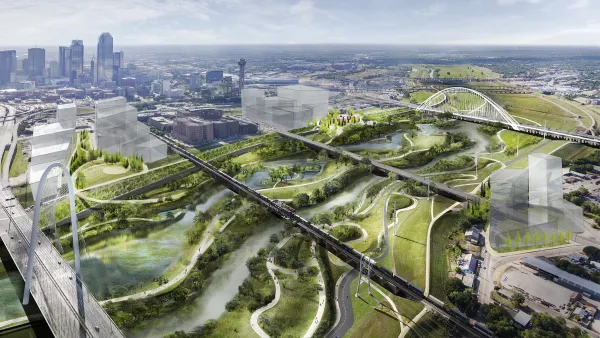
Checking in With the Trinity River Park Project in Dallas
With a plan to build a Trinity Toll Road a thing of the past, there are now two plans for parks along the Trinity River. One would "rewild" the watershed.
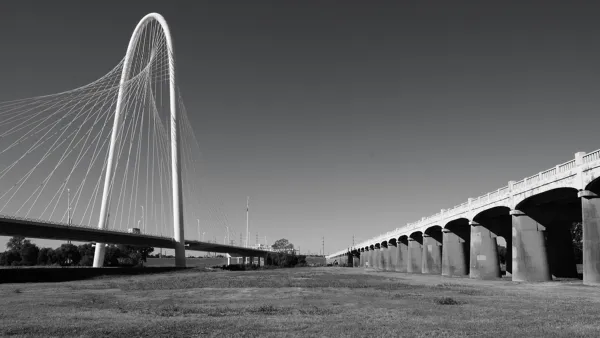
Is This the Trinity Park Plan of Dallas' Dreams?
Architecture critic Mark Lamster finally sees a proposal worth cheering for in Dallas' plans for a new park along the Trinity River.
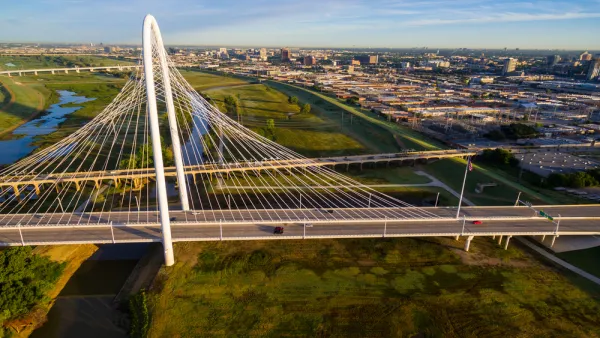
First Look at the Planned Trinity Park in Dallas
Dreams look a lot more like reality this week in Dallas.

Planetizen Federal Action Tracker
A weekly monitor of how Trump’s orders and actions are impacting planners and planning in America.

Amtrak, CN end decades-long dispute with eight-year agreement
The new operating agreement establishes an updated framework for the companies to work together, including processes to resolve disputes.

Judges permit Denver to divert 77,000 acre feet from the Colorado River for reservoir expansion
Overuse and climate change have caused the Colorado River’s water levels to plummet.

NYC DOT wants faster, more permanent street upgrades
The city is examining ways to build more concrete infrastructure without getting entangled in 'decades-long' projects.

'Something we’ve never seen before:' rising utility rates could strain city finances nationwide
Data centers, climate change and other factors have caused utility rates in the United States to increase by 38% since 2020.

Trump to overrule local leaders, lease millions of acres of America’s Pacific Island territories’ seafloors to mining companies
International law says that the Indigenous people of America’s territories have a right to prior and informed consent regarding projects that impact their countries.

FREE Course: Walkable City 1: Why Walkability?
After describing his path towards focusing on walkability as the essence of good planning, Jeff Speck marches through his five principal reasons for making more walkable places.
Reinventing Malls: Planning Alchemy—Turning Gray Fields Into Gold
The course focuses on the opportunities and imperatives that shape reinvention of mall sites.

Harvard University Graduate School of Design
KFH Group Inc.
Greater Baltimore Committee
The Architects Foundation
University of Cincinnati Online
The Pocatello Development Authority
The Urban Renewal Agency of the City of Pocatello