It's illegal for local governments to build broadband service in 20 states, and such legislation is spreading.


Internet service providers like Comcast and Verizon are often ranked among the least popular companies in the United States, but their interests have large effects on local politics. "More than 20 states have passed laws banning local governments from starting their own broadband service, largely at the behest of internet providers that want to avoid competition at all cost," Jacob Kastrenakes reports in The Verge.
Such prohibitions occur despite a lack of popularity of these laws among Americans. "In a phone survey of over 4,000 people last month, Pew found that 70 percent of respondents agreed that local governments should have the power to start their own high-speed networks if current offerings are 'too expensive or not good enough,'" Kastrenakes reports.
Meanwhile, internet service providers continue to gain power nationwide as new Federal Communications Commission regulations allow them to collect and sell their users’ browser data.
FULL STORY: Americans support letting cities build their own broadband networks, Pew finds

5G Broadband Coming in 2018, Says Verizon
The telecommunications company will debut the next-generation technology in three to five cities next year, including Sacramento.
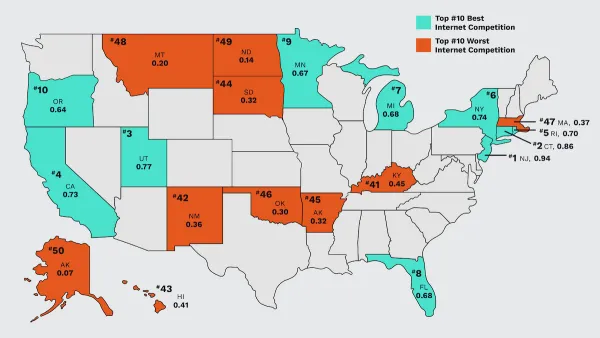
Do You Live in an ISP Monopoly?
Almost 9 million Americans live in an area with only one option for internet providers.

Tribal Communities Create Own Broadband Networks
Access to quality internet connectivity in many tribal and rural communities lags far behind other regions.

The state-sanctioned urbicide of Austin
People don’t kill cities. Freeways do.

US to reduce Colorado River water deliveries to Mexico
A new Colorado Treaty amendment reduces Mexico’s Colorado River water allocation by 250,000 acre feet.

New Jersey’s second-largest city bans standalone data centers
Jersey City will continue to allow co-location facilities, such as those meant for research institutions that store their own data.

Amtrak not solely to blame for New Jersey commuter rail's unreliability, report finds
A new study from the Garden State Initiative found that NJ Transit’s budget grew 20% across a 4 year period, but reliability declined significantly over the same period.

EPA erases limits on planet-warming pollution from power plants
Under Monday’s plan, power plants would still have some limits on how much mercury, arsenic and other contaminants they can emit.

Phoenix announces new on-demand transit service, more frequent RAPID buses
Both new services will launch in October, and are part of Phoenix's Project Effective Access Solutions for Easing Congestion.

FREE Course: Walkable City 1: Why Walkability?
After describing his path towards focusing on walkability as the essence of good planning, Jeff Speck marches through his five principal reasons for making more walkable places.
Reinventing Malls: Planning Alchemy—Turning Gray Fields Into Gold
The course focuses on the opportunities and imperatives that shape reinvention of mall sites.

Eagle County Government
Harvard University Graduate School of Design
Nashville Planning Department
The Architects Foundation
University of Cincinnati Online
The Pocatello Development Authority
The Urban Renewal Agency of the City of Pocatello
Journal of the American Planning Association