It's fun to write miracle comeback stories, but the epic of Detroit's resurgence has been exaggerated, according to an article in The Conversation.


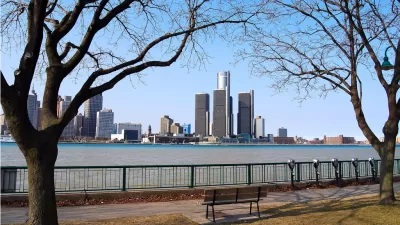
Since Detroit's 2013 bankruptcy, many around the Midwest and the country were eager to see how the city would respond. The resolution of the bankruptcy and the restoration of many downtown buildings has led some to trumpet a turnaround. That news may be premature, the city is still shrinking. Laura A. Reese and Gary Sands look into the state of today's Detroit, and their conclusions aren't rosy.
"First, by a number of measures Detroit continues to decline, and even when positive change has occurred, growth has been much less robust than many narratives would suggest. Second, within the city recovery has been highly uneven, resulting in increasing inequality," Laura A. Reese and Gary Sands write for The Conversation. Among other growing problems the authors point out, real estate values in the city remain flat, even as prices increase in cities all around the Midwest and Detroit's income and wealth inequality continue to grow.
FULL STORY: Detroit’s recovery: The glass is half-full at most

Optimism and Investment, Not 'Managed Decline," for the Rust Belt
Managed decline assumes that struggling cities will continue to struggle indefinitely. Is there a better way to plot neighborhood stabilization?
'Detroit Future City' Enters a New Stage
The Detroit Future City Implementation Office has completed a new strategic plan that will redirect the organizations revitalization efforts, four years after the city adopted the largely successful Detroit Future City framework.
Detroit and Michigan on the Upswing
It's been 66 years since the Motor City last grew its population. Census data released last month revealed an increase of nearly 2,000 people last year, nearly half the state's population growth.

The state-sanctioned urbicide of Austin
People don’t kill cities. Freeways do.

US to reduce Colorado River water deliveries to Mexico
A new Colorado Treaty amendment reduces Mexico’s Colorado River water allocation by 250,000 acre feet.

New Jersey’s second-largest city bans standalone data centers
Jersey City will continue to allow co-location facilities, such as those meant for research institutions that store their own data.

Amtrak not solely to blame for New Jersey commuter rail's unreliability, report finds
A new study from the Garden State Initiative found that NJ Transit’s budget grew 20% across a 4 year period, but reliability declined significantly over the same period.

EPA erases limits on planet-warming pollution from power plants
Under Monday’s plan, power plants would still have some limits on how much mercury, arsenic and other contaminants they can emit.

Phoenix announces new on-demand transit service, more frequent RAPID buses
Both new services will launch in October, and are part of Phoenix's Project Effective Access Solutions for Easing Congestion.

FREE Course: Walkable City 1: Why Walkability?
After describing his path towards focusing on walkability as the essence of good planning, Jeff Speck marches through his five principal reasons for making more walkable places.
Reinventing Malls: Planning Alchemy—Turning Gray Fields Into Gold
The course focuses on the opportunities and imperatives that shape reinvention of mall sites.

Eagle County Government
Harvard University Graduate School of Design
Nashville Planning Department
The Architects Foundation
University of Cincinnati Online
The Pocatello Development Authority
The Urban Renewal Agency of the City of Pocatello
Journal of the American Planning Association