2017 has all the makings of a classic showdown in Oregon, where the state legislature will consider to policies that deeply divide the interest interests of tenants and landlords.



Doug Brown reports that "the divide between tenant advocates and the landlord lobby is greater than ever" in Oregon as the state prepares to debate proposed policies on no-cause evictions and control in the coming year.
When the legislative session opens three weeks from now in Salem, it will be just the second time in more than three decades the state legislature will meet to discuss changes to landlord-tenant law that were not first proposed by the Landlord-Tenant Coalition.
In fact, so far two key bills have been proposed for considering by the Oregon State Legislature with relevance to rental housing: "Speaker Kotek proposed a bill on Monday that would repeal the statewide ban on local jurisdictions implementing rent control policies," and "Gov. Brown proposed a bill that would ban landlords from terminating month-to-month leases without due cause."
The political battles that have followed between organizations like the Oregon Rental Housing Association and the Community Alliance of Tenants have resulted in the end of the state's Landlord-Tenant Coalition. Landlord groups have also established the Equitable Housing Political Action Committee. "The PAC, formerly known as Multifamily NW PAC, raised nearly $300,000 last year (about $270,000 more than its previous high mark in 2014) during the breakup of the Landlord-Tenant Coalition," reports Brown.
A previous article by Shelby R. King sets the stage for the current debate over no-cause evictions from its origins in 2015.
Read the full story: Eviction Wars
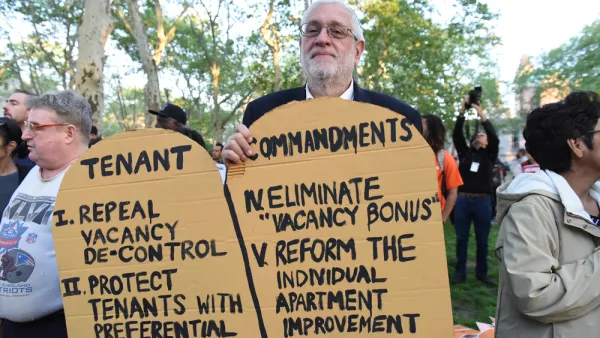
The New Tenants' Rights Movement
Tenants' rights advocacy groups around the country are gaining steam, and supporters, as more and more renters are experiencing the shocks of an over-priced housing market.

More Cities Supporting Legal Counsel as a Right for All Renters
Cities, headlined by New York, are finding new ways to support renters facing eviction.

NYC landlords sue Mamdani administration over rent freeze
The suit charges the administration with unfairly promoting the rent freeze and accuses the city's Rent Guidelines Board of yielding to pressure from the mayor.

Desperate measures: Advocates weigh draining Lake Powell to fill Colorado River
Draining the reservoir could reduce evaporation losses by a couple hundred thousand acre-feet.

Eastern Nebraska is running out of electricity
Data centers and electrification are straining eastern Nebraska’s grid, throttling economic development.

Move over, LA: St. Louis gears up for Olympics, invests millions in downtown redevelopment
The Missouri city will host the 2028 Olympic soccer group stage and knockout matches.

‘No clear next steps’ for Chicago's permanent festival grounds
Eleventh Ward Ald. Nicole Lee has suggested Soldier Field as a possible location for the permanent event space.

California, Hawaii, Rhode Island approve housing propositions
Hawaii and Rhode Island each approved their sole proposition, while California approved two of its three.

Officials claim feds 'rushed' Amtrak environmental review
Amtrak plans to move their Chicago maintenance facility from an industrial area to a residential one.

FREE Course: Walkable City 1: Why Walkability?
After describing his path towards focusing on walkability as the essence of good planning, Jeff Speck marches through his five principal reasons for making more walkable places.
Reinventing Malls: Planning Alchemy—Turning Gray Fields Into Gold
The course focuses on the opportunities and imperatives that shape reinvention of mall sites.

City of Rosemead
Rutgers University, Edward J. Bloustein School of Planning and Public Policy
One Hundred Miles
University of Michigan School for Environment and Sustainability (SEAS)
Hunter College, City University of New York (CUNY)
The Architects Foundation
City of Cambridge
Montrose County
The Pocatello Development Authority