Indianapolis' I-65/I-70 inner loop, now 40 years old, made a big impact on the city.


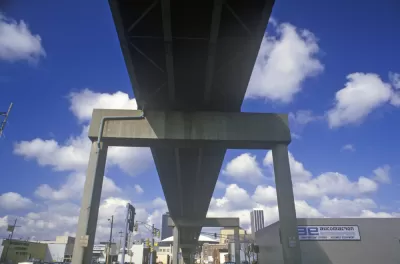
In a story for Indianapolis Monthly, Brian D. Smith reports that the I-65/I-70 inner loop is, for better or worse, one of the most important pieces of infrastructure Indianapolis ever built.
Many of the improvements and key features of the city would never have been built if the expressway hadn't been there. Smith writes, "Without this key piece of infrastructure, there might never have been a Lucas Oil Stadium."
There have, however, been problems associated with the loop. "Just three days after the ribbon-cutting, a Noblesville truck driver lost his life near the northeast interchange on a sharp bend where three other semis had already flipped." This stretch of road known locally as "Dead Man's Curve," was eventually the subject of a $500,000 renovation for safety. Other issues were the people moved and neighborhoods disrupted, "The project displaced a total of 17,000 residents, including 6,000 from Fountain Square (one-fourth of the population)."
Today the I-65/I-70 inner loop is a defining feature of Indianapolis, for better and worse.
Read the full story: Fruits of the Loop: An Unsung Milestone in Indy’s Downtown Development
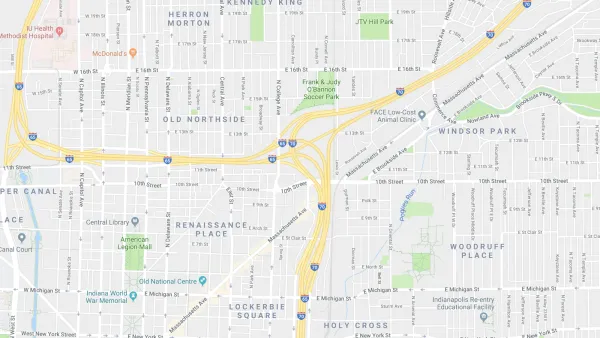
State Plan to Expand a Downtown Indianapolis Intersection Meets Local Resistance
Local urbanists are opposing a plan to greatly expand a freeway intersection in neighborhoods adjacent to Downtown Indianapolis.
Indianapolis rents grew by 30% since 2020
The metro area has a shortage of roughly 137,000 affordable homes for the lowest-income households.
Indianapolis could establish special zoning district for data centers
A city commission advanced a proposal that would establish guardrails for data centers within city limits.

Planetizen Federal Action Tracker
A weekly monitor of how Trump’s orders and actions are impacting planners and planning in America.

Eastern Nebraska is running out of electricity
Data centers and electrification are straining eastern Nebraska’s grid, throttling economic development.

Move over, LA: St. Louis gears up for Olympics, invests millions in downtown redevelopment
The Missouri city will host the 2028 Olympic soccer group stage and knockout matches.

Dallas releases zoning code overhaul to officials
The drafted overhaul is over 400 pages long.

NYC renovations for dangerous, ‘mercilessly crammed’ street delayed until 2027
Construction was supposed to begin this fall.

San Diego’s Midway Rising project gets greenlight from city council
The project looks to become the largest affordable housing development in California's history.

FREE Course: Walkable City 1: Why Walkability?
After describing his path towards focusing on walkability as the essence of good planning, Jeff Speck marches through his five principal reasons for making more walkable places.
Reinventing Malls: Planning Alchemy—Turning Gray Fields Into Gold
The course focuses on the opportunities and imperatives that shape reinvention of mall sites.

City of Rosemead
Rutgers University, Edward J. Bloustein School of Planning and Public Policy
One Hundred Miles
University of Michigan School for Environment and Sustainability (SEAS)
Hunter College, City University of New York (CUNY)
The Architects Foundation
City of Cambridge
The Pocatello Development Authority
The Urban Renewal Agency of the City of Pocatello