Most neighborhood parks go relatively unused by adult populations and women, giving young children, mostly boys, the run of the place.


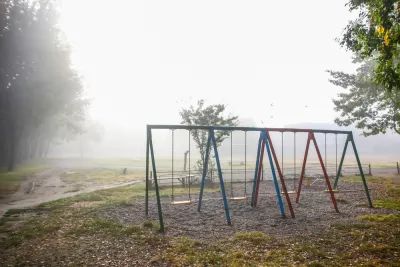
Nathan Collins reports on the findings of a new study that examines the use of parks around the United States. "The First National Study of Neighborhood Parks" finds that parks are mostly geared toward young children, which is a problem, "because parks are one of the easiest and least expensive places for an increasingly sedentary society to get exercise."
Collins details the methodology of the study, undertaken by RAND Corporation researcher Deborah Cohen and published in the American Journal of Preventative Medicine. The article includes a few of the demographic highlights from the study.
Read the full story: Who Uses the Nation’s Parks?

The Battle for Playgrounds
New York City parents are unhappy that fitness enthusiasts are turning to playgrounds for their workouts.
Playgrounds Could Provide Much-Needed Public Space
In communities lacking green space, public access to upgraded school playgrounds is a win-win solution.
A Comprehensive Plan for Every Neighborhood Park
Minneapolis wants more equity in its parks spending—and new plans are a key step in the process of delivering more equitable results.

Planetizen Federal Action Tracker
A weekly monitor of how Trump’s orders and actions are impacting planners and planning in America.

California plans to bury El Niño’s downpour
If the state plays its cards right, it may be able to store a billion acre-feet of El Niño’s water in aquifers.

Desperate measures: Advocates weigh draining Lake Powell to fill Colorado River
Draining the reservoir could reduce evaporation losses by a couple hundred thousand acre-feet.

California city breaks ground on transit connector
The project includes three mobility hubs and a pedestrian bridge.

After public outcry, Massachusetts city releases housing development tracker
Cambridge’s tracker currently shows 250 housing projects in various stages of development.

40 years after approval, Chicago breaks ground on new park
The park honors Jean Baptiste Point du Sable, the city’s first permanent non-native settler.

FREE Course: Walkable City 1: Why Walkability?
After describing his path towards focusing on walkability as the essence of good planning, Jeff Speck marches through his five principal reasons for making more walkable places.
Reinventing Malls: Planning Alchemy—Turning Gray Fields Into Gold
The course focuses on the opportunities and imperatives that shape reinvention of mall sites.

City of Rosemead
Rutgers University, Edward J. Bloustein School of Planning and Public Policy
One Hundred Miles
Hunter College, City University of New York (CUNY)
The Architects Foundation
University of Cincinnati Online
City of Cambridge
Montrose County
The Pocatello Development Authority