The National Association of City Transportation Officials (NACTO) is on a multi-modal roll, releasing two guides to non-automobile forms of transportation in recent weeks. The most recent offers guidance on why, where, and how to site bikeshare.


Jen Kinney reports on a new report released by the National Association of City Transportation Officials (NACTO), titled the "Bike Share Siting Guide" [pdf].
The bikeshare guide comes hot on the heels of another publication by NACTO—the Transit Street Design Guide. According to Kinney, NACTO's bikeshare guide, "draws on examples from across North America to offer models for locating stations in the safest, most accessible ways possible."
So, for instance, "NACTO research shows that bike-share stations placed within a 3- to 5-minute walking distance of each other throughout a contiguous service area are essential to a system’s success," writes Kinney.
The article includes a lot more insight into the findings and recommendations of the new guide, including five core principles for siting bikeshare stations.
Read the full story: The Why, Where and How of Adding Bike-Share Stations


NACTO Fights Autonomous Vehicle Safety Exemptions
Two major automakers have petitioned for the right to test thousands of vehicles without major safety features such as brake pedals and steering wheels.
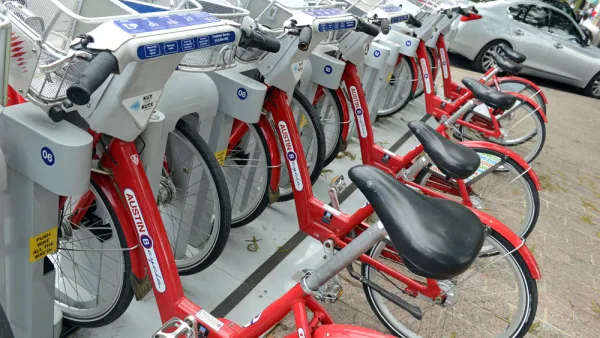
Transit, Bikeshare Integration Planned in Austin
Under a plan scheduled for implementation later this year, a transit pass will mean access to the city's bikeshare system.

Planning Ahead for an Autonomous Vehicle Future
A new guide says cities need to plan now for AVs so they are not caught off guard when the technology finally arrives.

Planetizen Federal Action Tracker
A weekly monitor of how Trump’s orders and actions are impacting planners and planning in America.

California plans to bury El Niño’s downpour
If the state plays its cards right, it may be able to store a billion acre-feet of El Niño’s water in aquifers.

Chicago breaks ground on $3 billion megadevelopment
The new neighborhood, titled Foundry Park, will one day host 3,700 residences.

Satanic Place Names
From streams and lakes to valleys and canyons, I mapped more than 1,000 places named after the Devil.

California High-Speed Rail Authority CEO resigns after $600,000 scandal
Under Ian Choudri, the authority used taxpayer dollars to fund first class flights and trips to nightclubs.

Want to study the Missouri River? Soon, you may need unanimous approval from 10 states
Legislation would require 10 governors’ permission to study or build projects moving water outside the basin.

FREE Course: Walkable City 1: Why Walkability?
After describing his path towards focusing on walkability as the essence of good planning, Jeff Speck marches through his five principal reasons for making more walkable places.
Reinventing Malls: Planning Alchemy—Turning Gray Fields Into Gold
The course focuses on the opportunities and imperatives that shape reinvention of mall sites.

City of Rosemead
Rutgers University, Edward J. Bloustein School of Planning and Public Policy
One Hundred Miles
Hunter College, City University of New York (CUNY)
The Architects Foundation
University of Cincinnati Online
City of Cambridge
Montrose County
The Pocatello Development Authority