Watching Wednesday's Democratic debate between Hillary Clinton and Sen. Bernie Sanders, I was startled to hear Clinton claim that Sanders said he would delay Obama's Clean Power Plan rule. PolitiFact investigated, though the result wasn't clear-cut.


The Clean Power Plan is President Barack Obama's signature climate initiative, so when I heard Clinton proclaim during Wednesday's (March 9) Washington Post-Univision Democratic debate in Miami, "The Clean Power Plan is something that Sen. Sanders has said he would delay implementing," I suspected there might be something she wasn't telling us. Fortunately, PolitiFact saved me from searching through the web for what it might be.
"We searched Google, LexisNexis and CQ for comments Sanders has made on the plan and found no evidence that Sanders has said he wants to delay the implementation," writes Linda Qiu of PolitiFact. "The Clinton campaign referred us to Sanders’ Feb. 21 interview with Grist, an environmental online magazine."
Now PolitiFact rates Clinton's charge as "false," but in reading the Grist piece, which is based not on Sander's position on climate change but what Sanders would do "to halt fracking not just on public land but on private land too," and two articles based on that interview appearing in The Hill and LegalPlanet, I understood Clinton's charge, though as I suspected, she omitted a major part of Sander's position on the Clean Power Plan.
In that interview with Grist's Ben Adler, Sanders indicated "six significant executive actions that a President Sanders would likely take to put the squeeze on fracking and natural gas," including:
- "Change the Clean Power Plan to incentivize renewables instead of (natural) gas.
- "Regulate methane, not just carbon, through the Clean Power Plan."
In response, Richard L. Revesz, dean emeritus and a professor at New York University School of Law, blogged in The Hill:
It is [...] troubling that Democratic presidential candidate Sen. Bernie Sanders (Vt.) has been reported as advocating changing the Clean Power Plan to also regulate methane emissions that result from fossil fuel extraction. The Clean Power Plan cannot be changed at the stroke of the pen. Just as the Republican presidential candidates could not accomplish their stated goal of repealing various regulations on their first day in office, neither can such regulations be strengthened instantaneously...
Similarly, Ann Carlson of the UCLA School of Law, writes in LegalPlanet:
Revising the Clean Power Plan would cause significant delay in its implementation simply because of the procedural requirements of notice and comment ..... [Emphasis added]
Clinton really just restated what Professor Carlson wrote last month, almost word-for-word, in fact, about how Sanders anti-fracking platform would jeopardize the country's most important climate initiative, though Sanders never said he would delay its implementation. Carlson added that Sander's "strategy also raises pretty starkly the dilemma raised by a strategy that elevates principle over pragmatism," perhaps validating one of Clinton's campaign themes.
Last word goes to Grist writer Ben Adler, whose Feb. 21 article is the source of the confusion, writes on March 11 that Clinton's charge "turns out to be a misleading interpretation of a very different Sanders proposal — one first reported by me."
Read the full story: Hillary Clinton wrongly says Bernie Sanders wants to delay the Clean Power Plan

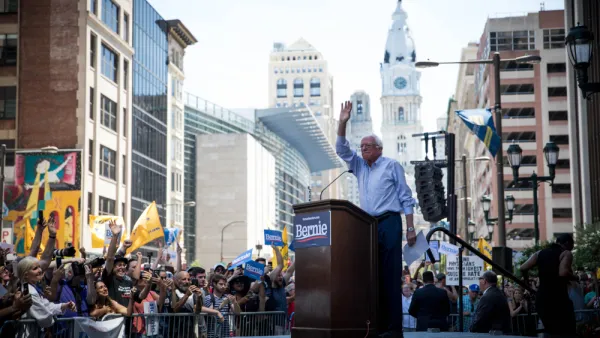
Scrutinizing the Reality of Bernie's Energy and Climate Plans
CNN host Fareed Zakaria questions whether the goals of Sanders' ambitious Green New Deal are realistic.
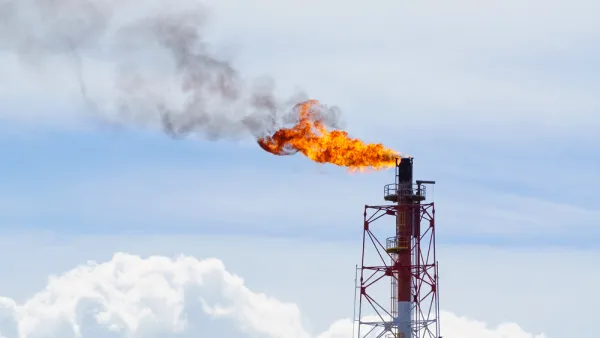
Big Oil Not Happy With Methane Regulation Rollback
The Trump administration's rollback on August 29 of an Obama-era regulation to reduce methane emissions in the production and distribution of oil and natural gas did not sit well with large oil and gas companies who see value in reducing emissions.
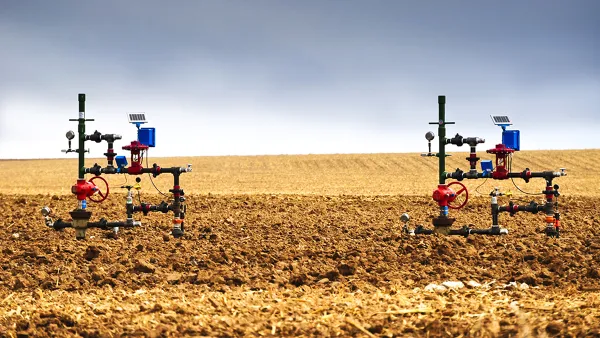
Another Environmental Regulation Rollback Finalized by Trump Administration
A one-year suspension of an Obama-era rule to reduce methane emissions from oil and gas drilling on Federal and Indian lands will increase global warming and reduce federal revenue. Trump took action after Congress failed to repeal the rule.

Planetizen Federal Action Tracker
A weekly monitor of how Trump’s orders and actions are impacting planners and planning in America.

Amtrak, CN end decades-long dispute with eight-year agreement
The new operating agreement establishes an updated framework for the companies to work together, including processes to resolve disputes.

Judges permit Denver to divert 77,000 acre feet from the Colorado River for reservoir expansion
Overuse and climate change have caused the Colorado River’s water levels to plummet.

NYC DOT wants faster, more permanent street upgrades
The city is examining ways to build more concrete infrastructure without getting entangled in 'decades-long' projects.

'Something we’ve never seen before:' rising utility rates could strain city finances nationwide
Data centers, climate change and other factors have caused utility rates in the United States to increase by 38% since 2020.

Trump to overrule local leaders, lease millions of acres of America’s Pacific Island territories’ seafloors to mining companies
International law says that the Indigenous people of America’s territories have a right to prior and informed consent regarding projects that impact their countries.

FREE Course: Walkable City 1: Why Walkability?
After describing his path towards focusing on walkability as the essence of good planning, Jeff Speck marches through his five principal reasons for making more walkable places.
Reinventing Malls: Planning Alchemy—Turning Gray Fields Into Gold
The course focuses on the opportunities and imperatives that shape reinvention of mall sites.

Harvard University Graduate School of Design
KFH Group Inc.
Greater Baltimore Committee
The Architects Foundation
University of Cincinnati Online
The Pocatello Development Authority
The Urban Renewal Agency of the City of Pocatello