Summarizes Justice Scalia's most important Takings Clause decisions.



Since Justice Antonin Scalia passed away a few days ago, the media has been full of articles on Justice Scalia's work; however, I have seen very little discussion of his land use legacy. It seems to me that two of his Takings Clause opinions are especially noteworthy.
In my first-year property class, I nearly always teach Scalia's majority opinion in the case of Lucas v. South Carolina Coastal Council. State government prohibited the Lucas plaintiff from developing his land. The plaintiff claimed that the state had taken the property in question, and thus was required to compensate him under the Takings Clause of the Fifth Amendment.
Even before Lucas, it was well settled that a government regulation could constitute a taking when it had gone "too far." However, pre-Lucas decisions had often been unclear about how far is "too far." Scalia sought to clarify this question by writing that a land use regulation is always a taking if it "denies all economically beneficial or productive use of land." He reasoned that such deprivation is "from the landowner’s point of view, the equivalent of a physical appropriation" because if a landowner cannot profit from land, there isn't much point in owning it. Moreover, most regulation is designed to assure an "average reciprocity of advantage to everyone concerned"—but no such reciprocity exists when government imposes such a huge loss upon the landowner.
I use Lucas to explain that the Takings Clause imposes at least one seemingly clear limit on government regulation: that government cannot make your land worthless and undevelopable. I then use other cases to show the limits of this principle. As a practical matter, government regulation rarely eliminates all "economically beneficial or productive use of land," even when it reduces a parcel’s resale value by 90 percent. So although the Lucas decision is conceptually interesting, it had more bark than bite. Takings cases involving partial deprivation of value are usually governed by a balancing test that weighs a variety of factors, rather than by a categorical rule.
A second major Scalia decision is Nollan v. California Coastal Commission. In Nollan, the plaintiffs sought to build a three-bedroom house on a California beach. State bureaucrats were willing to grant them a permit, but only if they allowed a public easement across their property to the beach.
Justice Scalia, writing for the Court, began by stating that if the state had ordered the plaintiffs to create an easement for the public, this easement would undoubtedly have been a taking of plaintiffs' land. On the other hand, if the state had denied a permit to the plaintiffs, this might not be a taking, because the government had the power to forbid construction to serve public goals (such as protecting the public’s view of the beach). So was the condition more like a (prohibited) easement or a (permitted) development limit?
Scalia split the difference, holding that a permit condition was valid if it was "reasonably related to the public need or burden that the [plaintiffs’] new house creates." He found that this was not the case in Nollan, because the public harm caused by the house, if any, was "obstacles to viewing the beach"—a problem that would not be solved by making it easier for people already on the beach to walk across the plaintiffs' property. By contrast, if the state had imposed a condition "that would have protected the public’s ability to see the beach notwithstanding construction of the new house—for example, a height limitation, a width restriction, or a ban on fences… imposition of the condition would also be constitutional."
At first glance, Nollan seems so fact-specific as to be unimportant. But in later cases, the Supreme Court expanded upon Nollan, holding that it required permit conditions to be roughly proportional to the impact of a proposed land use, and that this rule applies not just to conditions upon building permits, but to conditions used to justify denial of permits, and to conditions requiring applicants to spend money. In other words, if you want a rezoning, and the government says "we will grant your rezoning only if you do X," X has to related to, and be roughly proportional to, the externalities (e.g. traffic congestion) caused by your rezoning.

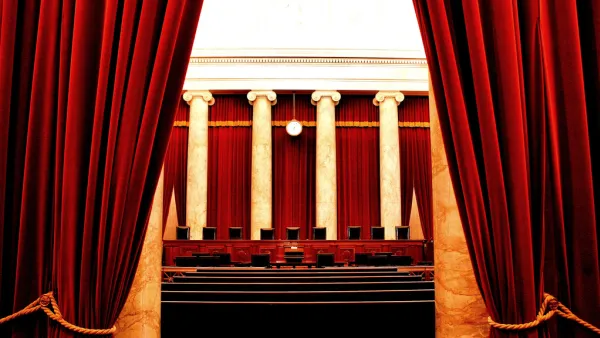
New Takings Case Argued Before the Supreme Court
William Fulton examines the likely outcome of a takings case that went before the U.S. Supreme Court last week. Oral arguments seemed to indicate the justices were leaning towards a surprising outcome.
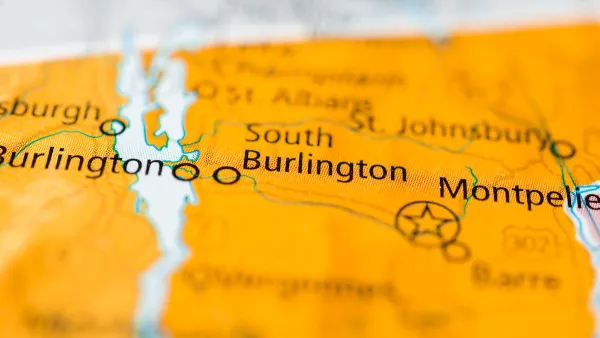
Vermont Land Use Case Could Go to Supreme Court
Property owners argue that a new law protecting wildlife corridors amounts to an unconstitutional taking of property.

U.S. Supreme Court: California's Impact Fees May Violate Takings Clause
A California property owner took El Dorado County to state court after paying a traffic impact fee he felt was exorbitant. He lost in trial court, appellate court, and the California Supreme Court denied review. Then the U.S. Supreme Court acted.

Planetizen Federal Action Tracker
A weekly monitor of how Trump’s orders and actions are impacting planners and planning in America.

‘Going backwards:’ Baltimore mayor, students rally against state's transit funding plan
Maryland's proposed six-year plan provides no funding for Baltimore’s BMORE bus program and reduces its road maintenance funding.

Detroit to transform waterfront with $2.2 billion investment
Developers will convert about 18 acres of unused parking lot space into civic spaces.

HUD, USDA agree on framework to simplify housing environmental review standards
Their agreement is a requirement of the 21st Century ROAD to Housing Act.

Cost of water rising at a faster pace than inflation, median household income
California and Maryland residents have seen their water bills grow especially high.

NYC building owners overwhelmingly comply with new emissions limits
The New York City Department of Buildings is fining owners who did not file emissions reports.

FREE Course: Walkable City 1: Why Walkability?
After describing his path towards focusing on walkability as the essence of good planning, Jeff Speck marches through his five principal reasons for making more walkable places.
Reinventing Malls: Planning Alchemy—Turning Gray Fields Into Gold
The course focuses on the opportunities and imperatives that shape reinvention of mall sites.

planning NEXT
City of Thousand Oaks
City of Wisconsin Rapids
The Architects Foundation
University of Cincinnati Online
Northern Illinois Transit Authority (NITA)
The Pocatello Development Authority
The Urban Renewal Agency of the City of Pocatello

