The comeback story for the city of Philadelphia's oldest neighborhood—Old City—displays the power of community organization and deliberate planning.



As recently as the late 1990s, Old City seemed destined for great things, "fueled by an enticing mix of high-end restaurants, cool boutiques and celeb-friendly lounges," according to James Jennings. But the nightlife turned into a nuisance and the neighborhood came to be known as the "Land of 1,000 Snookies"—an unkind reference to the former star of the Jersey Shore reality show.
Jennings, however, is more interested in documenting Old City's recent comeback story, which, according to his sources, began in 2014 when the Old City District (OCD) hired Job Itzkowitz as executive director. "Among other initiatives, Itzkowitz has used his first year on the job to promote continual engagement among OCD, its residents and visitors, and its businesses," writes Jennings. Other initiatives include an OCD security detail and another group known as the Old City Nuisance Task Force.
There is also a large planning effort underway. "The next big step for Old City is a 10-year master plan dubbed 'Vision 2026,' expected to be released by the end of the year. An OCD survey informing the plan drew nearly 500 respondents, most of whom focused on the neighborhood’s future —optimizing green space, dealing with population density, improving transit access, attracting diverse businesses, and enhancing bicycle and pedestrian experiences — rather than its sordid recent past," reports Jennings.
Read the full story: After the Hangover: How Old City Finally Sobered up and Crafted a Grown-up Vision for Itself
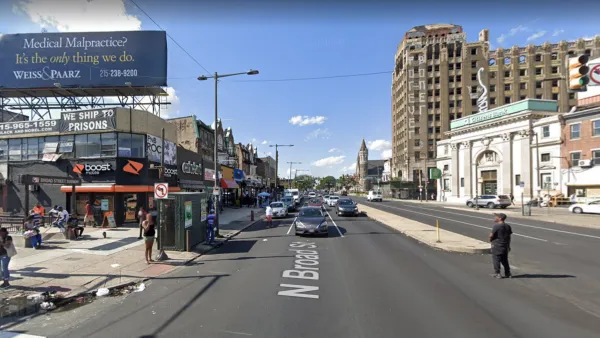
Dramatic Overhaul Planned for Key North Philadelphia Intersection
An architecture critic writes about plans for a key intersection in North Philadelphia: "By all means, straighten out the street and make it safe, but keep the twists and turns that make this an authentic Philadelphia place."
The Philadelphia Design District Makes its Debut
Long a hub of creative workers in Philadelphia, a collaboration of companies based in the Old City neighborhood in Philadelphia has rebranded as the Philadelphia Design District.
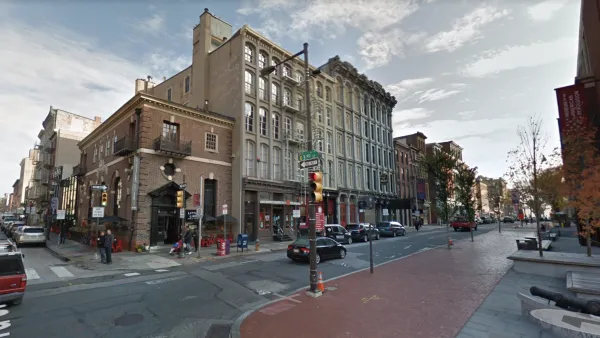
After Another Catastrophic Fire, Reexamining Fire Safety in Philadelphia
"Why does Old City keep burning?" That's the question posed by Philadelphia Inquirer architecture critic Inga Saffron.

Planetizen Federal Action Tracker
A weekly monitor of how Trump’s orders and actions are impacting planners and planning in America.

Eastern Nebraska is running out of electricity
Data centers and electrification are straining eastern Nebraska’s grid, throttling economic development.

Study reveals best places in the U.S. for cycling, walking
New research from Streetlight Data examines bicycle and pedestrian miles per capita in the 100 largest U.S. cities by population.

Why does it take an emergency for the U.S. to expedite infrastructure projects?
In June 2023, Philadelphia repaired a melted interstate in 12 days thanks to an emergency order.

Federal government nominates new FTA administrator
Mark Aesch is currently the founder and CEO of a transportation management consulting firm.

Developers reveal $10 billion stadium plan as ‘Hail Mary’ to keep Bears in Chicago
The plan would also boast a public park, high- and mid-rise buildings and a youth sports complex.

FREE Course: Walkable City 1: Why Walkability?
After describing his path towards focusing on walkability as the essence of good planning, Jeff Speck marches through his five principal reasons for making more walkable places.
Reinventing Malls: Planning Alchemy—Turning Gray Fields Into Gold
The course focuses on the opportunities and imperatives that shape reinvention of mall sites.

City of Charlotte
City of Rosemead
Rutgers University, Edward J. Bloustein School of Planning and Public Policy
University of Michigan School for Environment and Sustainability (SEAS)
Hunter College, City University of New York (CUNY)
The Architects Foundation
City of Cambridge
The Pocatello Development Authority
The Urban Renewal Agency of the City of Pocatello