The new record for skyscrapers built in a year brakes the record set by the previous year. The record is expected to be set again next year.


Dezeen shares news from the Council on Tall Buildings and Urban Habitat's (CTBUH) annual report on tall building construction. The news in skyscrapers is big: "A record-breaking total of 106 skyscrapers over 200 metres tall were completed in 2015, and even more are predicted for 2016," according to the report.
The previous record was 97 in 2014—and the recent building spree brings the worldwide total of skyscrapers to 1,040. The new total marks a "392 per cent increase from 2000, when the total was just 265."
The article shares a few of the key infographics from the report, and provides another fact from the report to provide context for what's described as a skyscraper surge: "As in previous years, Asia continues to dominate the list, particularly China. Excluding the Middle East, 81 of the year's 106 skyscrapers were located in Asia, 76 per cent of the total."
Read the full story: Record number of skyscrapers completed in 2015

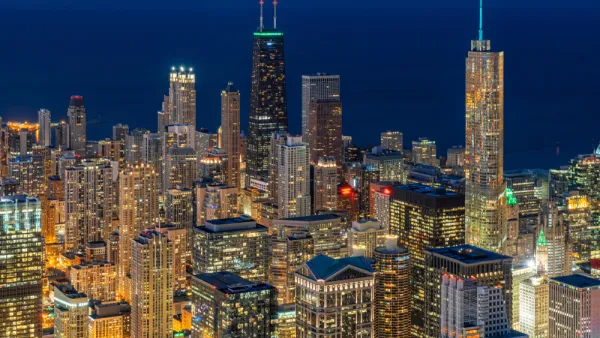
The 50 Most Influential Tall Buildings of the Last 50 Years
Sure to stir controversy, the Council on Tall Buildings and Urban Habitat has compiled a list of the 50 most influential tall buildings of the last 50 years.
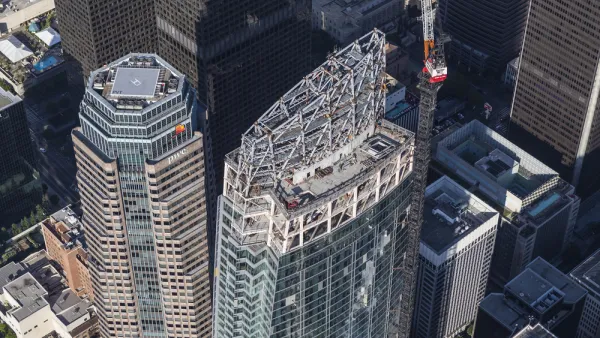
Tall Building Construction Continues to Smash Records and Redefine Skylines
There are 402 percent more tall buildings in the world than there was in 2000.
Report: 2014 the 'Tallest Year Ever' for New Skyscrapers
The heights of the building envelope saw unprecedented expansion in 2014.

Planetizen Federal Action Tracker
A weekly monitor of how Trump’s orders and actions are impacting planners and planning in America.

Amtrak, CN end decades-long dispute with eight-year agreement
The new operating agreement establishes an updated framework for the companies to work together, including processes to resolve disputes.

Judges permit Denver to divert 77,000 acre feet from the Colorado River for reservoir expansion
Overuse and climate change have caused the Colorado River’s water levels to plummet.

Boston has spent millions making the Green Line more accessible — and there’s no end in sight
While the city has invested millions into expanding and adding platforms to the Green Line to make it more accessible, new train cars set to arrive next year will be too tall for disabled passengers to board without raising the current platforms.

Idaho may see an 18% drop in federal surface transit funding — the largest estimated cut in the US
Transit systems in rural communities are much more reliant on federal funding to provide their services.

How ‘post-disaster gentrification’ alters neighborhoods after natural calamities
After hurricanes, fires or other calamities, the original residents of a community are often replaced by younger, wealthier residents.

FREE Course: Walkable City 1: Why Walkability?
After describing his path towards focusing on walkability as the essence of good planning, Jeff Speck marches through his five principal reasons for making more walkable places.
Reinventing Malls: Planning Alchemy—Turning Gray Fields Into Gold
The course focuses on the opportunities and imperatives that shape reinvention of mall sites.

City of Wisconsin Rapids
Harvard University Graduate School of Design
KFH Group Inc.
The Architects Foundation
University of Cincinnati Online
The Pocatello Development Authority
The Urban Renewal Agency of the City of Pocatello