The Conference of Parties (COP21) held during the last two weeks in Paris establishes ambitious climate change emission reduction targets. This will be a challenge and opportunity for planners. Here are some highlights.



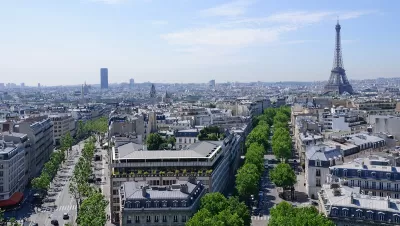
We live in amazing times! The Paris COP21 Conference achieved important and challenging goals: through it almost all the countries in the world developed strategies (called Intended Nationally Determined Contributions, or INDCs) that outline their commitments on climate change mitigation and adaptation. Many of these have significant implications for transportation and land use planning.
A good source of information on these implications is the Sustainable Low Carbon Transortation (SLoCaT) Partnership, an international coalition of major organizations (including development banks, government agencies and advocacy organizations), which took a leadership role in providing information resources, and organizing the "We Are Transport" and the 80 Days campaigns which shared this information through various networks. This helped convince many experts and decision-makers that transport and land use policy reforms can help achieve emission reduction targets.
- "Creating jobs and sustaining growth as well as eradicating poverty in a carbon-constrained world demand a restructuring of energy and transport systems." (Seretse Khama Ian Khama, President of Botswana)
- "The best economic and scientific data will serve as a basis for strategic options, which will include carbon pricing, support for energy efficiency initiatives, clean electricity and transport technology, and sustainable building and infrastructure." (Justin P. J. Trudeau, Prime Minister of Canada)
- "China will, on the basis of technological and institutional innovation, adopt new policy measures to improve the industrial mix, build low-carbon energy systems, develop green building and low-carbon transportation, and build a nation-wide carbon emission trading market so as to foster a new pattern of modernization featuring harmony between man and nature." (Xi Jinping President of the People’s Republic of China)
- "My government has announced projects aimed at speeding up the decarbonizing of transport, fisheries and agriculture – in cooperation with the industries concerned, which we think is crucial for success." (Sigmundur Davíd Gunnlaugsson, Prime Minister of Iceland)
- "My office has launched an initiative, to reduce global dependence on crude oil, especially in transportation." (Benjamin Netanyahu, Prime Minister of Israel)
- "To illustrate, there are technologies to produce, store and transport hydrogen towards realizing CO2-free societies, and a next-generation battery to enable an electric car to run five times longer than the current level." (Shinzo Abe, Prime Minister of Japan)
- "We have taken the first steps in switching Jordan’s public sector fleet to eco-friendly electrical vehicles." (Abdullah II Ibn Al Hussein, The King of Jordan)
- "Some of the sector-wide voluntary domestic measures and actions to address climate change include low carbon and efficient transportation systems." (Uhuru Kenyatta, President of Kenya)
- "Korea's best known island, Jeju will transition into a carbon free island by replacing its entire fleet of cars with electric vehicles and meeting 100% of its energy needs through renewable energy sources." (Park Geun-hye, President, Republic of Korea)
- "In the next few years, Panama will culminate the building and integrate the urban transport system, which will have three metro lines, a bus network to provide public transport system which is modern, efficient and environmental friendly." (Juan Carlos Varela, President of Panama)
- "In Paraguay we are renewing our public transport fleet, investing new technologies that are multi-modal and efficient for reducing the use of fossil fuels." (Horacio Manuel Cartes, President of Paraguay)
- "Several mitigation initiatives including promotion of affordable renewable technologies, measures towards energy efficiency, implementation of a mass transport system, and expansion of hydroelectrical potential are already part of our development strategies." (Muhammad Nawaz Sharif, Prime Minister of Pakistan)
- "We are working on all fronts to achieve this target by using less fossil fuels and more renewable energy, such as promoting the use of hybrid and electric cars, switching from road to rail transport." (Prayut Chan-O-Cha, Prime Minister of Thailand)
This is a huge achievement. Well done diplomats! But now that their job is done, our work begins. It is also a huge challenge and a huge opportunity. As discussed in my recent column, "We Are Transport! We Have Solutions!" many climate change emission reduction strategies can help achieve other planning goals, ranging from traffic and parking congestion reductions, to improving affordability. Now that many local, state/provincial, and federal jurisdictions are establishing emission reduction objectives, we have another opportunity to build support for these win-win emission reduction strategies.
Critics often assume that emission reductions are economically harmful and unfair to disadvantaged people, but many transport and land use policy reforms actually increase efficiency and improve affordable mobility and housing options, and so help achieve economic and social as well as environmental goals. The New Climate Economy's Better Growth, Better Climate and my study, Analysis of Public Policies That Unintentionally Encourage and Subsidize Urban Sprawl, describe specific policies that help achieve these multiple goals. Many of these can be implemented at the local or regional level.
During the COP21 closing session, the South Africa representative noted that we must turn "the finish line that is Paris into a new starting line for the ongoing process that leads to Marrakech and beyond." She then quoted her country's great leader:
"I have walked that long road to freedom… I have not faltered, [though] I have made many missteps along the way. I have taken a moment here to rest, to steal a view of the glorious vista that surrounds me…but I can only rest for a moment, for with freedom comes responsibilities and I dare not linger, because my long walk is not ended." (Nelson Mandela)
This is, overall, a good news story for planners and the people we serve. We can create truly sustainable communities that balance economic, social and environmental goals. Our challenge is to communicate to sometimes skeptical stakeholders that they can benefit overall from innovative solutions. Who will identify and implement these solutions? We will, planners!

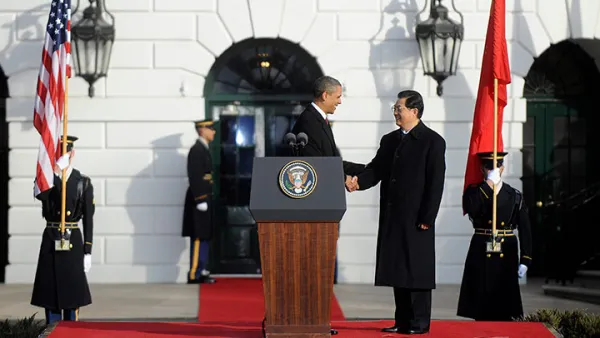
Climate Change Targets? No Problem! We Have Win-Win Solutions
Ambitious new emission reduction targets can be met with strategies that also help achieve other economic, social, and environmental objectives.
Yes, We Can Have a Healthy Environment and Economic Development: Reconciling Conflicting Planning Objectives
I am sorry to report that, Canada, my chosen country (I immigrated here in 1993), recently withdrew from the Kyoto Accord, which sets international climate change emission reduction targets. It’s worth noting that this decision was made...

Oregon to End Sales of Gas-Powered Vehicles by 2035
There must be something about having a coast on the Pacific Ocean that makes states set policies to accelerate the end of the internal combustion engine.

The state-sanctioned urbicide of Austin
People don’t kill cities. Freeways do.

US to reduce Colorado River water deliveries to Mexico
A new Colorado Treaty amendment reduces Mexico’s Colorado River water allocation by 250,000 acre feet.

New Jersey’s second-largest city bans standalone data centers
Jersey City will continue to allow co-location facilities, such as those meant for research institutions that store their own data.

Amtrak not solely to blame for New Jersey commuter rail's unreliability, report finds
A new study from the Garden State Initiative found that NJ Transit’s budget grew 20% across a 4 year period, but reliability declined significantly over the same period.

EPA erases limits on planet-warming pollution from power plants
Under Monday’s plan, power plants would still have some limits on how much mercury, arsenic and other contaminants they can emit.

Phoenix announces new on-demand transit service, more frequent RAPID buses
Both new services will launch in October, and are part of Phoenix's Project Effective Access Solutions for Easing Congestion.

FREE Course: Walkable City 1: Why Walkability?
After describing his path towards focusing on walkability as the essence of good planning, Jeff Speck marches through his five principal reasons for making more walkable places.
Reinventing Malls: Planning Alchemy—Turning Gray Fields Into Gold
The course focuses on the opportunities and imperatives that shape reinvention of mall sites.

Eagle County Government
Harvard University Graduate School of Design
Nashville Planning Department
The Architects Foundation
University of Cincinnati Online
The Pocatello Development Authority
The Urban Renewal Agency of the City of Pocatello
Journal of the American Planning Association

