The Ferguson Commission report includes recommendations for combating racial inequity in the Saint Louis region with better-funded, more expansive transit access.


The introduction to the recently released Ferguson Commission report describes it as the "People's Report," an unflinching study of underlying issues that created the climate in which the police killing of Michael Brown and subsequent riots occurred.
"Some of the things we look at may at first seem unrelated to the events in Ferguson. However, our work and the community feedback has shown that these factors have either a direct or indirect connection to the environment in the St. Louis region, and therefore must be considered when discussing any potential changes that might lead to progress."
Among the findings that point to the connections between transportation and racial inequity, the report states that "23.5 percent of Black households do not have access to a car in St. Louis, as compared to 5.2 percent of White households."
The 189 policy recommendations cover a wide range of issues. Among these are two specific calls to action related to enhanced access to transportation. One is to "identify priority transportation projects in the Saint Louis region"; the other is to “develop a state-support funding plan for public transit.”
The St. Louis-based organization Citizens for Modern Transit writes that its recently released Transit Funding study was in the Commission's report, specifically, "when it calls for stakeholders to work together to determine which transit project(s) the region will prioritize. The report notes that such prioritization is necessary in order for the region to focus resources to successfully expand transit, and to get regional 'buy-in' by elevating the importance of key projects for the region and making tangible the need and potential benefits of transit."
Read the full story: Transit included among Ferguson Commission Report’s “Signature Priorities"

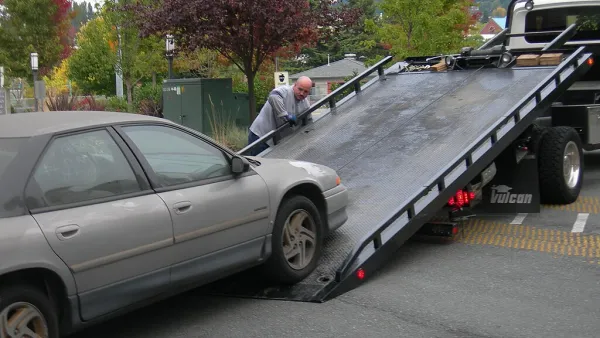
Milwaukee can now Impound Cars of Reckless Drivers
The city compares reckless drivers to firearms — “Let’s get as many of them off the street as possible.”
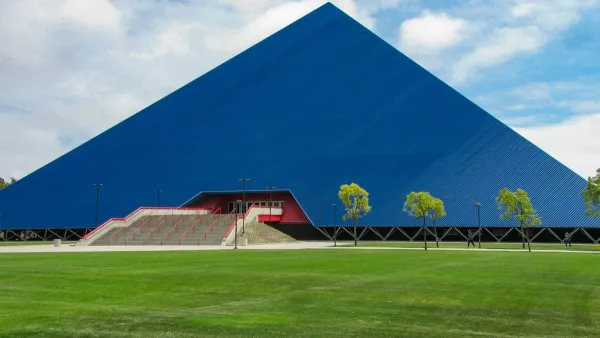
California State University System Leads Nation in Economic Mobility for Students
A new study ranks California State University campuses among the top institutions in California for economic mobility, demonstrating their success in providing affordable education that significantly boosts students’ long-term earnings.
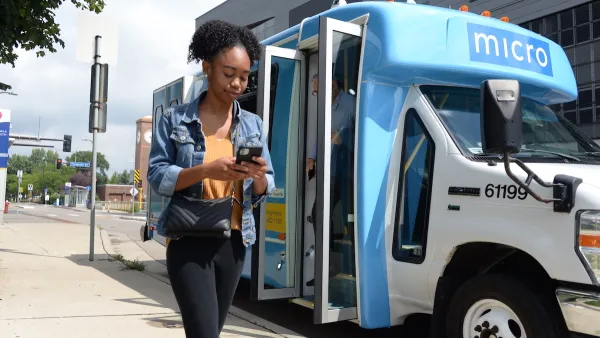
Public Transit Alternatives to Rideshare Offer Affordable and Accessible Mobility
In Minnesota, local transit agencies are seeing growth in ridership for on-demand microtransit services since the start of the pandemic.

Planetizen Federal Action Tracker
A weekly monitor of how Trump’s orders and actions are impacting planners and planning in America.

California plans to bury El Niño’s downpour
If the state plays its cards right, it may be able to store a billion acre-feet of El Niño’s water in aquifers.

Chicago breaks ground on $3 billion megadevelopment
The new neighborhood, titled Foundry Park, will one day host 3,700 residences.

This road in NYC is infamously dangerous — and Mamdani can't fix it
New York City's Ocean Parkway is known for reckless driving, but the power to implement safety measures lies with the state rather than the city.

One of Denver’s busiest corridors to gain BRT
The project will span 18 miles and contain 74 bus rapid transit stations.

275,000 bus trips are at stake on Seattle's ballot
If passed, the Seattle Transit Measure would trigger a 0.3% sales tax and raise an average of $138 million per year to maintain and expand Seattle’s bus services.

FREE Course: Walkable City 1: Why Walkability?
After describing his path towards focusing on walkability as the essence of good planning, Jeff Speck marches through his five principal reasons for making more walkable places.
Reinventing Malls: Planning Alchemy—Turning Gray Fields Into Gold
The course focuses on the opportunities and imperatives that shape reinvention of mall sites.

City of Rosemead
Rutgers University, Edward J. Bloustein School of Planning and Public Policy
One Hundred Miles
Hunter College, City University of New York (CUNY)
The Architects Foundation
University of Cincinnati Online
City of Cambridge
Montrose County
The Pocatello Development Authority