The 1848 High Bridge spanning Harlem River emerged in June from a multi-year, $61.8 million renovation—it's reviewed by Architect and former Empire State Development Corp VP Carol Berens.


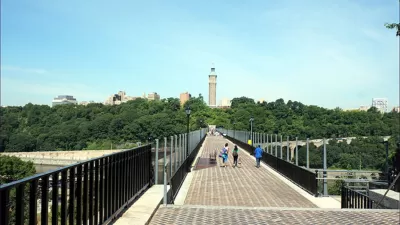
"The oldest river crossing in New York City is now the newest. The 1848 High Bridge that spans the Harlem River and links upper Manhattan to The Bronx has recently emerged from a multi-year, $61.8 million renovation. It re-opened to the public on June 9th," reports architect and former Empire State Development Corp VP Carol Berens after paying the High Bridge a visit. She goes on to observe that at present, High Bridge is operating more as a neighborhood amenity than as a regional attraction. She writes:
...the High Bridge was part of the Croton Aqueduct system that brought fresh water from Westchester County, north of the city to Manhattan. A pedestrian walkway was added above the water pipes not quite 20 years after the bridge’s opening, creating in some people’s eyes the City’s first 'High Line.' At the time, it was a generator of social and economic activity, a focus that attracted people as well as artists and photographers. Hotels and restaurants sprouted up around it.
High Bridge later fell into disrepair and disuse as roadway projects, public housing projects, and pollution isolated it. While it's too early to tell if High Bridge will be a catalyst for revitalization like the High Line, the efforts of local volunteers and Bette Midler's New York Restoration Project in restoring the neighboring High Bridge Park, as well as talk of opening the adjoining historic water tower to the public, offer hope.
Read the full story: The High Line? No, The High Bridge!
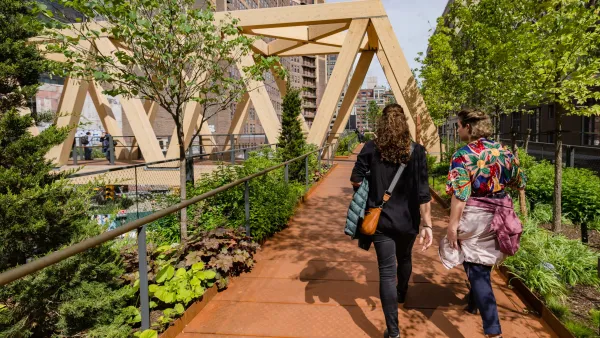
High Line-Moynihan Connector Opens in New York City
Two footbridges now link the High Line park to the most recent expansion of the Penn Station complex, the Moynihan Train Hall.
Massive, Expensive Redevelopment of Midtown Manhattan Proposed
New York Governor Cuomo's State of the State speeches last week included an ambitious proposal for a large-scale redevelopment project on Manhattan's west side, adjacent to Penn Station.
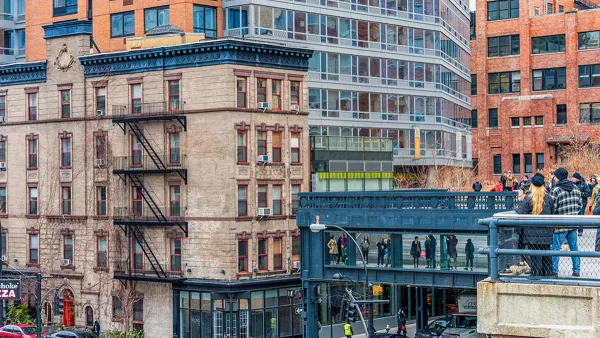
Proposal Would Connect the High Line to the New Moynihan Train Hall
The High Line has a chance to add the role of civic connector to its list of plaudits.

Planetizen Federal Action Tracker
A weekly monitor of how Trump’s orders and actions are impacting planners and planning in America.

California plans to bury El Niño’s downpour
If the state plays its cards right, it may be able to store a billion acre-feet of El Niño’s water in aquifers.

Desperate measures: Advocates weigh draining Lake Powell to fill Colorado River
Draining the reservoir could reduce evaporation losses by a couple hundred thousand acre-feet.

US buildings threatened, destroyed by fires set to triple by 2060
Researchers found a high fire risk for socioeconomically vulnerable neighborhoods in the American West.

LA residents may be allowed to paint their own crosswalks
Councilwoman Katy Yaroslavsky put out a motion instructing the Los Angeles Department of Public Transportation to study the feasibility of allowing volunteers to paint crosswalks.

Dallas moves to overhaul its zoning code
The city's zoning reform will allow more multi-family and mixed-use developments.

FREE Course: Walkable City 1: Why Walkability?
After describing his path towards focusing on walkability as the essence of good planning, Jeff Speck marches through his five principal reasons for making more walkable places.
Reinventing Malls: Planning Alchemy—Turning Gray Fields Into Gold
The course focuses on the opportunities and imperatives that shape reinvention of mall sites.

City of Rosemead
Rutgers University, Edward J. Bloustein School of Planning and Public Policy
One Hundred Miles
Hunter College, City University of New York (CUNY)
The Architects Foundation
University of Cincinnati Online
City of Cambridge
Montrose County
The Pocatello Development Authority