A term you need to know.



A few excerpts from an article by Justin Davison:
"Could there be a more soporific or cryptic string of words than mandatory inclusionary zoning, the new rallying cry in the fight to make New York a place where New Yorkers can afford to live? And yet it’s an exciting concept, especially if your rent-regulated apartment is going co-op and you can’t afford to stay, or if you’ve fought to make your neighborhood a more pleasant place to live and now your children can no longer afford to live where they grew up. The city is drowning in its own money, and this is a lifejacket for those who can’t swim."
"That’s an expensive proposition: $6.7 billion in housing subsidies over the next decade, plus another billion or so to bring rezoned neighborhoods up to snuff. 'This isn’t just an issue of equity; it’s also an issue of growth,' says city planning commissioner Carl Weisbrod. In more affluent areas, developers will have to build the affordable (i.e. money-losing) apartments themselves, which effectively means that well-off residents subsidize their less affluent neighbors. (That, more or less, is what taxes do, too.)"
FULL STORY: ‘Mandatory Inclusionary Zoning’: The Dullest, Most Important Phrase in New York

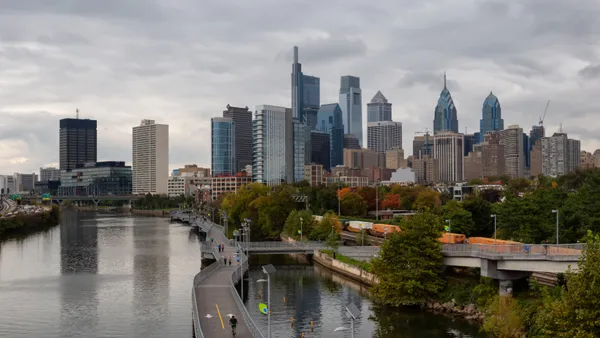
Will Philly's New Mandatory Inclusionary Zoning Yield Results?
City leaders hope a new affordable housing law will increase the supply of affordable units in the city, but critics say the policy may lead to reduced construction and higher housing costs.
Density, Affordability, and the 'Hungry Dogs' of Land Price Speculation
Patrick Condon argues that increasing density without affordability inflates urban land values, resulting in nearly all of the value of labor and creative enterprise of entrepreneurs in regional economies being absorbed as land wealth.

Study Identifies Inclusionary Zoning's Fatal Flaw
Inclusionary zoning can't work because of the exclusionary zoning policies that the system relies on, according to new research.

Planetizen Federal Action Tracker
A weekly monitor of how Trump’s orders and actions are impacting planners and planning in America.

The state-sanctioned urbicide of Austin
People don’t kill cities. Freeways do.

US to reduce Colorado River water deliveries to Mexico
A new Colorado Treaty amendment reduces Mexico’s Colorado River water allocation by 250,000 acre feet.

Mamdani overhauls NYC's Vision Zero plan with 100 new policy goals
The overhaul aims to reduce traffic deaths and make streets safer for pedestrians, cyclists and drivers through lower speed limits, new safety infrastructure and more.

Amtrak not solely to blame for New Jersey commuter rail's unreliability, report finds
A new study from the Garden State Initiative found that NJ Transit’s budget grew 20% across a 4 year period, but reliability declined significantly over the same period.

EPA erases limits on planet-warming pollution from power plants
Under Monday’s plan, power plants would still have some limits on how much mercury, arsenic and other contaminants they can emit.

FREE Course: Walkable City 1: Why Walkability?
After describing his path towards focusing on walkability as the essence of good planning, Jeff Speck marches through his five principal reasons for making more walkable places.
Reinventing Malls: Planning Alchemy—Turning Gray Fields Into Gold
The course focuses on the opportunities and imperatives that shape reinvention of mall sites.


Eagle County Government
Harvard University Graduate School of Design
Nashville Planning Department
The Architects Foundation
University of Cincinnati Online
The Pocatello Development Authority
The Urban Renewal Agency of the City of Pocatello
Journal of the American Planning Association